
Why Stainless Steel Prices Rise While Nickel Falls
A fabricator’s nickel ticker can point down while 304 and 316L mill adjustments rise. See the timing, inputs, and quote lines behind the gap.
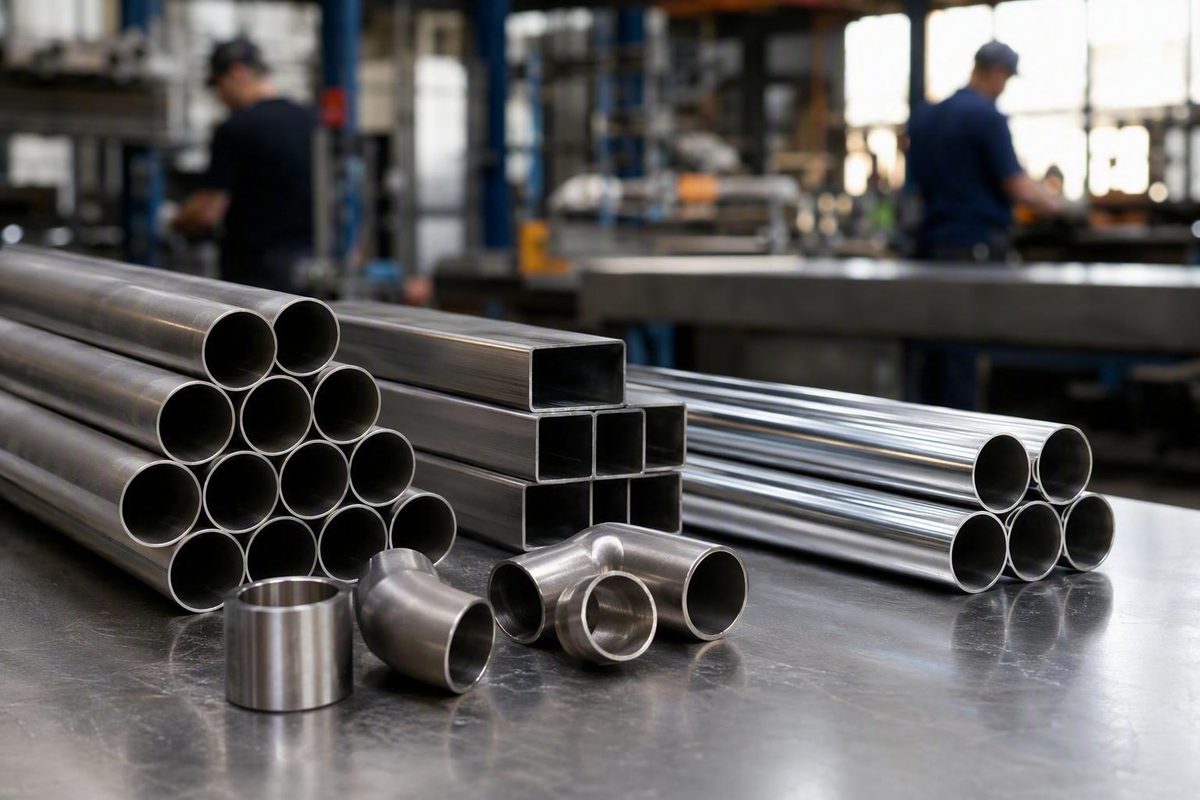
Tang Eng raised September 304 prices by NT$1,500 per tonne and 316L surcharges by NT$2,500 per tonne even after LME three-month nickel fell from $17,114 to $16,760 per tonne. The verdict for tubing buyers is narrow but clear: a falling daily nickel quote does not tell you whether next month’s stainless adjustment will fall. Mill pricing can reflect earlier averaging periods, nickel pig iron and scrap costs, base-price decisions, and restocking demand instead (Argus; Yieh).
This is not evidence that nickel has stopped mattering. It is evidence that the ticker and the stainless quotation measure different things on different schedules. The Taiwan announcements were also regional producer announcements, not proof that all global transaction prices increased.
Why Watching LME Nickel Usually Makes Sense
The received wisdom has a sound foundation. Nickel is a major alloy input for nickel-bearing stainless grades, so sustained weakness should eventually reduce the nickel-sensitive part of many surcharge calculations. Buyers track LME nickel because it is visible, frequently updated, and directionally relevant.
A stainless quotation can be represented as: total quotation equals base price plus alloy surcharge plus product and order extras, adjusted for commercial terms. The alloy surcharge exists partly to pass volatile alloy costs through without rebuilding the base price every time a market moves. Published guidance describes this structure while emphasizing that formulas differ by mill, grade, product, benchmark, and calculation period (Ulbrich).
The consensus fails only when the daily LME move is treated as a direct forecast of the next all-in quote. A nickel decline can be real and relevant while the surcharge still reflects an earlier window, the base price rises, or other costs offset it.
Enter the nickel move you watched, choose the grade and pricing month, then add your own invoice and tonnage if you want the job-level effect.
Test The Ticker Against The Mill Adjustment
The tool compares the LME move you saw with Tang Eng’s reported monthly direction. It does not invent a nickel-to-stainless conversion coefficient.
Two-Month Direction Record
| Pricing Month | Grade And Adjustment | LME Direction In Evidence | Divergence |
|---|---|---|---|
| August 2026 | 304 +NT$1,500/t implied from two-month total | — | Unknown |
| August 2026 | 316L +NT$2,500/t implied from two-month total | — | Unknown |
| September 2026 | 304 price +NT$1,500/t | Down ~2.1% | Yes |
| September 2026 | 316L surcharge +NT$2,500/t | Down ~2.1% | Yes |
| September 2026 | Yusco 430 unchanged | Down ~2.1% | Not Opposite |
Documented comparison: the mill direction opposed the LME direction in both comparable September grade observations. August’s LME comparison is unavailable in the cited evidence.
The September Increase Moved Against The Nickel Ticker
On August 6, Argus reported LME three-month nickel at $16,760 per tonne, compared with an August 5 close of $17,114 per tonne. Arithmetic from those values gives a decline of $354 per tonne, or about 2.1%. The report itself stated a $369 decline, so the published figures are internally inconsistent; the direction and sub-$17,000 level are clearer than the exact reported change (Argus).
The decline followed expectations of greater Indonesian ore availability as the country reviewed its 2026 mining quota. Speculation centered on a possible increase of more than three times for one major operation. That increase was not confirmed as immediate physical supply, and the final national quota remained uncertain. The exchange was pricing an expectation, not a verified drop in every stainless mill’s purchased nickel cost.
On August 31, Yieh reported Tang Eng’s September changes:
| Grade | September Change | Two-Month Change | Component Reported |
|---|---|---|---|
| 304 | NT$1,500/t up | NT$3,000/t up | Stainless price |
| 316L | NT$2,500/t up | NT$5,000/t up | Alloy surcharge |
| 430 | Unchanged at Yusco | — | Stainless price |
Tang Eng’s changes were described as its second consecutive monthly increases. Yusco reportedly announced the same September increases for 304 and 316L while leaving 430 unchanged (Yieh).
The component labels matter. The NT$1,500 figure was reported as a 304 price increase, while NT$2,500 was specifically a 316L surcharge increase. They are not matching measures and do not prove that the all-in price of 316L rose more than the all-in price of 304.
The two-month totals imply that the preceding monthly movements were also NT$1,500 for 304 and NT$2,500 for 316L. The source does not provide a comparable LME movement for that earlier pricing window, so only the later episode can be classified as a documented directional divergence.
Tang Eng Cited Physical Inputs And Restocking
Tang Eng attributed the increases to continuing high production costs for nickel pig iron and stainless scrap, along with approaching peak-season demand and growing downstream restocking needs. It did not cite the latest LME close as the sole pricing input (Yieh).
That explanation is plausible without being independently quantified. The report does not publish time series for Tang Eng’s nickel pig iron or scrap purchases, its inventory position, order book, or formula coefficients. Those inputs therefore cannot be assigned exact shares of the increase.
LME nickel is a financial and physical-market benchmark, but it is not a complete ledger of every nickel unit entering stainless production. Mills may face nickel pig iron, stainless scrap, and other physical inputs whose prices and purchasing schedules do not move one-for-one with the latest exchange quote.
Liquidity also affects how much confidence a buyer should place in a short price move. LME nickel contract trading volume had fallen 21% month over month in July 2026, reducing the activity behind the benchmark buyers were watching (Recycling Today). That does not invalidate the LME price. It reinforces the need to distinguish a short exchange move from a mill’s actual input basket.
Restocking can override the ticker for a different reason. Distributors rebuilding inventory ahead of a busier season can support mill orders even if end-user consumption has not yet strengthened. The available report does not separate distributor restocking from sustained demand by fabricators or end users, so the duration of that support is unknown.
Trailing Windows Delay Nickel Pass-Through
A daily LME quote and a monthly stainless adjustment usually refer to different periods. Alloy methodologies may use selected reference prices averaged over a preceding window. Monthly resets are common, although suppliers may also use weekly, daily, quarterly, or fixed-period arrangements (Loftis Steel).
The practical sequence is straightforward. Nickel moves during one period, the supplier completes its specified average, the next surcharge is published, and the adjustment becomes effective under the contract’s order, shipment, or delivery rule. A buyer with fixed-price coverage may not see the change until a later reset.
Thresholds can create another delay. Some methodologies charge only for alloy costs above an assigned reference value. Falling nickel may reduce a positive surcharge without producing a credit, particularly if the input remains above the formula’s threshold.
The exact lag cannot be calculated from the public Taiwan reports. Tang Eng’s private formula, averaging dates, inventory costs, and customer contract terms were not available. A buyer therefore cannot take the 2.1% LME decline and convert it honestly into an expected NT-dollar surcharge reduction.
A separate U.S. episode shows the same timing mechanism without proving a common market trend. MetalMiner reported that its Stainless Monthly Metals Index rose 2.16% from March to April 2025, partly because early-April surcharges reflected earlier nickel and copper strength. It expected later nickel weakness to reduce future surcharges, but that was a forecast. The same report described weak demand, broadly stable prices, high mill discounts, and historically short lead times in the United States (MetalMiner).
The 2025 U.S. index and 2026 Taiwan announcements should not be combined into a global trend. Their shared lesson is limited to timing: a published stainless measure can still reflect earlier alloy strength after current nickel has turned down.
Base Price And Surcharge Can Move Separately
Even after weaker nickel reaches a surcharge formula, the total quotation can rise. The supplier can change the base price independently, while processing, finish, dimensional, freight, currency, tariff, and commercial adjustments affect other parts of the invoice.
For tubing, the comparison must hold product details constant. Welded and seamless material, wall thickness, outside diameter, finish, testing, documentation, cut length, quantity, and delivery basis can all change the quote independently of alloy values. Comparing an LME chart with a polished, cut-to-length tube price mixes a commodity benchmark with a processed product.
The Taiwan wording demonstrates the problem. A 304 price increase and a 316L surcharge increase cannot establish relative grade sensitivity. A valid comparison requires surcharge against surcharge or all-in quotation against all-in quotation.
Grade differences still matter. The alloy assumptions for 304, 316L, and 430 are not identical, so their surcharges need not move together. Yet the exact sensitivity depends on the producer’s coefficients, benchmarks, thresholds, and product rules. The unchanged Yusco 430 price is consistent with differentiated grade treatment, but the announcement does not prove why management chose that result.
Audit The Quote Before Changing A Tubing Bid
A fabricator should identify which line changed before revising a customer bid. Record the prior and current base price, alloy surcharge, processing extras, freight, discount, currency basis, and quote-validity period. If the supplier provides only an all-in figure, request the change by component.
Then establish the timing rules. The necessary questions are which nickel reference applies, whether physical inputs such as nickel pig iron or scrap enter the calculation, what averaging window is used, when the adjustment is published, and whether order date or shipment date controls the charge.
Comparable quotations should use the same grade, tube form, dimensions, finish, quantity, delivery location, and pricing month. Otherwise, a processing or availability difference can be mistaken for an alloy move.
Evidence that the divergence is ending would include sustained nickel weakness through a full averaging window, lower later surcharges, easing nickel pig iron and scrap costs, short lead times, persistent discounts, and comparable transaction quotes following the lower charge. No single public source in the available evidence supplies all of those figures.
The September announcement remains pricing intent rather than proof that every buyer paid the full increase. Discounts, contracts, inventory positions, and negotiation can separate an announced adjustment from a realized transaction.
For a tubing buyer, the useful forecast is therefore not “nickel fell, so stainless must fall next month.” It is: “nickel fell; now identify the supplier’s measurement window, physical-input references, grade-specific component, and contract reset.” That is the point at which the ticker becomes usable purchasing information rather than a misleading shortcut.