
Is Stainless Steel Magnetic? Sometimes
Annealed 304 and 316 usually show little pull; ferritic, martensitic and duplex grades attract magnets, while fabrication can change the response.
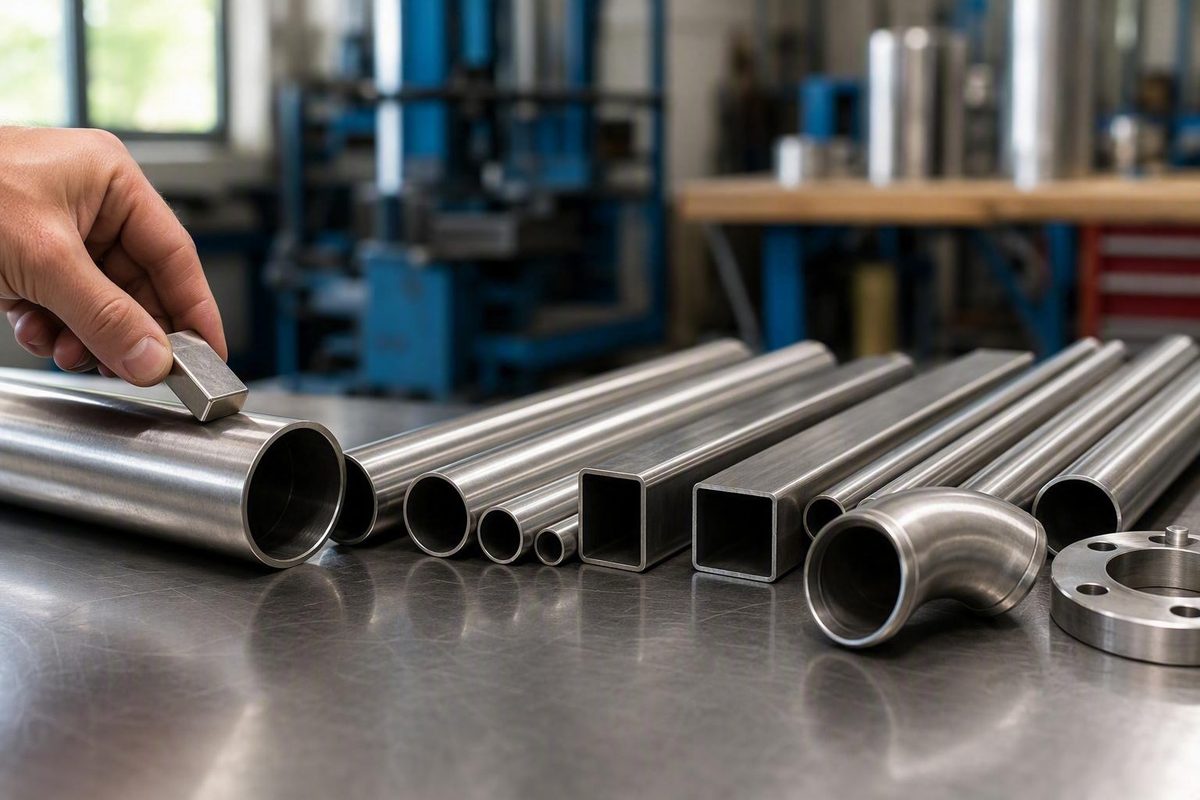
The short answer: stainless steel can be magnetic
Will a magnet stick to stainless steel? Sometimes. Some stainless steels attract a magnet strongly. Others show no obvious pull, a weak pull, or attraction limited to particular areas.
That variation exists because stainless steel is a family of alloys, not one uniform material. Grade, internal crystal structure, processing history, and the condition of the finished part all affect its response. The Australian Stainless Steel Development Association (ASSDA) explains that composition, metallic structure, processing methods, and physical condition all influence the magnetic properties of stainless steel.
A simple magnet test can produce a spectrum of qualitative results:
- No obvious pull: The magnet produces no readily noticeable attraction.
- Weak pull: Attraction is detectable but modest.
- Localized pull: The magnet reacts at particular bends, corners, welds, edges, or formed areas.
- Strong pull: The magnet is readily and firmly attracted.
The terms “non-magnetic” and “essentially non-magnetic” are also engineering shorthand. For stainless steel, they generally describe a very low magnetic response under stated conditions—not an absolute guarantee that every sample will show zero response under every test.
As a practical starting point:
- Annealed 304 and 316: usually show little magnetic attraction.
- 409 and 430: generally magnetic.
- 410, 420, and 440: generally magnetic.
- Duplex 2205: magnetic because its mixed microstructure includes substantial ferrite.
These family-level expectations are useful for screening, but a magnet cannot confirm an exact grade. A magnetic item is not automatically fake stainless steel, and an item with no obvious attraction is not automatically 304 or 316.
Crystal structure—not iron content alone—controls the answer
It is tempting to reason that stainless steel contains iron, iron is magnetic, and therefore every stainless steel must be magnetic. That misses the decisive variable: how the atoms are arranged within the alloy.
Two stainless steels can look virtually identical yet have different crystal structures. Those structures respond differently to a magnetic field:
- Austenite: The structure associated with the very low magnetic response of annealed wrought 304 and 316. It has a face-centered cubic atomic arrangement.
- Ferrite: A strongly magnetic structure with a body-centered cubic arrangement.
- Martensite: A hard, generally magnetic structure associated with grades such as 410, 420, and 440. It can also form in some austenitic steels after cold deformation.
- Duplex: A mixed structure containing austenite and substantial ferrite. Its ferritic phase makes duplex stainless steel magnetic.
Composition matters because alloying elements influence which structures form and remain stable. Chromium can promote ferrite. Nickel, nitrogen, and carbon stabilize austenite and reduce its tendency to transform during cold work. Nickel is important, but saying that nickel alone “makes stainless non-magnetic” is an oversimplification. Magnetic behavior follows the resulting microstructure, not one element in isolation.
A more technical measure of magnetic response is relative permeability—how strongly a material concentrates a magnetic field compared with air or vacuum, whose reference value is taken as 1, according to ASSDA’s technical guidance on stainless-steel magnetism. A relative permeability close to 1 indicates a low response, but not necessarily behavior absolutely identical to air under every condition.
The practical implication is straightforward: interpret magnetism by considering four factors together:
- Grade or alloy composition
- Crystal microstructure
- Processing history
- Current physical condition
An annealed sheet and a deeply formed component made from that sheet may retain the same nominal grade while responding differently to the same magnet.
Magnetic stainless-steel grades at a glance
The table summarizes typical family behavior supported by industry guidance. It does not provide guaranteed measurements: attraction can vary with composition within grade limits, processing condition, phase balance, component geometry, thickness, magnet strength, and test setup.
| Stainless family | Example grades | Typical annealed response | Important exceptions |
|---|---|---|---|
| Austenitic | 304, 316 | Very low magnetic response; generally not significantly attracted | Cold rolling, drawing, pressing, stamping, bending, or stretching can create weak or localized attraction |
| Ferritic | 409, 430 | Generally magnetic | Apparent pull varies with geometry, thickness, condition, and the magnet used |
| Martensitic | 410, 420, 440 | Generally magnetic | Heat treatment and physical condition can affect magnetic characteristics, but these remain magnetic-grade structures |
| Duplex | 2205 | Magnetic | Attraction varies with phase balance, condition, geometry, and test setup |
Austenitic stainless steel: 304 and 316
Austenitic grades cause much of the confusion. Wrought 304 and 316 in the annealed condition generally show very low magnetic response. They may nevertheless become weakly or locally magnetic after fabrication because deformation can transform some austenite into martensite.
This is why a flat coupon, finished sink, cold-drawn tube, and stamped fastener made to the same nominal grade may not behave alike.
Ferritic stainless steel: 409 and 430
Ferritic stainless steels have a ferritic crystal structure and are generally magnetic. Common examples include 409 and 430.
Grade 430 appears in products such as appliance components and decorative or functional sheet. A magnet sticking to such a component is entirely compatible with genuine stainless steel; it is not proof that the product is plated carbon steel or counterfeit.
Martensitic stainless steel: 410, 420, and 440
Martensitic stainless steels are also generally magnetic. Common examples include 410, 420, and 440.
A familiar example is a 420 stainless-steel knife. Its attraction to a magnet is expected from its martensitic structure and does not prevent it from being stainless steel.
Duplex stainless steel: 2205
Duplex grades combine austenitic and ferritic phases. Grade 2205 therefore attracts a magnet because its microstructure contains substantial ferrite.
People may describe a particular duplex sample as partially or strongly magnetic, but those qualitative descriptions are not universal measurements. The observed pull depends on the material’s phase balance and condition as well as the magnet and test arrangement.
These classifications narrow the possibilities; they do not establish the exact alloy.
Are 304 and 316 stainless steel magnetic?
Annealed wrought 304 and 316 are generally not significantly attracted to a magnet. Yet a finished product labeled 304 or 316 can exhibit weak or localized attraction without being mislabeled.
The principal mechanism is deformation-induced martensite. Cold work deforms the metal below hot-working temperatures. In susceptible austenitic stainless steel, that deformation transforms part of the low-response austenitic structure into magnetic martensite. The nominal grade does not change merely because some of its microstructure transforms.
Operations capable of producing this effect include:
- Cold rolling
- Wire, tube, or bar drawing
- Pressing
- Stamping
- Bending
- Stretching
- Deep drawing
- Other severe forming operations
The effect is often uneven because deformation is uneven. Bends, corners, edges, necked sections, drawn areas, threads, and other heavily worked locations may respond more strongly than broad, relatively undeformed surfaces.
A pressed 304 sink is a useful example. Flat areas may show little response, while corners or the deepest formed sections pull more noticeably because they experienced more severe stretching and deformation.
Grade 316 can also develop deformation-induced magnetism, but it is generally less prone than 304 under comparable cold work because its austenitic structure is more stable. “Less prone” does not mean immune. The result depends on composition, amount and path of deformation, temperature, prior condition, and finished geometry.
The distinction between specified stock condition and finished-part condition is important. Supplier data for annealed 304 sheet describe the material in its annealed state. Once that sheet is rolled, drawn, pressed, bent, welded, machined, or otherwise fabricated, the component may have a different magnetic response while remaining 304.
Magnetic attraction therefore does not prove that a purported 304 or 316 item is counterfeit. It may instead reveal its processing history. Conversely, the absence of obvious attraction does not prove either grade.
How forming, welding, casting, and heat treatment change magnetic response
The grade name is only part of the story. Fabrication can change phase balance, introduce localized magnetic structures, or leave residual magnetic fields. These mechanisms are related but not interchangeable.
Cold forming
Cold-drawn wire, formed vessel ends, fasteners, and tubing can show more attraction than the annealed stock from which they were made. Severe deformation is especially important because it can produce more martensite.
The response may vary across one component:
- A straight tube section may show little pull while a tightly formed end responds.
- A bolt head or rolled thread may respond differently from the shank.
- A deep-drawn vessel end may be more magnetic than an adjoining shell.
- Cold-drawn wire may respond more noticeably than annealed wire of the same nominal grade.
This is not necessarily a defect. It is a condition-dependent property whose importance depends on the intended service.
Welding
An austenitic stainless weld may contain a small amount of ferrite. That ferrite can cause weak or localized attraction around the weld even when the surrounding 304 or 316 base material shows little response.
A localized response at a weld is therefore a clue, not a diagnosis.
Inappropriate heat treatment or certain high-heat-input welding conditions can cause additional metallurgical changes. Their significance depends on the alloy and procedure.
Casting
An austenitic stainless casting may retain some ferrite and therefore behave differently from a nominally comparable wrought product.
For example, a cast austenitic alloy represented as comparable or equivalent to wrought 316 can have different specification ranges, solidification history, ferrite content, and magnetic behavior from wrought 316 sheet. A weak response from the casting may therefore be compatible with retained ferrite; it is not sufficient evidence of grade substitution.
Heat treatment and solution annealing
Suitable solution annealing followed by appropriate cooling can restore more of the austenitic structure and reduce cold-work-induced magnetic effects in some austenitic material. ASSDA notes, however, that this treatment can reduce properties gained through cold work and may cause distortion.
Other practical drawbacks include:
- Surface condition may need to be restored.
- A large or assembled component may be impractical to heat treat.
- The proper cycle depends on the alloy and required final properties.
- Heating and cooling may compromise dimensional tolerances.
Solution annealing should not be presented as a guaranteed way to make every component completely non-magnetic. The decision must account for mechanical properties, dimensions, surface requirements, assembly constraints, and any applicable magnetic-property specification.
Degaussing is not the same as changing the microstructure
Degaussing can reduce a residual magnetic field in some circumstances. It does not reliably eliminate the underlying magnetically hard martensitic phase created by cold work.
That distinction is crucial. Annealing can alter microstructure under suitable conditions; degaussing changes magnetic state without necessarily removing the phase responsible for the response. Electrical demagnetization is generally more effective on magnetically soft ferrite than on relatively hard martensitic structures.
What a household magnet test can—and cannot—tell you
A household magnet test is a preliminary screening method, not a standardized grade test. It can reveal patterns and help sort broad categories, but it cannot establish exact chemistry or certify a product.
For a more useful qualitative check:
- Use the same magnet throughout. Changing magnets makes comparisons unreliable.
- Keep the contact method consistent. Do not compare direct contact in one location with a test through packaging, a coating, or a gap elsewhere.
- Test several locations. Include broad flat areas, bends, corners, edges, welds, drawn sections, and machined or threaded regions.
- Compare similar geometries where possible. A thin edge and a broad flat face can feel different even in the same material.
- Describe rather than overinterpret. Record the result as no obvious pull, weak, localized, or strong.
- Note the part’s condition. If known, record whether it is annealed, cold formed, cast, welded, or heat treated.
How to interpret the result
No obvious pull is consistent with annealed austenitic stainless steel. It does not prove that the material is 304 or 316.
Weak or localized pull may be consistent with:
- Cold-worked 304
- Cold-worked 316
- An austenitic weld containing some ferrite
- An austenitic casting retaining some ferrite
- Different processing conditions across the same component
Strong pull is consistent with ferritic, martensitic, or duplex stainless steel. It is not proof of one family or grade. Carbon steel can also respond strongly, so attraction alone cannot establish that a sample is stainless.
Perceived pull also depends on:
- Magnet strength and shape
- Component thickness and geometry
- Contact area
- Distance or coatings between the magnet and metal
- Surface contour
- Material condition
- Test location
A magnet therefore cannot:
- Reliably distinguish 304 from 316
- Certify stainless-steel authenticity
- Determine an exact grade
- Confirm chemical composition
- Verify corrosion resistance
- Establish compliance with a material specification
ASSDA treats magnetic response as a broad sorting aid and explains that some grade distinctions require portable instrumentation or laboratory analysis because qualitative tests cannot separate them reliably.
Magnetism is not a quality or corrosion-resistance rating
The common buying rule that “good stainless is non-magnetic” and “cheap stainless is magnetic” is wrong.
Magnetic response and corrosion performance arise from different combinations of properties. Magnetism is strongly influenced by crystal structure and processing. Corrosion behavior depends on alloy composition, surface condition, fabrication quality, and the service environment.
Consider three legitimate stainless grades:
- 420 is martensitic and magnetic.
- 430 is ferritic and magnetic.
- 316 is austenitic and generally has a very low magnetic response when annealed.
The fact that 420 and 430 attract a magnet does not make them fake stainless. The fact that annealed 316 usually does not attract one does not mean low magnetic response causes its corrosion behavior. These are separate material characteristics.
“Quality” is also application-specific. Correctly specified 430 may be better for a particular job than incorrectly specified 316. A properly heat-treated martensitic knife steel may be the intended choice when hardness and edge performance matter. A duplex grade may be selected for its combination of mechanical and corrosion requirements despite attracting a magnet.
A magnet test cannot determine:
- Whether a product is safe for food contact
- Whether it is suitable for a particular chemical
- Whether it will resist a marine, industrial, or high-temperature environment
- Whether its welds are acceptable
- Whether it has the required strength or hardness
- How long it will remain in service
- Whether its surface was properly cleaned or finished
Grade selection should instead follow the actual application requirements:
- Expected corrosion environment
- Temperature and exposure conditions
- Mechanical properties
- Fabrication route and final condition
- Weldability and heat-treatment requirements
- Surface finish
- Applicable material standard
- Any specified magnetic-property or permeability limit
Whether a refrigerator magnet sticks may be interesting and occasionally useful, but it is not a quality rating.
When exact grade or low permeability matters, verify it properly
When material identity affects safety, regulatory compliance, corrosion performance, fabrication, or contractual acceptance, begin with documentation rather than a magnet.
Check:
- Mill test certificates
- Purchase specifications
- Heat or batch identification
- Supplier declarations
- Receiving-inspection records
- Traceability from raw material to finished component
- Required positive material identification records
Documentation may be sufficient when traceability is intact and there is no reason to doubt it. When stock has been mixed, markings are missing, or the consequences of an error are significant, additional verification may be necessary. ASSDA specifically recommends positive material identification in appropriate safety-critical cases and explains that the required test depends on the consequences of using the wrong alloy in its grade-confirmation guidance.
Molybdenum spot testing
A molybdenum spot test can help distinguish molybdenum-bearing 316 from essentially molybdenum-free 304. It is useful for targeted screening, but a positive result establishes the presence of molybdenum rather than every element, grade suffix, or product condition.
It may not resolve alloys with overlapping chemistry or determine whether a material meets every requirement of a complete grade specification.
Handheld XRF
Handheld X-ray fluorescence can identify elements such as chromium, nickel, and molybdenum. It is useful for rapid positive material identification and sorting of many stainless alloys.
Its limitation matters when carbon is decisive. XRF is not generally the preferred method for carbon measurement, so it may not separate grades that differ mainly by their carbon limit. Nor can bulk elemental composition alone answer questions that depend on microstructure.
Optical emission spectroscopy
Optical emission spectroscopy can be used when carbon measurement or more complete grade differentiation is required.
Guidance on stainless-steel identification distinguishes these tools by purpose: molybdenum spot testing can screen 304 from 316, handheld XRF can measure elements including chromium, nickel, and molybdenum, and OES is preferred when carbon measurement is required (AZoM’s overview of stainless-steel testing methods).
Instrumental chemistry does not automatically explain every unexpected property. Two samples with similar bulk chemistry can behave differently because of cold work, phase balance, heat treatment, casting, or welding.
Metallography
Metallography is appropriate when the question concerns crystal structure or the cause of unexpected magnetism.
This is especially valuable when chemistry confirms the nominal alloy but the component behaves unexpectedly. Its processing condition, rather than incorrect composition, may be the explanation.
Match the verification method to the consequence
Positive material identification or laboratory analysis is appropriate for:
- Safety-critical components
- Regulated systems
- Corrosion-sensitive service
- Undocumented or mixed inventory
- Disputed material identity
- Components whose failure would have serious consequences
- Cases requiring distinctions that a portable method cannot provide
No single method answers every question. Documentation establishes traceability; XRF and OES address composition; metallography addresses structure; mechanical testing addresses properties; and controlled magnetic measurement addresses magnetic performance.
Low-permeability applications need a measured requirement
For MRI-adjacent equipment, marine-compass hardware, instrumentation, and other magnetically sensitive uses, the generic label “non-magnetic” is not enough.
The project should define the magnetic-property requirement, measurement method, component condition, and acceptance criteria. A finished cold-worked fastener may not behave like the annealed bar from which it was made. A weld may differ from its base metal, and a cast component may differ from a wrought one.
Verify measured properties on the finished or a representative component against the applicable project specification. Do not substitute a household magnet for controlled permeability measurement, and do not assume one universal permeability limit applies to every use. ASSDA’s guidance shows both that cold work can alter austenitic stainless steel’s response and that safety-critical grade verification should be matched to the consequences and formal requirements of the application.
Frequently asked questions
Is 304 stainless steel magnetic?
Annealed wrought 304 generally has a very low magnetic response and is not significantly attracted to an ordinary magnet. Cold rolling, stamping, drawing, bending, or other deformation can transform some austenite into magnetic martensite.
A finished 304 product may therefore show weak or localized attraction, especially at bends, corners, threads, edges, or deeply drawn areas. That response alone does not indicate a counterfeit or incorrectly graded product.
Is 316 stainless steel magnetic?
Annealed wrought 316 generally shows very little magnetic attraction. It can become weakly or locally magnetic after cold work, welding, or casting.
Under comparable deformation, 316 is generally less prone than 304 to deformation-induced magnetism because its austenitic structure is more stable. It is not immune, and low magnetic response cannot confirm that an item is 316.
Why is a stainless-steel sink more magnetic at the corners?
Pressing and stretching sheet into a sink bowl deforms the corners and deep contours more severely than flatter areas.
In an austenitic grade such as 304, that local deformation can convert some austenite into magnetic martensite. The corners may consequently attract a magnet more strongly even though the entire sink remains the same nominal grade.
Can a magnet tell the difference between 304 and 316 stainless steel?
No. Annealed 304 and 316 both tend to have very low magnetic response, and both can become magnetic after processing. Their responses overlap too much for reliable identification.
Use traceable documentation or appropriate composition analysis instead. Depending on the question, that may involve a molybdenum spot test, XRF, OES, or laboratory examination.
Does magnetic stainless steel rust more easily?
Not necessarily. Magnetic response is not a corrosion-resistance scale. Ferritic 430 and martensitic 420 are genuine corrosion-resistant stainless grades even though they attract magnets.
Corrosion performance depends on the alloy, surface condition, fabrication, and service environment. A magnet cannot predict rusting, pitting, suitability for a particular environment, or service life.
The practical takeaway
Identify both the stainless-steel family and its condition before interpreting magnet attraction. Annealed 304 and 316 usually show little response; ferritic, martensitic, and duplex grades generally attract magnets; and fabrication can make an austenitic part respond weakly or only in heavily worked areas.
Treat a magnet as a clue, not a certificate. When exact grade or controlled permeability matters, use traceable documentation and the appropriate instrumental, laboratory, or controlled magnetic test.