
Steel and Stainless Steel: How to Compare Tubing
Compare carbon steel and stainless tubing by exposure, grade, product standard, OD, wall and finish—and avoid mixed-metal fabrication problems.
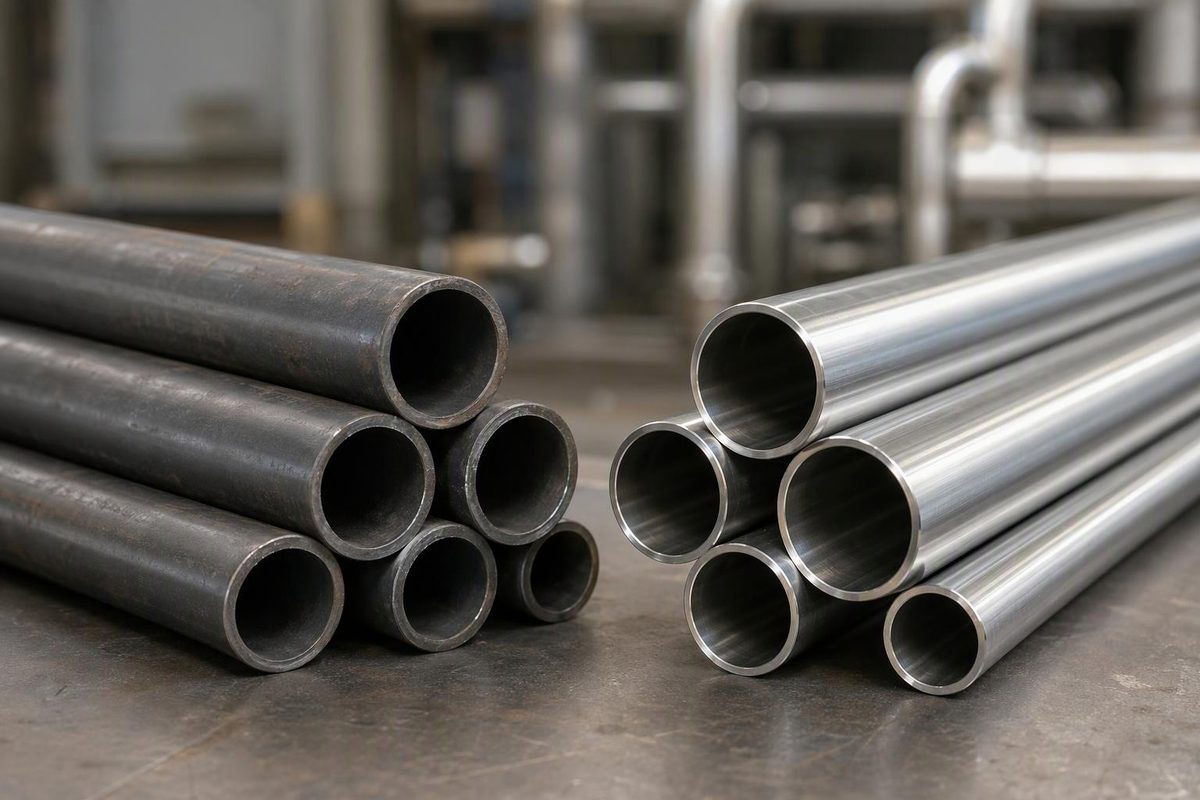
Stainless steel is a type of steel, not a separate metal. When a tubing supplier lists “steel and stainless,” clarify whether “steel” means carbon steel, low-alloy steel or another specified material. Neither label is a complete purchase specification.
Stainless steels are iron alloys containing at least 10.5% chromium. Chromium produces the protective, self-repairing passive surface layer that distinguishes stainless from other steels. The grade determines the additional alloying elements and resulting properties; stainless is not one material with one strength or corrosion rating. Source: British Stainless Steel Association
What changes when you choose stainless?
| Selection question | Carbon-steel tubing | Stainless-steel tubing |
|---|---|---|
| What controls corrosion performance? | Evaluate the exposure and any coating or other corrosion-protection system. | Match the grade and surface condition to the exposure; “stainless” alone is insufficient. |
| Which is stronger? | Check the specified grade, condition and design properties. | Check the same fields. Stainless is not automatically a stronger replacement. |
| What finish should be ordered? | Define the supplied surface and any coating preparation and application requirements. | Define the required finish, cleanliness and post-weld treatment separately from grade. |
| How should costs be compared? | Include preparation, coating, installation and planned maintenance. | Include grade, finish, fabrication, cleaning and planned maintenance. |
These are comparison fields, not a universal ranking. BSSA identifies corrosion resistance, strength, formability and weldability as distinct selection considerations, with substantial differences between stainless families. Source: BSSA selection guidance
For common stainless choices, 304 and 316 are austenitic grades. The 316 family contains molybdenum, which improves resistance to pitting and crevice corrosion. Source: BSSA That is a reason to evaluate 316 for a more demanding exposure—not a guarantee that it will suit every chloride concentration, temperature or joint detail. BSSA’s seawater guidance specifically identifies these limitations. Source: BSSA seawater guidance
Keep the material standard separate from the dimensions
A carbon-steel tube and a stainless tube can have the same outside dimensions without being interchangeable. Their specifications can impose different manufacturing, condition, tolerance and testing requirements. These ASTM specifications illustrate the distinction; they are not a complete list of tubing standards.
| Product specification | Relevant scope | What it tells the buyer |
|---|---|---|
| ASTM A500 | Cold-formed welded and seamless carbon-steel structural tubing, including round, square and rectangular shapes | Identifies a structural carbon-steel tube specification. Steel Tube Institute |
| ASTM A554 | Welded stainless-steel mechanical tubing for ornamental, structural, exhaust and other applications | Identifies a mechanical-tubing specification; grade, shape, condition and finish still need selection. ASTM A554-26 |
| ASTM A269/A269M | Seamless and welded austenitic stainless tubing for general corrosion-resisting and low- or high-temperature service | Includes heat-treatment and testing requirements; matching dimensions alone do not establish equivalence to A554. ASTM A269/A269M-25 |
For round tubing, keep outside diameter (OD), wall thickness and inside diameter (ID) distinct. Precision stainless tubing is generally ordered by OD and wall; a calculated ID is not a guaranteed bore dimension. Source: Eagle Stainless
For example, a round tube specified as 1.000 in. OD × 0.065 in. nominal wall has a nominal calculated ID of:
ID = OD − 2 × wall = 1.000 − 0.130 = 0.870 in.
The equivalent dimensions are 25.40 mm OD, approximately 1.65 mm wall and 22.10 mm calculated ID. If a shaft, insert or fitting depends on the bore, specify the required clearance and tolerance rather than relying on that calculation alone.
Do not substitute a pipe-size designation for tube OD. ASME distinguishes pipe dimensions from tube dimensions: for NPS 12 and smaller, pipe OD is numerically larger than the nominal size. A schedule identifies a pipe-wall series, not a stainless grade. Source: ASME B36.19M
For a square-tube example, see the 1×1 tubing dimension and ordering guide.
Using carbon steel and stainless together
Two separate problems deserve attention:
- Fabrication contamination: carbon-steel grinding dust, wire brushes and previously used abrasives can deposit iron on stainless. These particles can rust and initiate corrosion. Use dedicated clean abrasives and stainless-only brushes, and protect stainless from adjacent carbon-steel operations. Source: ASSDA fabrication guidance
- Galvanic corrosion in service: electrically connected dissimilar metals can form a corrosion cell when wetted by a conductive liquid. With passive stainless and carbon steel, the carbon steel is the more active member. Exposure, relative wetted areas and electrical isolation matter; dry contact alone does not establish a galvanic-corrosion problem. Suitable insulating strips, washers and sleeves can interrupt the electrical connection, provided bolts or other conductive paths do not bridge the isolation. Source: ASSDA galvanic-corrosion guidance
If the materials will be welded together, identify both base metals before selecting the procedure and consumable. Use the stainless welding-wire selection guide rather than ordering generic “stainless wire.”
What to put on the order
Replace “steel or stainless tube” with a defined request:
- Service: fluid or atmosphere, temperature, pressure or structural load, and cleaning exposure.
- Material: exact grade and product standard, including the required edition.
- Dimensions: shape, OD or outside dimensions, wall, length and tolerances; bore requirements where critical.
- Manufacture and condition: welded or seamless where applicable, heat treatment, and hardness where the connection requires it.
- Surface: finish, coating or cleaning requirements, including treatment after fabrication.
- Verification: required material test report, traceability and any supplementary testing.
Compare quotations against those same fields. A matching diameter and a lower price do not establish an acceptable material substitution.