
304 vs 430 Stainless Steel: Grade Selection for Tubing and Fabrication
Compare 304 and 430 stainless steel for corrosion, magnetism, forming, welding and cost—and check the tube specification before substituting grades.
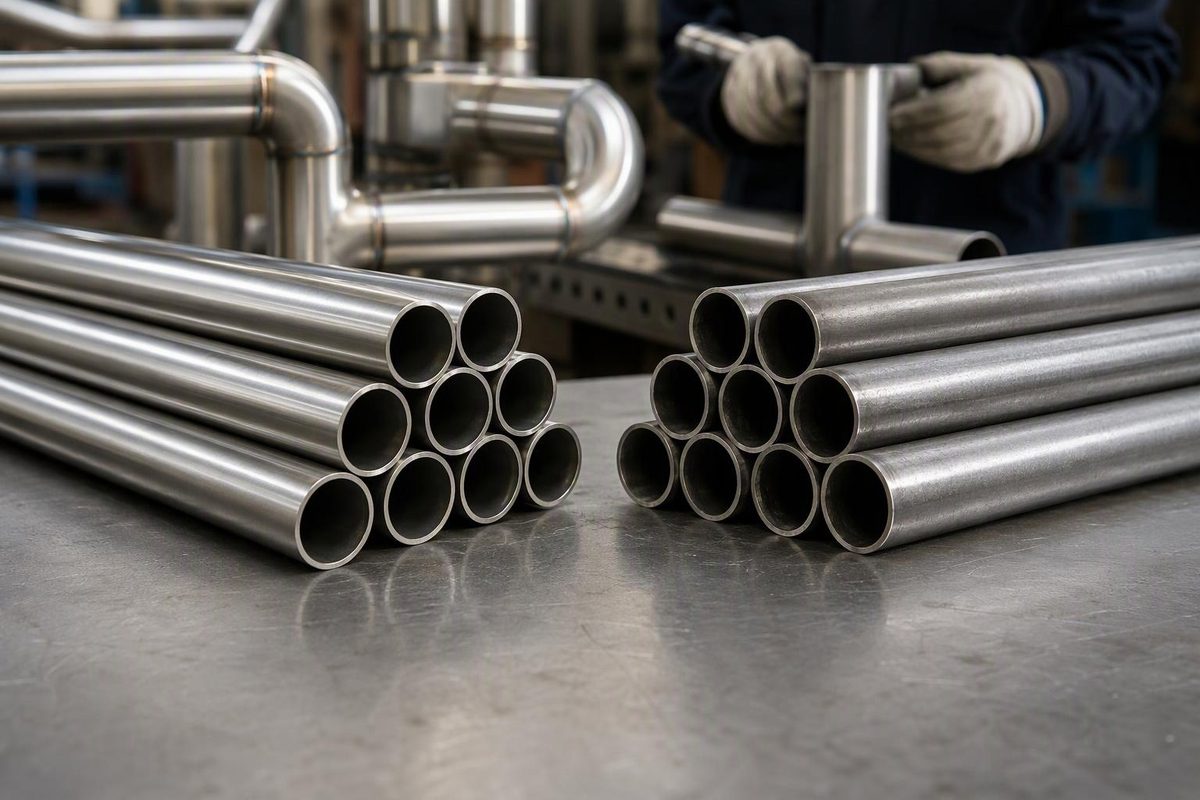
304 is generally the better starting point for wet-service components and welded fabrication; 430 is a lower-cost option for mildly corrosive service, especially appliance panels and trim. The distinction is metallurgical: 304 is a nickel-bearing austenitic stainless steel, while 430 is a ferritic stainless steel with no deliberate nickel addition. Outokumpu identifies 304 as an all-purpose grade with good formability and weldability, and 430 as a grade for mildly corrosive environments. 304 datasheet · 430 datasheet
For tubing, a matching outside diameter and wall thickness do not make these grades interchangeable. Check the exposure, welding requirements and product standard before accepting a substitution.
Comparison at a glance
| Property | 304 stainless steel | 430 stainless steel |
|---|---|---|
| Grade identifiers | UNS S30400; commonly EN 1.4301 | UNS S43000; commonly EN 1.4016 |
| Structure | Austenitic | Ferritic |
| Typical chromium content* | 18.1% | 16.2% |
| Typical nickel content* | 8.1% | No deliberate addition; residual nickel can be present |
| Magnet response | Usually little or no attraction when annealed; cold working can increase attraction | Magnetic |
| Chloride pitting and crevice corrosion | More resistant than 430, but not immune | Less resistant than 304 |
| Chloride stress corrosion cracking | Susceptible | Much more resistant than 304, but not immune |
| Forming | Excellent stretch formability; work-hardens strongly | Suitable for drawing, bending and roll forming; less suited to stretch forming |
| Welding | Good weldability; consider 304L for welded corrosive service | Weld-region ductility and corrosion resistance need particular attention |
| Thermal expansion, 20–100 °C (68–212 °F)* | 16 × 10⁻⁶/K | 10 × 10⁻⁶/K |
| Thermal conductivity at 20 °C (68 °F)* | 15 W/(m·K) | 25 W/(m·K) |
| Relative material cost | Generally higher | Generally lower |
*Composition is percent by mass. Composition and thermal values are Outokumpu’s published values, not universal purchase limits or design allowables. Sources: Core datasheet, Moda datasheet, ATI 430 forming and residual-nickel data, Thyssenkrupp magnetism and cost comparison, and SSINA stress corrosion cracking guidance.
Choose by exposure, not appearance
430 can be adequate without being equivalent to 304. It is used for kitchen equipment, household appliances and trim. Outokumpu reports resistance to many domestic liquids, including detergents and soaps when properly rinsed, and to mildly corrosive indoor and outdoor atmospheres. It also explicitly rates 430 below 304 for localized corrosion in chloride-containing media. 430 corrosion guidance
That generally favors 304 when the component sees more demanding wet exposure, provided 304 itself is suitable. Salt deposits, chloride-bearing liquids, higher temperatures and crevices require a closer material review—not simply an upgrade from 430 to 304. Outokumpu warns that 304-family steels can suffer chloride pitting, crevice corrosion and stress corrosion cracking; aggressive marine or industrial conditions may require higher-alloyed grades. 304 corrosion guidance
The corrosion ranking is not universal: 430 is much more resistant to chloride stress corrosion cracking than 304. That advantage does not eliminate its pitting or crevice-corrosion limitations. For hot chloride service under tensile stress, assess both failure modes rather than choosing by a single corrosion rating. SSINA guidance
Neither a shiny finish nor the word “stainless” establishes suitability. Surface condition also matters; see why stainless steel can rust.
Welding is a major substitution check
430 is weldable, but “can be welded” does not mean it performs like 304 after welding. ATI reports reduced ductility in the weld and heat-affected zone, plus reduced corrosion resistance in some environments. Outokumpu states that its traditional unstabilized 430 product is not intended for use in the as-welded condition and requires post-weld heat treatment for adequate weld-region properties. ATI welding guidance · Outokumpu fabrication guidance
For a welded tube assembly, establish the required final condition and qualified fabrication procedure before choosing 430. Its lower thermal expansion and higher conductivity can reduce welding distortion relative to austenitic grades, but that advantage does not remove the metallurgical concerns.
For welded corrosive service, consider 304L, the low-carbon variant of 304. Its lower carbon content reduces carbide precipitation from welding heat and improves resistance to intergranular corrosion. Weld oxides still need appropriate removal to restore corrosion resistance. 304L and welding guidance
A magnet is a screening tool, not a certificate
430 attracts a magnet, but cold-worked 304 can also show attraction. Other stainless grades can produce either response, so a magnet cannot positively identify 304 or 430. Use traceable material documentation—and chemical verification where required—rather than accepting or rejecting a tube by magnet alone. Magnetism comparison
The fuller explanation is in Is Stainless Steel Magnetic?.
Compare complete tube specifications and costs
The product standard is separate from the grade:
- ASTM A269/A269M covers austenitic tubing for general service; ferritic 430 is not a like-for-like A269 replacement. Its requirements include heat treatment and nondestructive electric or hydrostatic testing. ASTM A269/A269M-25
- ASTM A554 covers welded mechanical tubing, including ferritic and austenitic families, for ornamental, structural, exhaust and other applications. That scope alone does not establish suitability for a particular pressure or sanitary system. ASTM A554-26
Before comparing quotes, state service, standard and edition, grade, manufacturing route, final heat-treatment condition, OD, wall thickness, length, tolerances, finish and documentation requirements. Specify any critical inside diameter or weld-bead clearance separately; tube OD and wall are not pipe schedule designations.
304 generally costs more because of its nickel-bearing composition, but there is no universal price premium. Compare the same product form, dimensions, finish, quantity and certification—and include welding, heat treatment and finishing costs. A cheaper 430 tube is only a saving if the finished component meets the same service requirements. Cost comparison