
314 Stainless Steel: Composition, Heat Limits and Fabrication
Identify 314 stainless steel, compare heat-service limits, and check composition, fabrication and tubing requirements before specifying it.
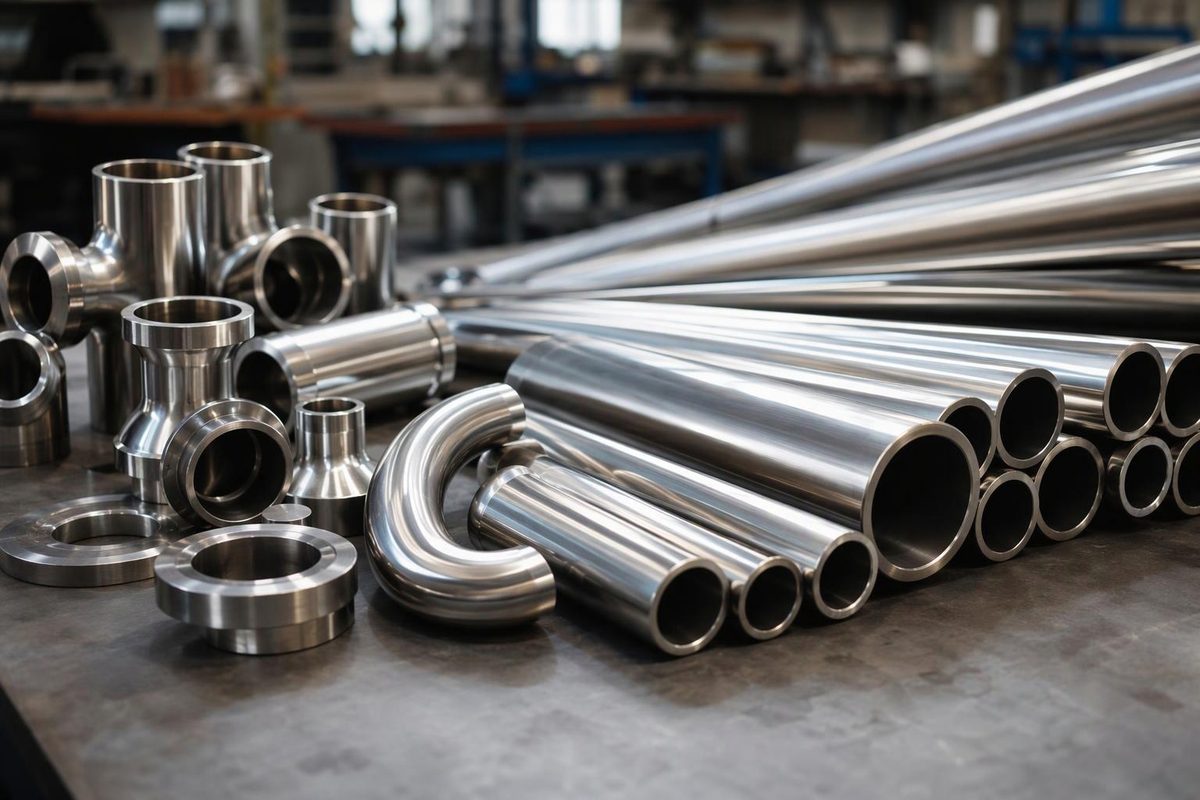
314 stainless steel is an austenitic, high-silicon chromium–nickel grade intended for high-temperature service. It is identified as UNS S31400 and commonly cross-referenced to EN 1.4841. Its main attraction is oxidation resistance: Outokumpu lists guidance for use in air up to approximately 1,150°C (2,100°F). That figure is not an allowable pressure, load or guaranteed service-life rating. Outokumpu Therma datasheet
For tubing or furnace components, the decisive checks are the actual atmosphere, metal temperature, exposure time, mechanical loading and fabrication condition—not the grade number alone.
Composition: high silicon is the distinguishing feature
The following are specification limits for S31400 reported in Chandan Steel’s datasheet under ASTM A276/A276M. All values are percentages by mass; they are not typical heat analyses. Chandan S31400 datasheet
| Element | S31400 composition limit |
|---|---|
| Chromium, Cr | 23.0–26.0% |
| Nickel, Ni | 19.0–22.0% |
| Silicon, Si | 1.50–3.00% |
| Carbon, C | 0.25% maximum |
| Manganese, Mn | 2.00% maximum |
| Phosphorus, P | 0.045% maximum |
| Sulfur, S | 0.030% maximum |
Chromium and silicon are beneficial to protective oxide formation at high temperature. Outokumpu’s typical 314 chemistry contains 24.3% chromium, 19.2% nickel and 1.6% silicon; its typical 310S contains only 0.5% silicon. This helps explain why 314 is considered separately from 310S rather than treated as another name for it. Outokumpu, composition and oxidation sections
Treat the UNS/EN cross-reference as identification guidance, not proof of dual certification. The purchase specification and mill certificate should establish which standard’s chemistry, properties and product requirements the material actually meets.
Heat resistance: three separate limits
1. Oxidation resistance
Outokumpu gives the following application-temperature guidance for air, referencing EN 10095:
| Grade | Guidance temperature in air | Selection distinction |
|---|---|---|
| 314 / 1.4841 | 1,150°C (about 2,100°F) | High-silicon grade with excellent oxidation resistance |
| 310S / 1.4845 | 1,050°C (1,922°F) | Lower listed air-temperature limit |
| 253 MA / 1.4835 | 1,150°C (about 2,100°F) | Same listed temperature ceiling, but a different creep-strength and cyclic-service profile |
These are selection guides, not interchangeable design ratings. Outokumpu, Tables 1–4
An air-temperature figure does not establish suitability for sulfur-bearing gases, carburizing conditions, molten deposits or a wet shutdown environment. Outokumpu warns that high-temperature alloys can have less satisfactory low-temperature wet-corrosion resistance and recommends avoiding or draining acid condensates. Specify the atmosphere as carefully as the temperature. Outokumpu, corrosion-resistance section
2. Strength under sustained load
Resisting scale does not mean resisting creep—the time-dependent deformation of metal under load at elevated temperature. A tube wall, unsupported span or furnace fixture needs strength data appropriate to its temperature and intended operating life.
For context, Chandan reports annealed bar minima of 515 MPa (75 ksi) tensile strength, 205 MPa (30 ksi) 0.2% yield strength and 30% elongation. Those are not tube acceptance values or high-temperature allowable stresses. Chandan S31400 datasheet
3. Structural stability
314 has a high susceptibility to embrittlement during continuous operation at 600–900°C (1,112–1,652°F), according to Outokumpu. A component can therefore remain oxidation-resistant while losing toughness. Long exposure in that range deserves explicit review, especially where cooled parts must later be straightened or repair-welded. Outokumpu, applications and heat-treatment sections
Applications and fabrication
Manufacturer-listed applications include furnace equipment, superheater suspensions, enameling grates, hardening boxes, valves and flanges. These examples establish where 314 is used; they do not qualify every furnace atmosphere or pressure application. Outokumpu, Table 2
For fabrication:
- Forming and machining: Outokumpu describes its austenitic Therma grades as hot- and cold-formable, but their strain-hardening behavior must be considered during machining.
- Welding: The range supports conventional arc-welding processes. For 314, Outokumpu lists the 25 20 ISO alloy designation for covered electrodes and solid wire. Select the actual consumable and qualify the welding procedure for the joint and service; do not assume a filler used for 304 is suitable here.
- Repair preparation: Remove the oxide layer from heat-exposed material before welding. Assess service embrittlement before straightening or repair.
- Heat treatment: Outokumpu lists a solution-annealing range of 1,050–1,150°C (1,922–2,102°F) for 314. Use a qualified heat-treatment procedure rather than treating that temperature range as a complete recipe.
Outokumpu, fabrication section and Tables 16–17
What to specify when ordering 314 tubing
“314 stainless tube” is an incomplete purchase description. State:
- Material: S31400 or the required EN designation, governing product standard and required certification.
- Product form: Seamless or welded, delivery heat-treatment condition and weld-seam requirements.
- Dimensions: Actual OD × wall thickness, length and tolerances. If ordering pipe, state NPS and schedule separately; see the pipe-dimension guide.
- Surface and ends: Required finish, end preparation and cleanliness.
- Service: Maximum metal temperature, dwell time, thermal cycling, atmosphere, pressure and mechanical loads.
- Verification: Mill test certificate, traceability, required inspection and acceptance criteria.
Outokumpu’s listed 314 product forms are sheet, coil, plate and precision strip—not a blanket guarantee of tube availability or certification. Have the tube producer confirm the applicable standard and grade coverage before accepting a quotation or substitution. Outokumpu, applications and products