
A286 Stainless Steel: Grade, Heat Treatment and Tube Specs
Identify A286 (UNS S66286), distinguish temperature capability from design limits, and specify tube dimensions, heat treatment and certification.
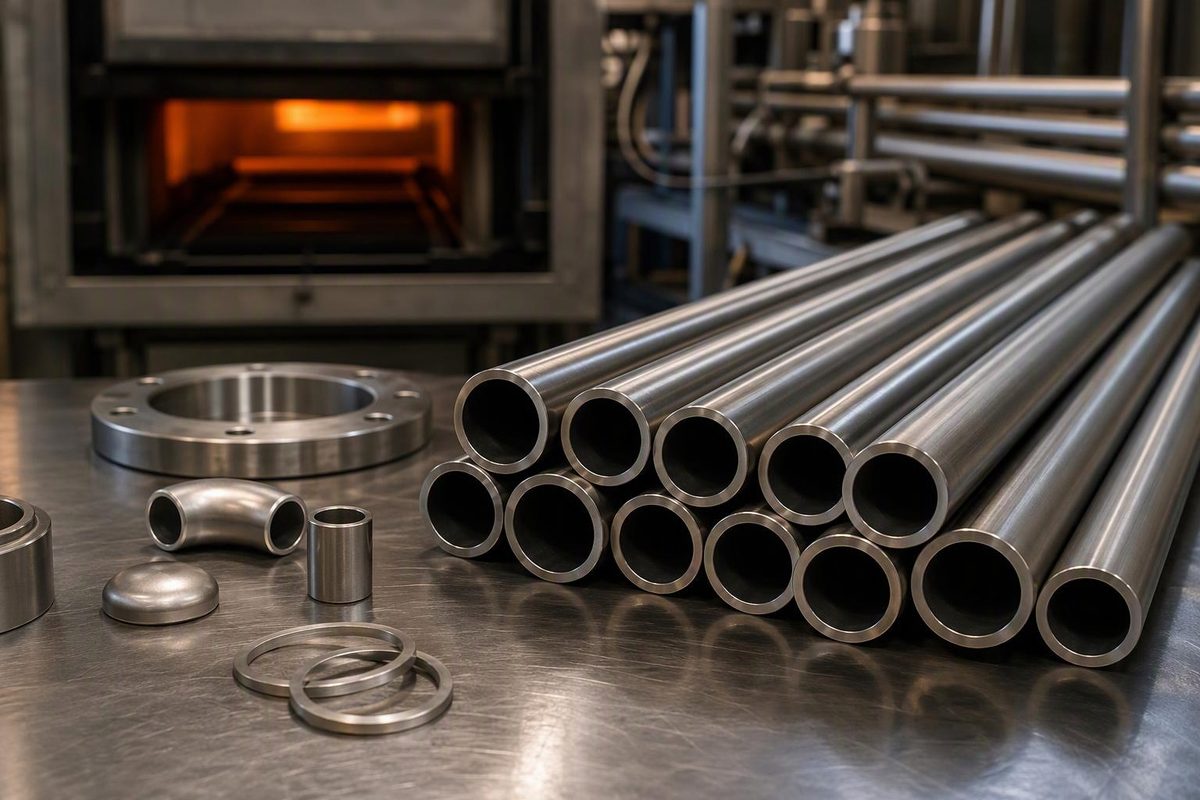
A286 stainless steel, also written A-286, is an age-hardenable, austenitic iron-based superalloy identified as UNS S66286. It is selected for high strength at elevated temperature, not simply as a more corrosion-resistant substitute for 304 or 316. ATI describes applications requiring high strength and corrosion resistance up to 1,300°F (704°C) and identifies the alloy as Grade or Type 660 in several specifications. ATI’s A286 datasheet gives the identification and service context.
For a tubing purchase, “A286” is only the alloy identification. The product standard, heat-treatment condition, actual outside diameter, wall thickness and inspection requirements still need to be specified.
Composition and basic properties
A286 contains roughly 25% nickel, 15% chromium and additions of molybdenum and titanium. Carpenter publishes the following selected chemistry values; these are not a complete purchase specification.
| Element | Published weight percent |
|---|---|
| Nickel | 24.00–27.00% |
| Chromium | 13.50–16.00% |
| Molybdenum | 1.00–1.50% |
| Titanium | 1.90–2.30% |
| Vanadium | 0.10–0.50% |
| Carbon | 0.08% maximum |
| Iron | Balance |
Source: Carpenter’s A-286 alloy datasheet. Use the chemistry limits in the specified standard and revision when accepting material.
ATI lists typical density as 7.92 g/cm³ (0.286 lb/in³) in the solution-treated condition and 7.94 g/cm³ (0.287 lb/in³) after solution treatment and aging. It describes the alloy as non-magnetic, with typical magnetic permeability close to 1 in both conditions. Those properties are useful reference values, but a magnet response is not a substitute for material certification. ATI physical-property data.
Temperature capability is not a pressure rating
Separate three different questions:
- Strength under load: ATI’s general high-strength service description extends to 1,300°F (704°C), but it states that creep and stress-rupture properties—not short-time tensile strength—limit elevated-temperature design.
- Oxidation resistance: ATI reports high oxidation resistance for continuous service up to 1,500°F (816°C) and intermittent service up to 1,800°F (982°C).
- Actual service life: A component must be evaluated for its stress, temperature and exposure duration. An oxidation-resistance temperature does not establish an allowable pressure or load. ATI service and creep data.
A286 is also not immune to wet corrosion. ATI characterizes its aqueous corrosion resistance as comparable to austenitic stainless steels and reports attack in its ferric-chloride crevice-corrosion test. Do not assume that the “superalloy” label establishes suitability for seawater, chlorides or a particular process chemical. ATI corrosion data.
Heat treatment changes what you receive
Solution-treated A286 and solution-treated-and-aged A286 are not equivalent delivery conditions. Solution-treated material is easier to form; subsequent aging develops its high strength.
ATI describes two solution-treatment routes and a common aging treatment:
| Treatment | Purpose described by ATI |
|---|---|
| Solution treatment at 1,650°F (899°C) | Finer grain size; superior short-time tensile properties at room and elevated temperatures |
| Solution treatment at 1,800°F (982°C) | Slightly coarser grain size; superior creep and stress-rupture properties |
| Aging at 1,325°F (718°C) for 16 hours, then air cooling | Develops high strength after either solution treatment |
These are manufacturer guidance, not a universal shop recipe. Section size affects cooling requirements, and cold work can alter the aging response. Follow the governing material specification and approved heat-treatment procedure. ATI heat-treatment guidance.
Which specification applies to A286 tubing?
Two SAE specifications illustrate why condition must accompany the alloy name:
- AMS5731M: consumable-electrode-remelted A286, solution heat treated at 1,800°F (982°C), precipitation hardenable.
- AMS5732K: consumable-electrode-remelted A286, solution and precipitation heat treated, with the same stated solution temperature.
Both scopes expressly include mechanical tubing and specify product-size limits. That does not, by itself, qualify a tube for a pressure system. Specify the revision required by the drawing or contract and verify the complete standard’s scope and acceptance requirements.
For fasteners, ASTM A453/A453M-26 includes Grade 660 Classes A, B, C and D for high-temperature bolting. It is a bolting specification, not a substitute tubing specification; “660” without the class leaves the order incomplete.
Fabrication checks before ordering
A286 can be cold drawn and formed in the solution-treated condition, but Carpenter notes that it is stiffer than Types 316 and 310 and work-hardens rapidly. Plan forming loads around the actual condition. Carpenter workability guidance. Easier forming does not necessarily mean easier machining: ATI describes solution-treated A286 as gummy and says it is generally machined after partial or full aging, or overaging. ATI machining guidance.
Do not treat A286 welding as routine 304/316 fabrication. ATI warns of hot cracking, particularly in aged material and heavy sections; Carpenter warns of heat-affected-zone cracking during fusion welding. Establish an alloy-specific qualified procedure, filler selection and heat-treatment sequence before buying material for a welded assembly. ATI welding guidance; Carpenter weldability guidance.
An A286 tube inquiry should state:
- Material: UNS S66286, governing product standard and revision.
- Condition: solution treated or solution treated and aged; required processing route.
- Dimensions: actual OD × wall × length, with units and tolerances—not merely a pipe schedule.
- Bore requirements: ID, ovality and straightness where functional fit demands them.
- Surface: internal and external finish, cleanliness and end preparation.
- Verification: heat/lot traceability, certified chemistry, heat-treatment records and required mechanical or nondestructive tests.
For nominal round tubing, ID = OD − 2 × wall. As a dimensional example—not a stock-size claim—a 1.000-in OD × 0.065-in wall tube has a nominal 0.870-in ID; actual clearance depends on tolerances. For mass estimates, use the appropriate A286 density rather than a generic stainless value in the pipe and tube weight calculation.