
SS Welding Wire Selection Starts With Both Base Metals
A "stainless MIG wire" category may include solid GMAW wire, gas-shielded or self-shielded flux-cored wire, and metal-cored wire.
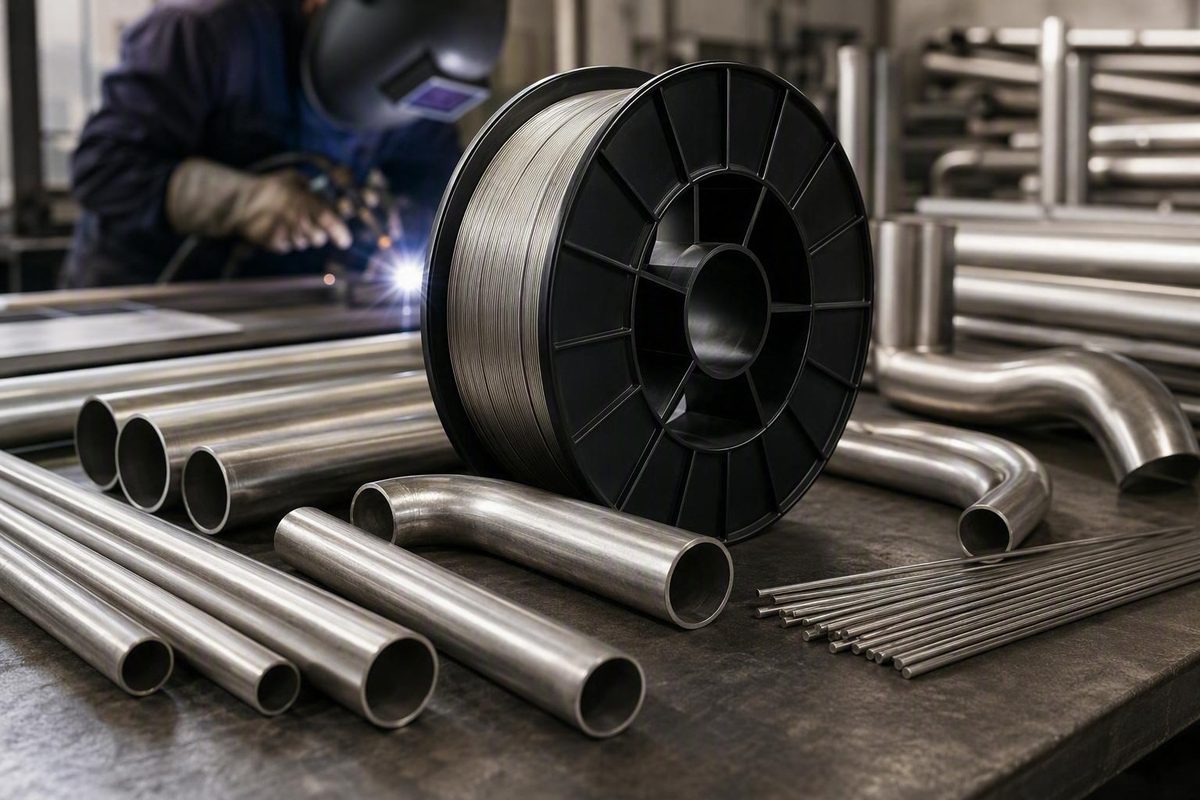
Choosing SS welding wire is not simply a matter of finding a spool labeled “stainless.” The filler classification must suit the identified base metals, joint, service environment, and required weld properties. Only then should you choose the wire construction and diameter, confirm shielding requirements, and check whether the package fits the feeder.
Search results make this harder because a “stainless MIG wire” category may contain solid GMAW wire, gas-shielded flux-cored wire, self-shielded flux-cored products, and occasionally metal-cored wire. Similar alloy numbers do not make these products interchangeable.
This guide therefore treats published compatibility charts as commercial starting points rather than standards-level selection rules. The defensible purchase is a compatible combination of filler, process, gas, equipment, joint design, documentation, and—where required—a qualified welding procedure.
Start Here: A Practical Stainless Welding Wire Decision Tree
In most shopping contexts, SS welding wire means stainless-steel filler supplied in continuous, spool-fed form. This article focuses on solid MIG/GMAW wire and tubular stainless wires sold for flux-cored or related continuous-wire processes.
An ER classification can also appear on filler supplied as straight lengths for TIG/GTAW. A related alloy designation may indicate similar filler chemistry, but a cut-length rod cannot be loaded into a wire feeder merely because its designation resembles that of a spool. Confirm both the classification and the supplied product form.
Use this sequence before comparing brands or prices:
- Identify both base metals. Record complete grades where possible, not merely “stainless” and “steel.”
- Define the joint. Determine whether it joins the same stainless grade, two different stainless grades, or stainless to carbon or low-alloy steel.
- Assess the service. Consider corrosion exposure, chlorides, process chemicals, operating temperature, cyclic loading, and required mechanical properties.
- Identify the process. Establish whether the procedure calls for solid GMAW wire, gas-shielded FCAW, self-shielded FCAW, or another continuous-wire product.
- Select the filler family. Consider dilution and required deposited-weld properties rather than matching alloy numbers mechanically.
- Choose the diameter. Base it on material thickness, joint geometry, position, transfer mode, deposition needs, machine output, and procedure limits.
- Verify the complete setup. Check feeder capacity, package dimensions, contact tip, liner, drive rolls, polarity, shielding-gas capability, and gun duty cycle.
- Review the documentation. Confirm the complete classification, applicable specification, manufacturer data sheet, traceability, certificates, approvals, and welding procedure requirements.
Commercial welding guides commonly associate ER308L or ER308LSi with many 304/304L applications, ER316L or ER316LSi with 316/316L, ER309L or ER309LSi with many stainless-to-carbon-steel joints, and ER2209 with duplex 2205. The same guidance also identifies base-metal composition, corrosion conditions, diameter, gas, joint design, and welding parameters as selection variables. NS Arc summarizes these common associations and limitations.
| Base metal or joint | Commercial starting point | Why it enters the comparison |
|---|---|---|
| 304 or 304L to compatible material | ER308L or ER308LSi | Commonly associated with routine 304-series fabrication |
| 316 or 316L to compatible material | ER316L or ER316LSi | Molybdenum-bearing filler considered where 316-series compatibility and related corrosion performance are required |
| Stainless to carbon or mild steel | ER309L or ER309LSi | More highly alloyed filler commonly considered when accounting for dissimilar-metal dilution |
| Stabilized 321 or 347 stainless | ER347 | Supplier-listed association for stabilized stainless applications |
| Duplex 2205 | ER2209 | Supplier-listed duplex filler association |
| Super-duplex stainless | ER2594 | Supplier-listed association requiring specialist verification |
| Certain martensitic stainless applications | ER410NiMo | Supplier-listed association requiring grade-specific engineering review |
The specialist associations in the final four rows come from a commercial classification guide rather than an AWS or ISO standard. They do not establish procedure suitability, specification limits, or product approval. The supplier guide lists ER347, ER2209, ER2594, and ER410NiMo for these respective families.
Every table entry is general commercial guidance, not a qualified procedure. Exact base metals, dilution, corrosion exposure, design properties, governing code, and the welding procedure specification can change the correct choice.
Do not select filler for an unidentified stainless component solely from a generic chart. The component could be a common austenitic alloy, but it could instead be duplex, martensitic, ferritic, precipitation-hardening, clad, or another material for which ordinary 300-series assumptions are inappropriate. Records review, positive material identification, or specialist assessment may be necessary—particularly for consequential work.
How to Read ER308L, ER308LSi and Other Wire Designations
A designation such as ER308LSi provides useful information, but it is not a complete purchase specification. It must be read under the governing classification system rather than decoded one character at a time without context.
In the supplier convention used by the available commercial guide:
- ER is a combined designation indicating filler classified for use as an electrode or rod.
- S, when it appears as the designated wire-type element in another classification pattern, means solid wire.
- T, in the relevant tubular-wire pattern, identifies tubular or flux-cored construction.
- C, in the relevant composite-wire pattern, identifies composite or metal-cored construction.
These letters are not universally interchangeable, and their meaning depends on their position and governing specification. Most importantly, the “S” in “Si” is not a solid-wire construction marker. “Si” is the chemical symbol used in the suffix indicating increased silicon.
What the alloy number means
The numerical portion—308, 309, 316, 347, 2209, or another identifier—places the filler in an alloy family. It does not prove that the filler is suitable for every base metal with a similar number.
Suitability still depends on:
- both base-metal specifications;
- dilution from each side of the joint;
- deposited-weld chemistry;
- corrosion and temperature exposure;
- joint design and restraint;
- required mechanical properties;
- the applicable standard and procedure.
A label such as “308 stainless wire” is therefore incomplete. It does not tell the buyer enough about construction, diameter, package, gas, polarity, documentation, or the exact classification.
What “L” means
For the relevant austenitic stainless filler examples, L denotes low carbon. Commercial product and supplier guidance for ER308L and related L variants cites a maximum carbon content of 0.03%, but that number is classification-oriented seller guidance rather than a certificate for a particular spool. One ER308L product page states the 0.03% maximum and identifies its product as solid MIG wire.
If chemistry limits matter to the contract or procedure, obtain the manufacturer’s current specification and the required lot-specific documentation. A package label or retailer description is not a substitute for a certificate.
What “Si” means
Si denotes increased silicon relative to the corresponding L variant.
That does not establish that an LSi product is universally stronger, more corrosion resistant, or otherwise superior. One seller guide notes improved wetting and bead smoothness while describing a possible mechanical-property tradeoff. Product data and the WPS must decide whether the LSi variant is acceptable.
| Low-carbon variant | Higher-silicon variant | Practical distinction to investigate |
|---|---|---|
| ER308L | ER308LSi | Both are common starting families for 304/304L; LSi may be considered where puddle wetting and bead appearance matter |
| ER309L | ER309LSi | Both enter many dissimilar-metal and overlay comparisons; LSi may change puddle behavior |
| ER316L | ER316LSi | Both are associated with 316/316L; LSi is an alternative, not an automatic upgrade |
Flux-cored suffixes require product-specific decoding
Tubular-wire classifications may include suffixes concerning welding position, shielding category, or other operating characteristics. The exact interpretation depends on the governing specification and complete classification.
Do not transfer requirements from one flux-cored product to another merely because both contain “309” or “316.” Confirm the exact manufacturer data sheet for:
- approved shielding gas;
- polarity;
- welding positions;
- diameter and operating range;
- storage and handling;
- required drive-roll setup;
- applicable classification and approvals.
Compact product-label decoder
Before ordering, locate every field below:
| Label or listing field | Question it answers |
|---|---|
| Complete classification | What filler family and subtype are being supplied? |
| Governing specification | Under which classification system should the designation be interpreted? |
| Product form | Is it continuous wire or cut-length rod? |
| Construction | Is it solid, flux-cored, self-shielded flux-cored, or metal-cored? |
| Intended process | Is it specified for GMAW, FCAW, or another process? |
| Diameter | Will it run through the feeder, liner, tip, and approved procedure range? |
| Package weight and dimensions | Will the feeder accept the spool physically and safely? |
| Shielding requirement | Is external gas required, and which product-approved gas applies? |
| Polarity | Can the equipment provide the required arrangement? |
| Data sheet and certificate | Are stated properties typical, guaranteed, or lot-specific? |
| Lot number and approvals | Can the delivered material be traced and accepted for the job? |
Match the Filler to 304, 316, Dissimilar Metals and Specialist Stainless
Filler selection begins with metallurgy, but “matching” does not always mean choosing a number identical to the base metal. Stabilized and duplex grades require grade-specific guidance that a basic 304 chart cannot supply.
| Base metal or joint | Common commercial starting filler | Reason for consideration | Verification required |
|---|---|---|---|
| 304 to 304 or 304L | ER308L or ER308LSi | Common association for routine 304-series fabrication | Exact grades, corrosion exposure, dilution, joint design, gas, and WPS |
| 304L to 304L | ER308L or ER308LSi | Low-carbon filler family commonly associated with 304L | Required chemistry, properties, heat control, and procedure |
| 316 to 316 or 316L | ER316L or ER316LSi | Molybdenum-bearing filler associated with 316-series applications | Service medium, temperature, corrosion requirements, and WPS |
| Stainless to carbon or low-alloy steel | ER309L or ER309LSi | Commonly considered for dissimilar-metal dilution | Both exact grades, restraint, service, strength requirements, and code |
| Stainless overlay on carbon steel | ER309L or ER309LSi | Common commercial starting point for some overlay applications | Dilution, number of layers, required surface chemistry, and qualified procedure |
| 321 or 347 stainless | ER347 | Supplier-listed association with stabilized grades | Exact base grade, service temperature, required properties, and procedure |
| Duplex 2205 | ER2209 | Supplier-listed duplex association | Alloy-specific WPS, consumable data, gas, inspection, and qualified personnel |
| Super-duplex stainless | ER2594 | Supplier-listed super-duplex association | Specialist procedure, qualification, documentation, and inspection |
| Certain martensitic grades | ER410NiMo | Supplier-listed limited association | Exact grade, thermal requirements, engineering review, and procedure |
These are purchasing starting points only. The available evidence does not establish that any listed filler is approved for a particular pressure, structural, marine, food, chemical, or other regulated application.
Scenario: Routine 304 fabrication
For known 304 or 304L joined to compatible 304-series material, ER308L is a common first candidate. ER308LSi enters the comparison where its increased silicon and associated puddle-wetting behavior suit the process, joint, and procedure.
Some retailer descriptions also list ER308L for related grades such as 308/308L, 321, and 347. That does not make ER308L the preferred filler whenever the stabilized character of 321 or 347 matters. Treat the retailer list as a product-location aid, not as procedure qualification.
Scenario: Chloride-exposed 316 equipment
For 316 or 316L base metal, ER316L or ER316LSi is the usual commercial starting family. Commercial comparisons distinguish ER316L from ER308L by its molybdenum content and discuss that difference in connection with pitting and chloride-bearing environments. A supplier comparison explains the ER308L–ER316L composition and application distinction.
The conclusion is not that ER316L is “better” in every joint. Base-metal compatibility, required deposited-weld composition, dilution, environment, mechanical properties, cost, and procedure acceptance must all align. More alloy content on the spool does not by itself prove better performance.
Scenario: Stainless-to-mild-steel repair
For many stainless-to-carbon-steel or stainless-to-low-alloy-steel joints, ER309L or ER309LSi is a common starting family. Its more highly alloyed deposit is considered when accounting for dilution from the non-stainless side.
Before selecting it, establish:
- the actual stainless grade;
- the carbon or low-alloy steel specification;
- whether either component is hardened or heat treated;
- operating temperature and corrosion exposure;
- joint restraint and required properties;
- whether the repair is governed by a code or approved repair procedure.
A familiar ER309L spool does not make an unknown repair procedure sound.
Scenario: Stabilized stainless
For 321 or 347 stainless, do not rely solely on a seller’s broad statement that ER308L can weld “related stainless.” Supplier guidance specifically associates ER347 with stabilized 321/347 applications.
That association remains only a starting point. The final decision must account for the exact base material, required properties, operating temperature, thermal cycling, and approved WPS.
Scenario: Duplex 2205
Supplier charts associate ER2209 with duplex 2205, but the alloy number alone is insufficient. Use an alloy-specific procedure, manufacturer documentation, appropriate inspection requirements, and personnel qualified for the work.
Apply the same restraint to super-duplex, martensitic, ferritic, precipitation-hardening, pressure-retaining, structural, and other consequential applications. The available commercial evidence is not a substitute for an applicable standard or qualified procedure.
Solid MIG Wire vs Flux-Cored and Metal-Cored Stainless Wire
Products displayed in the same “stainless MIG wire” category may require different processes. Separate construction and shielding requirements before comparing deposition or price.
Solid stainless wire
Solid stainless GMAW wire is continuous wire used as both electrode and filler. It requires an appropriate external shielding gas and is commonly considered for clean material in controlled working conditions.
Its performance still depends on the complete setup. Poor shielding, contamination, unsuitable transfer conditions, or incorrect parameters can defeat an otherwise reasonable filler selection.
Gas-shielded flux-cored wire
Flux-cored stainless wire has tubular construction with formulated core ingredients. Some stainless flux-cored products require external shielding gas.
Commercial supplier guidance associates certain gas-shielded stainless FCAW products with thicker work, higher deposition, slag-supported puddles, and positional capability. Those are product-dependent attributes, not guarantees for every tubular wire. Fortis Metal describes these general gas-shielded FCAW use cases.
Position, gas, polarity, and operating range must be taken from the complete classification and data sheet.
Self-shielded flux-cored wire
A self-shielded product is formulated to operate without an externally supplied shielding-gas cylinder. It is a distinct FCAW product—not a conventional solid-wire GMAW product with the gas turned off.
Commercial guidance says self-shielded stainless products are available but may be less common and may produce more spatter or a rougher appearance. Treat those as supplier-stated generalizations. Do not assume that every flux-cored wire is self-shielded or that a self-shielded product is unrestricted for outdoor use.
Metal-cored wire
Metal-cored stainless wire is another composite or tubular product category. The available evidence does not support broad claims about its gas, deposition, slag, or positional behavior across all products.
Confirm its complete classification and manufacturer instructions rather than treating “cored” as proof that it is interchangeable with solid GMAW or flux-cored wire.
| Construction | External gas | General context | Cleanup and handling | Required checks |
|---|---|---|---|---|
| Solid GMAW wire | Required | Clean material and controlled work where the approved setup is available | Normally no flux-generated slag; protect wire and joint from contamination | Gas, polarity, transfer mode, diameter, feeder range, WPS |
| Gas-shielded flux-cored wire | Required | Product-dependent; some are marketed for heavier or positional work | Slag and interpass cleanup may be required | Full classification, gas, polarity, position, drive setup |
| Self-shielded flux-cored wire | Not externally supplied | Where the specific product and procedure permit operation without cylinder gas | Product-dependent spatter, surface, fumes, and cleanup | Position, polarity, environmental limits, procedure |
| Metal-cored wire | Product-specific | Only where the machine and procedure support the identified product | Product-specific | Gas, polarity, transfer conditions, feeder, qualification |
Retail categories are not reliable evidence of construction. One retailer category mixed solid stainless wire with a .045-inch, 28-pound DW309LT-1 flux-cored product, demonstrating why the full product name matters more than the category heading. See the mixed stainless inventory.
Choosing Wire Diameter and Spool Size Without Guessing
Wire classification and diameter solve different problems:
- Choosing ER308L instead of ER316L is primarily a metallurgy and service decision.
- Choosing .030 instead of .035 inch is primarily an equipment, operating-range, control, and deposition decision.
One cannot correct an error in the other. A convenient diameter does not make an incompatible filler suitable, while the correct filler family will not run properly through an unsuitable setup.
Selecting between .030, .035 and .045 inch
Diameter should reflect:
- base-metal thickness;
- joint type and root opening;
- welding position;
- transfer mode;
- desired deposition;
- heat-control requirements;
- available current and wire-feed range;
- contact-tip, liner, and drive-roll compatibility;
- WPS limits.
As a general principle, smaller wire tends to provide more control on thinner material, while larger wire is associated with thicker work or higher deposition. This is not a fixed thickness rule. ESAB’s general MIG guidance makes the same distinction and recommends evaluating the wire-and-gas combination under intended production conditions. See ESAB’s MIG wire selection guidance.
Retail evidence shows:
- .030 and .035 inch are common solid stainless product sizes;
- .025 inch appears in some retail catalogs;
- .045 inch appears in heavier packages and at least one captured cored-wire listing.
Do not repeat ambiguous references to 0.30, 0.35, or 0.45 inch as verified recommendations. Those values differ by a factor of ten from the common .030-, .035-, and .045-inch retail examples.
Spool size affects compatibility, not just value
Retail catalogs in the evidence include .025-, .030-, and .035-inch products in 2- and 10-pound packages. Other listings show 11-, 28-, 30-, and 33-pound packages, but those examples come from different sellers and products rather than one standardized package system. The Harris category illustrates the smaller diameter and package range.
A larger spool may reduce changeovers or the displayed cost per pound. It has no purchasing advantage if the feeder cannot accept its outside diameter, hub, spindle arrangement, or weight.
Pre-purchase machine and spool checklist
Confirm every item before ordering:
- [ ] The power source and feeder support the intended process.
- [ ] The feeder supports the selected diameter.
- [ ] The contact tip matches the diameter and wire type.
- [ ] The liner is compatible, clean, and correctly sized.
- [ ] The drive-roll groove and roll type suit solid or tubular wire.
- [ ] Drive pressure can be adjusted without slipping or deforming the wire.
- [ ] The spool’s outside diameter fits the enclosure.
- [ ] The hub bore, spindle, adapter, and retaining hardware fit.
- [ ] The feeder is rated for the package weight.
- [ ] Brake or hub tension can be adjusted correctly.
- [ ] The required polarity is available.
- [ ] The shielding-gas system supports the exact product.
- [ ] The gun and duty cycle suit the intended operating range.
- [ ] The selected diameter is permitted by the WPS.
Bulk price is irrelevant when the spool cannot be mounted or the product construction does not match the process.
Shielding Gas, Heat and Contamination: What the Wire Label Cannot Decide
Correct filler chemistry cannot compensate for poor shielding, contamination, unsuitable thermal practice, or an unapproved joint procedure.
Shielding gas must match the product and procedure
Solid stainless GMAW wire requires external shielding gas. No single mixture is established by the available evidence as universally correct for every stainless filler, transfer mode, position, joint, and machine.
Commercial guidance mentions several gas families:
- argon blends containing a small oxygen addition;
- low-CO2 argon blends;
- helium/argon/CO2 tri-mixes;
- product-specific gases for certain flux-cored wires.
These are categories to investigate, not universal prescriptions. Follow the current manufacturer data sheet, machine guidance, and applicable WPS for gas composition, polarity, transfer mode, flow, and operating window.
At a high level, shielding gas and voltage interact with puddle fluidity, bead profile, edge wetting, penetration, and spatter. Do not transfer a gas recommendation from an unrelated solid wire to a flux-cored product or assume that a carbon-steel setup is approved for stainless simply because the machine can deliver it.
Heat input and travel speed affect the result
Stainless welding requires control of the complete thermal process. Commercial guidance links excessive heat with oxidation and reduced corrosion performance, while poor parameter control can also contribute to fusion defects.
The appropriate response is not to copy unsupported voltage, amperage, wire-feed, or gas-flow numbers from a generic chart. Start with the operating range for the exact product and apply the WPS to the selected diameter, gas, position, transfer mode, joint, and material thickness.
Where the governing procedure permits, test the intended wire-and-gas combination on a representative production joint. A bead made on scrap of a different thickness does not establish performance in the actual joint, position, or restraint.
Contamination-control checklist
Protect stainless filler and base metal during storage, setup, and welding:
- [ ] Store wire in a clean, dry environment.
- [ ] Protect spools from moisture, dust, grinding debris, and oil.
- [ ] Do not handle clean wire or joint surfaces with contaminated gloves.
- [ ] Use stainless-dedicated wire brushes.
- [ ] Segregate grinding wheels and abrasives used on stainless.
- [ ] Prevent carbon-steel grinding dust from settling on the work.
- [ ] Use a clean liner rather than one contaminated by carbon-steel wire.
- [ ] Keep drive rolls, guides, and contact components clean.
- [ ] Clean joint and adjacent surfaces as required by the procedure.
- [ ] Protect the shielding envelope from drafts and leaks.
- [ ] Remove slag between passes where the product and procedure require it.
- [ ] Preserve spool identification and lot records.
Commercial stainless guidance specifically recommends dedicated brushes, abrasives, drive components, and liners to limit cross-contamination. Welder’s Choice discusses these cleanliness controls and related heat and shielding considerations.
A spool with the nominally correct classification cannot overcome oil, embedded carbon-steel debris, poor fit-up, inadequate shielding, or unsuitable parameters.
How to Compare Stainless Welding Wire Products and Prices
Compare products in this order:
- Complete filler classification
- Solid, flux-cored, self-shielded, or metal-cored construction
- Supported process
- Diameter
- Package dimensions, hub format, and net weight
- Shielding-gas and polarity requirements
- Manufacturer data sheet and governing specification
- Certificate, lot traceability, and required approvals
- Delivered price
Price belongs last because the least expensive spool that fails an earlier requirement is not a substitute.
Catalog breadth varies
The captured retail evidence includes 308L, 308LSi, 309L, 309LSi, 316L, and 316LSi solid-wire listings. Another category also includes DW309LT-1 flux-cored wire.
Absence from one catalog does not establish that a classification or diameter is unavailable elsewhere. Conversely, presence in a category does not prove suitability for a particular joint.
| Captured listing example | Construction | Diameter | Package | What it demonstrates |
|---|---|---|---|---|
| ER308L retail spool | Solid | .030 inch | 2 lb | Small-package format |
| ER308L retail spool | Solid | .035 inch | 10 lb | Same alloy family sold in another diameter and package |
| ER316L listing | Solid | .035 inch | 30 lb | Larger production-oriented package |
| ER308L listing | Solid | .035 inch | 33 lb | Large package with typical property data |
| DW309LT-1 listing | Flux-cored | .045 inch | 28 lb | A cored product displayed in a broader MIG-wire category |
Package, diameter, and construction must therefore be normalized before comparing prices.
Calculating displayed cost per pound
The basic calculation is:
Displayed product price ÷ net wire weight = displayed cost per pound
In an undated retail capture supplied for this article, a 2-pound, .030-inch ER308L spool was listed at $23.87, while a 10-pound, .035-inch ER308L spool was listed at $101.87. That produces displayed costs of approximately $11.94 per pound and $10.19 per pound, before shipping, tax, or other charges. These figures are historical listing examples, not current market quotations; verify the page before purchasing.
Cost per pound cannot fairly rank products that differ in:
- alloy classification;
- solid or cored construction;
- diameter;
- package and freight costs;
- documentation or traceability;
- stock status;
- process requirements.
Typical properties are not guaranteed limits
One captured ER308L listing described .035-inch wire on a 33-pound spool and published typical wire chemistry and typical as-welded mechanical properties. The word typical is decisive: those values are not necessarily guaranteed specification limits or lot-specific test results. The product listing illustrates the distinction between typical data and certification.
For a controlled purchase, determine whether the contract requires:
- a current manufacturer data sheet;
- identification of the governing classification specification;
- a certificate of conformance;
- lot or heat traceability;
- actual chemistry or test documentation;
- project or regulatory approvals;
- controlled storage and issue records.
A retailer page can help locate a product. It is not a certificate, procedure qualification record, or independent proof of suitability.
Product-listing warning signs
Pause and obtain manufacturer documentation if a listing:
- omits the complete classification;
- calls every tubular product “MIG wire” without identifying its process;
- omits shielding requirements;
- does not state diameter or package dimensions clearly;
- mixes rods and spools under one description;
- presents typical data as guaranteed;
- lists conflicting chemistry values;
- makes broad compatibility claims without supporting documentation;
- implies approval for critical service without identifying that approval;
- contains suspect decimal points or unit conversions.
Preserve the data sheet and certificate corresponding to the delivered lot, not merely a screenshot of a sales page.
Final Selection Checklist and When General Guidance Is Not Enough
Use this checklist as a purchase-release review.
Metallurgy and service
- [ ] Both base-metal grades are positively identified.
- [ ] The joint is classified as similar-metal, dissimilar-metal, overlay, or repair.
- [ ] Expected dilution has been considered.
- [ ] Corrosion exposure is defined, including chlorides or process chemicals where relevant.
- [ ] Operating and design temperatures are known.
- [ ] Required strength, ductility, toughness, corrosion behavior, and other properties are documented.
- [ ] The filler family is permitted by the governing procedure or engineering review.
Process and equipment
- [ ] The product is identified as solid, gas-shielded flux-cored, self-shielded flux-cored, or metal-cored.
- [ ] The process matches the equipment and WPS.
- [ ] Diameter is within the feeder and procedure range.
- [ ] Contact tip, liner, guides, and drive rolls are compatible.
- [ ] Spool diameter, hub, spindle, enclosure, and weight are acceptable.
- [ ] Required polarity is available.
- [ ] Shielding-gas composition and delivery capability are confirmed.
- [ ] Position, transfer mode, and operating range are permitted.
- [ ] Stainless-dedicated cleaning and handling controls are in place.
Documentation and qualification
- [ ] The complete classification and governing specification are stated.
- [ ] A current manufacturer data sheet is available.
- [ ] Required certificates of conformance are available.
- [ ] Lot traceability meets project requirements.
- [ ] Product approvals have been verified where applicable.
- [ ] The WPS covers the base metals, filler, process, diameter, gas, position, and joint.
- [ ] Procedure qualification records are available where required.
- [ ] Welder or operator qualifications are current for the work.
- [ ] Inspection and acceptance requirements are defined before welding begins.
Resolve an unknown base-metal grade before relying on any compatibility table. Choosing ER308L because a component “looks like 304,” or ER309L because one side “looks like mild steel,” is not a defensible approach to a consequential joint.
The available supplier evidence itself directs specialist fillers such as ER2209, ER2594, and ER410NiMo toward distinct alloy families rather than treating them as extensions of ordinary 300-series practice. General shopping guidance is therefore insufficient for code-regulated, pressure-retaining, structural, safety-critical, duplex, super-duplex, martensitic, or similarly specialist work. Use the applicable standard, current manufacturer documentation, certificates, qualified WPS and procedure records, defined inspection requirements, and appropriately qualified personnel.
The final selection is a wire-and-procedure system, not merely a spool carrying a familiar alloy number.
Use this hierarchy:
- Metallurgy first: identify both metals, the joint, service environment, and required properties.
- Process and equipment second: distinguish solid from cored products, then verify diameter, package fit, gas, polarity, and operating range.
- Documentation third: confirm the specification, data sheet, certificates, traceability, WPS, and qualifications.
- Price last: compare delivered cost only among products that satisfy the first three stages.
Frequently Asked Questions
What SS welding wire should I use for 304 stainless steel?
ER308L or ER308LSi is a common commercial starting choice for welding known 304 or 304L stainless to compatible material. ER308LSi contains increased silicon and may be considered where puddle wetting and bead appearance are important.
Confirm both base-metal grades, corrosion exposure, joint design, dilution, required properties, gas, diameter, and WPS before purchasing. A seller compatibility statement is not automatic approval for a particular application.
What is the difference between 308L, 309L and 316L welding wire?
308L is commonly associated with 304 and 304L stainless fabrication. 309L is commonly considered for many stainless-to-carbon-steel or low-alloy-steel joints and some overlay work. 316L is commonly associated with 316 and 316L base metals; its molybdenum content is relevant where the required corrosion performance includes chloride-bearing exposure.
They are different filler families, not good-better-best quality levels. ER316L should not be treated as a universal upgrade over ER308L for every 304 joint.
Can I weld stainless steel to mild steel with stainless wire?
Identify both grades and evaluate service temperature, corrosion exposure, restraint, cracking risk, required properties, and governing requirements. Pressure, structural, heat-treated, safety-critical, or otherwise consequential repairs need an approved procedure rather than a generic ER309L recommendation.
Is .030 or .035-inch stainless MIG wire better?
Neither is universally better. .030-inch wire may offer more control for lighter work or lower-output equipment, while .035-inch wire may suit a different operating or deposition range when the machine, joint, and procedure support it.
Choose according to material thickness, joint design, position, transfer mode, feeder range, contact tip, liner, drive rolls, and WPS—not diameter alone.
Does stainless welding wire need shielding gas?
Solid stainless MIG/GMAW wire requires appropriate external shielding gas. The correct composition depends on the exact wire, transfer mode, joint, position, equipment, and welding procedure.
Tubular products must be checked individually. Some flux-cored stainless wires require external shielding gas, while others are self-shielded. Metal-cored products also require product-specific verification. Never infer the shielding requirement solely from the alloy number or retailer category.