
304 Stainless Steel Sheet Needs a Full Specification
Verify whether 304 fits the exposure, then define actual thickness, finished dimensions, finish, cutting, tolerances and traceability before comparing quotes.
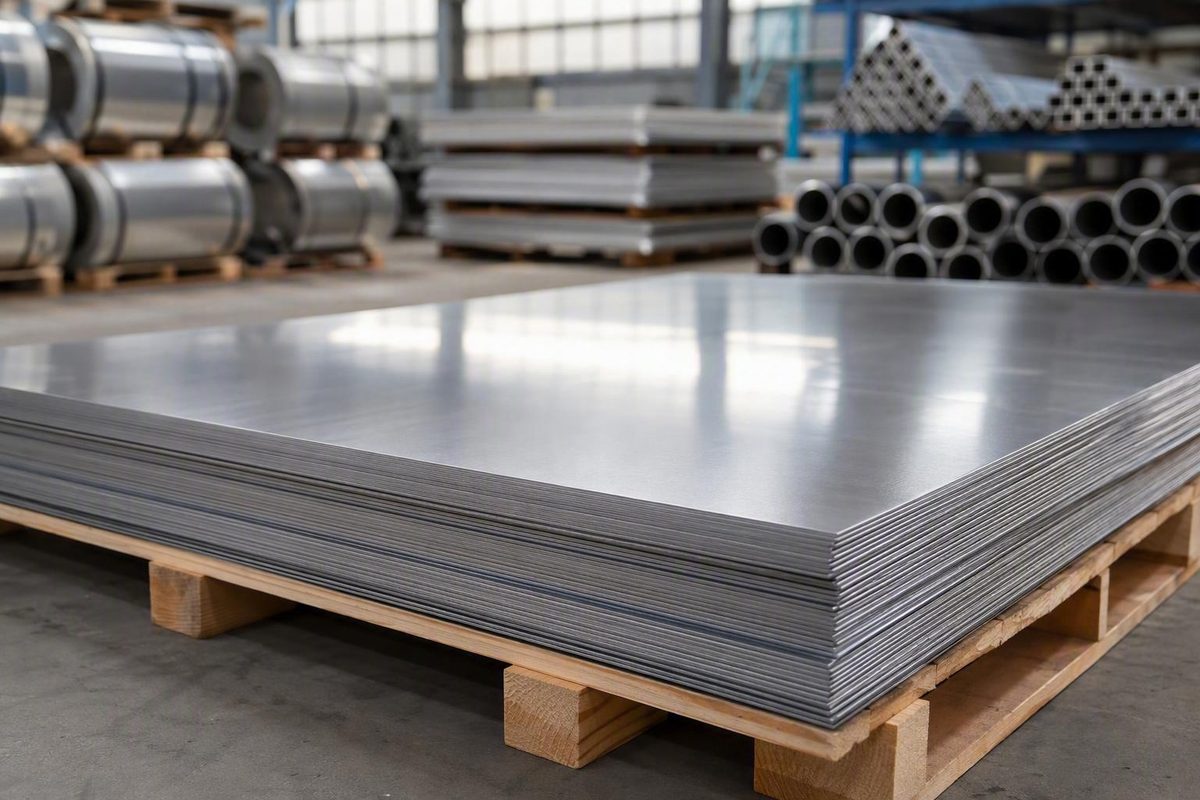
Buying 304 stainless steel sheet is not simply a matter of choosing an alloy and finding the lowest price. A usable order must define the service environment, exact thickness, finished dimensions, finish, tolerances, fabrication requirements, packaging and documentation.
That distinction matters because two products described as “304 sheet” may be substantially different. One may be thin 2B mill-finish stock intended for hidden fabrication; another may be a directional No. 4 panel with one polished face and protective film. A third may be a custom profile whose dimensional acceptance depends on a controlled drawing.
The reliable approach is specification first, supplier second: decide what the project requires, then compare sellers capable of supplying the same configuration.
What You Are Actually Specifying When You Buy 304 Sheet
Stainless sheet is thin, flat material produced by rolling. It may be cold rolled or hot rolled, depending on its thickness, finish and production route. “Sheet” is a useful commercial term, but it does not have one universal upper-thickness boundary. Depending on the supplier, market or governing specification, the same flat product might be categorized as sheet by one seller and plate by another.
Grade 304 is widely offered as a general-purpose stainless option. Supplier catalogs associate it with kitchen equipment, panels, tanks, enclosures, countertops, sinks, railings and industrial fabrication. They also commonly describe it as formable, weldable and resistant to corrosion in many ordinary environments. These are broad commercial descriptions, not proof that the alloy will perform under a particular combination of salt, chemicals, temperature, cleaning practices and exposure duration.
A complete sheet specification normally answers these questions:
- What will the material encounter? Consider indoor or outdoor service, moisture, salt, cleaning agents, process chemicals and temperature.
- Which grade is required? State 304, 304L, a permitted dual-certified product or another alloy as applicable.
- What is the actual thickness? Use decimal inches or millimetres, not gauge alone.
- What finished dimensions are needed? Give width and length rather than relying on “full sheet” or “half sheet.”
- What tolerances control acceptance? Address thickness, cut dimensions, squareness and critical features.
- Which finish and face are required? Identify 2B, No. 4, No. 8 or another finish, including grain direction where relevant.
- What fabrication is included? Distinguish stock sheet, rectangular blanks and drawing-controlled profiles.
- What quantity and packaging are needed?
- Which documents must accompany the material? Examples include a material test certificate, mill test report and heat-number traceability.
- Which delivery and receiving-inspection conditions apply?
Material selection and supplier selection are separate decisions. First establish the required configuration. Then compare suppliers on whether they can deliver it with the necessary tolerances, records, surface protection and lead time.
Application labels should be treated cautiously. A listing that mentions “food equipment,” “architectural,” “industrial” or “outdoor” use does not by itself establish regulatory approval, code compliance or certified suitability. The application still has to be reconciled with alloy identity, surface condition, fabrication, design and documentation.
Decide Whether 304 Fits the Service Environment
304 is a candidate for many indoor, mild-service and non-marine applications, but it is not a universal default. Recurring supplier-listed uses include sinks, countertops, backsplashes, food-processing equipment, enclosures, tanks, architectural panels, railings and general fabrication. Metal Supermarkets, for example, lists uses ranging from kitchen benches and sinks to architectural panels, screens, containers and heat exchangers in its overview of stainless steel sheet.
Those examples show where 304 is commercially offered; they do not establish exposure-specific performance. A countertop in a dry residential interior and a panel exposed to coastal spray may share an application label while experiencing very different corrosion conditions.
Screen the environment before requesting quotes:
- Will the surface encounter saltwater, sea spray or airborne coastal salts?
- Is it exposed to de-icing salt or chloride-containing process material?
- Which cleaning agents will be used, and at what concentration?
- Are process chemicals, acids or other corrosive substances present?
- What temperatures will the sheet and any deposited material reach?
- Will the surface remain wet, alternate between wet and dry, or dry promptly?
- Is exposure occasional, intermittent or continuous?
- Are deposits, crevices or difficult-to-clean joints likely?
- Is slight discoloration acceptable, or must the surface remain cosmetically uniform?
- Will welding, grinding or forming alter the supplied surface?
Commercial guides commonly recommend evaluating 316 or another alloy for coastal, marine, chloride-rich, chemical or frequent wash-down environments. Cut2SizeMetals, for example, positions 316/316L for chloride exposure, coastal conditions, wash-downs and mild chemicals rather than treating 304 as adequate by default in its stainless sheet alloy guide.
That does not mean every outdoor project automatically requires 316. Sheltered, non-marine outdoor service may differ materially from a coastal railing, de-icing-salt splash zone or chloride wash-down area. The point is to describe the actual exposure rather than order according to the word “outdoor.”
The available commercial evidence does not establish universal numerical chloride, chemical-concentration or temperature limits for 304. If failure could affect safety, sanitation, process integrity, warranty obligations or expensive installed work, obtain a qualified material-selection review based on actual operating conditions.
Food-related labels require similar care. The fact that suppliers offer 304 for sinks, counters and food equipment does not make every 304 sheet automatically compliant for food-contact service. Confirm the required alloy specification, finish, fabrication quality, joint and drainage design, cleaning regime and documentation. Regulatory or customer requirements may extend beyond the alloy designation.
Identify the required grade and governing material specification. If a seller proposes 304L, dual-certified stock or multi-grade certification as an alternative, have the substitution checked against the drawing, welding requirements and purchase specification before acceptance.
Choose Thickness by Decimal Value, Not Gauge Alone
In the common US sheet-gauge convention, a larger gauge number generally indicates thinner material. That relationship is counterintuitive, and gauge is not a universal unit of thickness. Conventions and published conversions can vary by material, market and supplier.
Put the controlling thickness on the RFQ and purchase order in decimal inches or millimetres. Gauge may be included as a secondary purchasing reference, but it should not override the stated numerical thickness.
One supplier guide gives these approximate examples:
| Gauge reference | Approximate thickness |
|---|---|
| 26 gauge | 0.0187 in |
| 20 gauge | 0.0359 in |
| 16 gauge | 0.0598 in |
| 11 gauge | 0.1196 in, often rounded near 0.120 in |
| 7 gauge | 0.1793 in |
These figures are examples from Mill Steel’s sheet-grade, size and application guide, not a universal conversion table.
The reason for controlling the decimal value becomes clear when tables are compared. Another supplier guide maps 18 gauge to 0.0500 inch and 20 gauge to 0.0375 inch, while the table above puts 20 gauge at approximately 0.0359 inch. A request for “20 gauge” alone therefore leaves avoidable uncertainty. “0.036 inch nominal,” “0.0375 inch nominal” and “0.95 mm nominal” are not necessarily equivalent purchasing instructions; the conflicting examples appear in this 304 sheet thickness guide.
Choose thickness by function, not merely by a familiar gauge:
- Decorative skins and substrate-backed surfaces: Thin material may be practical when continuously supported and used primarily as a cleanable or decorative face.
- Enclosures and general fabrication: Moderate thickness may improve stiffness, fastening performance and handling while remaining practical to cut, bend and form.
- Unsupported panels and assemblies: Span, load, vibration, attachment spacing, formed edges and acceptable deflection become more important than an application label.
- Heavier fabrication: Tanks, equipment components and load-carrying parts may require thicker sheet or plate, engineering analysis and tighter control of material properties.
BobCo Metals’ supplier-authored selection guide suggests 0.5–1.0 mm for backsplashes, cladding and enclosures and 1.2–2.0 mm for general fabrication, countertops and trim. For countertops, it suggests 1.2–1.6 mm over a substrate and generally 1.5–2.0 mm for unsupported designs. These are commercial starting points, not engineering limits, load ratings or evidence of code compliance. Support spacing, concentrated loads, seams, formed-edge geometry and fabrication method must govern the final choice. The ranges are presented in BobCo’s stainless sheet selection guide.
The sheet-versus-plate boundary is similarly inconsistent. Supplier conventions place it around 6 mm, 7 gauge, 3/16 inch or 1/4 inch. Atlantic Stainless, for example, describes sheet as material up to 6 mm while also approximating that limit as 0.25 inch, whereas another supplier uses approximately 7 gauge or 3/16 inch as a general division. Because such boundaries vary, use the terminology and requirements in the governing specification and confirm how the selected seller classifies the product.
A practical thickness instruction might read:
304 stainless steel sheet, 1.5 mm nominal thickness; allowable thickness variation to the stated purchase specification. Do not substitute a gauge-based nominal without written approval.
Select Stock Dimensions, Custom Sizes and Approximate Weight
Recurring North American stock dimensions include 48 × 96, 48 × 120 and 60 × 120 inches. Metric examples in supplier guides include 1000 × 2000, 1219 × 2438, 1219 × 3048, 1500 × 3000 and 1500 × 6000 mm. These dimensions are supported across supplier guides, including Atlantic Stainless’ purchasing overview.
Not every supplier stocks every dimension in every thickness, grade, finish or certification. Catalog filters and buying guides indicate possible offerings, not current inventory. Always put the finished dimensions in the inquiry rather than relying on labels such as “4 × 8,” “full sheet” or “half sheet.”
Stock sheet versus custom blank
A standard sheet can be simpler to source and may provide more flexibility if the buyer controls nesting and fabrication. Its disadvantages include possible scrap, extra handling and the need to cut a large sheet in-house.
It can also introduce:
- cutting or setup charges;
- seller-specific dimensional tolerances;
- questions about burrs and edge finishing;
- uncertainty about squareness or flatness;
- protective-film damage at cut edges;
- special packaging requirements;
- limited return options for made-to-order material.
Compare material yield, shop capacity and handling risk—not only the sheet price.
Approximate weight calculation
Using a supplier-stated 304 density assumption of 7.93 g/cm³, approximate mass can be calculated as:
Mass in kilograms = length in metres × width in metres × thickness in millimetres × 7.93
For a sheet measuring 1219 × 2438 × 1.5 mm:
- Length: 1.219 m
- Width: 2.438 m
- Thickness: 1.5 mm
1.219 × 2.438 × 1.5 × 7.93 ≈ 35.4 kg
The supplier-stated density, formula and worked dimensions appear in the cited 304 sheet thickness guide above. Calculated weight is an estimate based on nominal dimensions and assumed density. Actual dimensions and thickness can vary within applicable tolerances. For freight classification, lifting equipment, rack capacity or a purchase settled by weight, use supplier-confirmed values.
For custom parts, calculate the rectangular blank first if that is what the supplier ships. A profile containing cutouts will weigh less, but net CAD area may understate handling weight if skeletons or remnants are included in the shipment.
Compare 2B, No. 4, No. 8 and Other Finishes
It may also affect price and availability. For decorative work, a finish name alone is insufficient: state which face is visible, whether grain direction matters and whether protective film must remain in place.
| Finish | General appearance | Directional? | Common supplier-listed uses | Cosmetic considerations | Face and film questions |
|---|---|---|---|---|---|
| 2B | Smooth, dull or matte cold-rolled mill finish | No | Industrial fabrication, enclosures, tanks and non-cosmetic parts | Light scratches, roll marks or uneven dullness may be accepted as mill-finish characteristics | Do not assume film is included |
| No. 4 | Brushed or satin surface with visible grain | Yes | Kitchen equipment, appliances, counters and architectural panels | Scratches across the grain can be conspicuous; adjacent panels may require alignment | Specify polished face, grain direction and film |
| No. 8 | Highly reflective mirror finish | Generally treated as visually non-grained | Decorative panels and reflective features | Fingerprints, handling marks and scratches are readily visible | Confirm polished face and protective film |
| BA | Bright, reflective finish | Usually not ordered by directional grain | Reflective fabrication and decorative work | Appearance can differ from a true mirror polish | Confirm a sample and availability |
| Hairline | Fine specialty linear finish | Yes | Decorative or architectural work | Batch matching and grain direction can matter | Confirm the finish reference, face and film |
| No. 1 | Hot-rolled, annealed-and-pickled appearance | No decorative grain | Heavier industrial fabrication | Not normally selected as a cosmetic polish | Confirm whether the order is treated as sheet or plate |
2B should not be inspected as if it were a cosmetic polish. It is a non-directional mill finish, and commercial sellers may regard light scratches, roll marks and dull areas as normal on unpolished stock. If appearance matters, define objective acceptance criteria or approve a representative sample rather than writing only “2B.”
No. 4 has a directional brushed or satin grain. For adjacent backsplash panels, cladding, appliance faces or formed trim, show the direction on the drawing.
No. 8 is highly reflective. That reflectivity makes surface condition particularly important, but it also makes fingerprints and scratches easier to see.
Decorative finishes may be applied to only one face, and protective-film practices are seller-specific. Cut2SizeMetals states that its No. 4 and No. 8 products are finished and protected on one face, while its 2B product is supplied without film. Those conditions should not be generalized to every supplier.
Do not assume the reverse side of a decorative sheet is suitable for exposure. Likewise, do not assume film type, adhesion, temperature resistance or suitability for laser cutting. Ask:
- Which face is polished?
- Which face is filmed?
- Must the film remain through cutting or bending?
- When should the film be removed?
- Is fabrication through the film approved by the supplier and fabricator?
Catalog finish filters also do not prove that every combination is available. A seller might list 2B, No. 4, No. 8 and other finishes across its product family without stocking each finish in every thickness, dimension, grade, certification or origin category. Confirm the exact combination on the quote.
For visible multi-sheet installations, consider requesting finish samples and material from a consistent production lot. Finish names describe categories, but they do not guarantee a perfect visual match between suppliers or batches.
Plan Custom Cutting, Tolerances, Edges and Drawings
Suppliers advertise several methods for cutting stainless sheet, including shearing, laser cutting, waterjet cutting and plasma cutting. These processes should not be treated as equivalent.
The fabricator should select the process based on the drawing and acceptance criteria, not simply on which machine name sounds most precise.
A rectangular sheared blank and a profile-cut part are different purchases:
- A sheared blank may require only width, length, squareness and edge instructions.
- A profile-cut part may require CAD geometry, hole locations, internal features, contour tolerances, datum references and revision control.
- A cosmetic panel may add grain alignment, visible-face and protective-film requirements.
- A formed part may require bend information or a separate fabrication drawing.
All Metals offers customer-selected widths and lengths from 1 to 48 inches in one-eighth-inch increments and states a sheared-size tolerance of minus zero to plus one-eighth inch for the cited 11-gauge configuration. That tolerance belongs only to that seller and product; it is not a general rule for sheared stainless sheet. The dimensions and tolerance appear in the seller’s 11-gauge 304 listing.
If an enclosure opening is 24.000 inches wide, ordering a nominal 24-inch blank under a unilateral positive tolerance could produce a part too large for the opening. State acceptable plus/minus variation instead of assuming “cut to size” means exact.
A useful drawing checklist includes:
- units;
- grade and governing material specification;
- nominal thickness and allowable variation;
- finished width, length and profile dimensions;
- general and feature-specific tolerances;
- squareness or angular requirements;
- datum structure where needed;
- critical dimensions versus reference dimensions;
- finish designation;
- visible or polished face;
- grain direction;
- protective-film requirement;
- edge condition;
- quantity;
- drawing number and revision;
- inspection or reporting requirements.
Edge instructions might include as-cut, deburred or finished by an agreed method. Avoid relying on the word “smooth,” which is difficult to inspect without a defined criterion. If an edge will be exposed to users, welded, bonded, inserted into a gasket or used as a locating feature, tell the supplier.
Some sellers accept customer drawings in formats including PDF, DWG, DXF and STEP. Stainless Supply, for example, lists these and several other image or CAD formats with a 5 MB upload limit on its cut-to-size ordering page. File acceptance does not mean the geometry has been approved for manufacture. Request a reviewed quote or drawing acknowledgment showing the controlling revision.
Before ordering, ask the fabricator which process best satisfies the required accuracy, edge condition, heat control, flatness and budget. If those requirements matter, put them on the purchase documents rather than relying on a verbal discussion.
Write an RFQ That Controls the Material You Receive
A clear request for quote allows suppliers to identify exceptions before material is cut. It also makes competing quotes easier to normalize.
Use this sequence:
Material: 304 stainless steel sheet Governing standard and edition: [state if required] Thickness: [decimal inches or millimetres] Thickness tolerance: [requirement or governing reference] Finished size: [width × length, with units] Cut-size tolerance: [plus/minus or unilateral limits] Squareness/critical features: [requirements or drawing reference] Finish: [2B, No. 4, No. 8 or other] Visible/polished face: [identify] Grain direction: [parallel to a stated dimension or shown on drawing] Protective film: [required face and process constraints] Edges: [as-cut, deburred or another agreed condition] Quantity: [number of sheets or parts] Fabrication: [stock sheet, sheared blank, laser profile, formed part, etc.] Inspection: [receiving, dimensional or document requirements] Documentation: [MTR/MTC, heat traceability, origin or other requirements] Packing: [surface protection, separators, pallet or crate] Delivery: [location, required date and commercial terms] Application context: [brief exposure and fabrication description]
A supplier guide gives the compact example: “304 stainless steel sheet, 1.5 mm thick, 1219 × 2438 mm, 2B finish, PVC film, ASTM A240.” It also says a material test certificate may report chemical composition, mechanical properties, heat number and claimed standard compliance. These details appear in Voyage Metal’s stainless sheet buying guide.
That example is a useful starting structure, but a real order usually needs project-specific tolerances, face requirements, packing and documentation. “PVC film” alone may also be inadequate if film performance during cutting, bending, prolonged storage or elevated temperature matters.
Commercial listings may reference ASTM A240, ASME SA 240 and various AMS specifications. One triple-certified 302/304/304L listing names AMS 5516, AMS 5513, AMS 5511, ASTM A240 and ASME SA 240 among its selectable specifications. It should not be assumed that all apply simultaneously to every item or that the listing summarizes their current official requirements; the specifications are shown in the seller’s 302/304/304L sheet configuration.
When a standard governs the contract:
- state the required standard and edition if the project controls the edition;
- obtain and apply the current official text;
- identify supplementary customer requirements;
- require the promised documentation with the shipment;
- resolve substitutions before purchase.
Supplier summaries of representative ASTM A480 tolerances can illustrate the types of variation that may require attention, but they are not substitutes for the official edition governing a contract.
Triple-certified material needs similar care. A product certified to criteria for 302, 304 and 304L may satisfy some orders, but it should not automatically be treated as identical to dedicated 304 material for every application. Verify the certificate, governing specification, chemistry and project requirements.
Receiving inspection
Before material enters production, check:
- grade and document identification;
- heat number where traceability is required;
- thickness at the locations and by the method required by the purchase specification;
- width, length, squareness and critical features;
- finish consistency;
- correct polished-face orientation;
- grain direction;
- protective-film presence and condition;
- burrs or edge damage;
- flatness where controlled;
- dents, creases and transit damage;
- quantity and packaging.
Formal acceptance limits should come from the purchase specification, approved drawing or governing standard—not from a generic checklist.
Compare Quotes Without Being Misled by Unit Price
Two 304 sheet prices are not comparable until the configuration is normalized. At minimum, align:
- grade and certification;
- nominal thickness and tolerance;
- width and length;
- finish and polished face;
- grain direction;
- protective film;
- stock sheet versus custom cutting;
- cut tolerances and edge condition;
- quantity;
- material documents;
- packing;
- freight;
- lead time;
- quote date.
A full sheet may appear inexpensive but produce costly scrap or require handling equipment. Decorative finishing, film, documentation and protective packaging can also change delivered cost.
In an undated captured listing, All Metals displayed $20.64 for the shown 6 × 6-inch, 11-gauge, 2B grade 304 configuration. The page also showed custom-dimension options and conflicting sold-out, cart and pickup signals. The figure is therefore only an attributed, configuration-specific page example—not a current market price or square-foot benchmark. Freight, tax, final cutting charges and present availability were not established by the captured listing.
In another undated captured listing, Elite Xpressions displayed $185 for one 48 × 96-inch, 22-gauge, No. 4 T-304 sheet, described as approximately 0.030 inch thick, on its 48 × 96 product page. That product differs from the first in size, thickness and finish, making direct comparison meaningless without adjustment. Because the evidence does not provide reliable observation dates, neither captured price should be used as a current quote.
Some catalogs require a quote or account login because prices and availability change. A displayed “in stock” message is not a contractual stock commitment, just as a catalog filter does not guarantee the desired finish and certification combination.
When custom parts are involved, compare cost per usable accepted part, not merely price per sheet, square foot or kilogram.
Use a quote-comparison table like this:
| Seller | Quote date | Grade/certification | Thickness | Size | Finish | Cutting | Tolerance | Quantity | Documents | Freight | Lead time | Total delivered price |
|---|---|---|---|---|---|---|---|---|---|---|---|---|
| Supplier A | ||||||||||||
| Supplier B | ||||||||||||
| Supplier C |
Before issuing the purchase order, confirm current stock, exact finish and finished face, documentation, cutting tolerance, edge condition, shipping protection, lead time and return terms directly with the selected supplier.
The final workflow is straightforward: verify that 304 fits the exposure, state actual thickness rather than relying on gauge, select finished dimensions and finish, define cutting and tolerance requirements, request the necessary traceability, and compare quotes for the same delivered configuration. An exact RFQ is more reliable than choosing from a broad application label or headline price.
What are the most common stock sizes for 304 stainless steel sheet?
Recurring North American dimensions are 48 × 96, 48 × 120 and 60 × 120 inches. Metric examples include 1000 × 2000, 1219 × 2438, 1219 × 3048, 1500 × 3000 and 1500 × 6000 mm, as shown across commercial guides such as Mill Steel’s sheet-size overview linked above.
These are common supplier-listed dimensions, not a guarantee that every size is stocked in every thickness, finish or certification. State the required finished width and length on the RFQ and confirm current availability.
Is 304 stainless steel sheet suitable for outdoor or coastal use?
304 can be a candidate for some ordinary non-marine outdoor applications, but “outdoor” covers a wide range of exposure. Coastal salt, de-icing salt, chloride-rich wash-down, chemicals, persistent wetness and deposits can make another alloy more appropriate.
Commercial supplier guidance commonly recommends evaluating 316 or another alloy for coastal, marine and chloride-rich conditions. Because that guidance does not establish universal numerical exposure limits, uncertain or critical applications need project-specific material review.
What is the difference between 2B, No. 4 brushed and No. 8 mirror sheet?
2B is a non-directional cold-rolled mill finish commonly used for industrial fabrication. Light scratches, roll marks or dullness may be accepted as normal mill-finish characteristics unless tighter cosmetic criteria are agreed.
No. 4 is a directional brushed or satin finish. Specify grain direction, visible face and alignment across adjacent panels.
No. 8 is highly reflective and mirror-like. It tends to reveal fingerprints and scratches more readily.
Decorative finishes may be applied to only one face and may be protected with film on that face, but these are supplier-specific conditions. Confirm the finished face, grain and film before ordering.
How do I calculate the approximate weight of a 304 stainless sheet?
Using the supplier-stated density assumption of 7.93 g/cm³:
Mass in kilograms = length in metres × width in metres × thickness in millimetres × 7.93
A 1219 × 2438 × 1.5 mm sheet is therefore approximately:
1.219 × 2.438 × 1.5 × 7.93 ≈ 35.4 kg
This is an estimate based on nominal dimensions and assumed density. Use supplier-confirmed weight where freight, lifting, rack capacity or commercial settlement requires greater precision.
Which standards and material documents should I request when ordering?
Request the standard required by the drawing, customer or governing contract. Commercial listings may reference ASTM A240, ASME SA 240 or particular AMS specifications, but the applicable standard and edition must be determined for the actual order.
Where verified identity and traceability matter, request a mill test report or material test certificate tied to the supplied heat number. Depending on the product and document, it may report chemical composition, mechanical properties, heat identification and claimed compliance with the stated standard.
Also specify any required dimensional standard, tolerance, country-of-origin document, inspection record or certification. Review the supplied documents against the purchase order rather than assuming that the presence of a certificate proves every project requirement has been met.