
302 Stainless Steel: Properties, 304 Comparison and Tube Specs
Identify 302 stainless steel, compare it with 304 and 304L, and check cold work, welding risks and tube specifications before ordering.
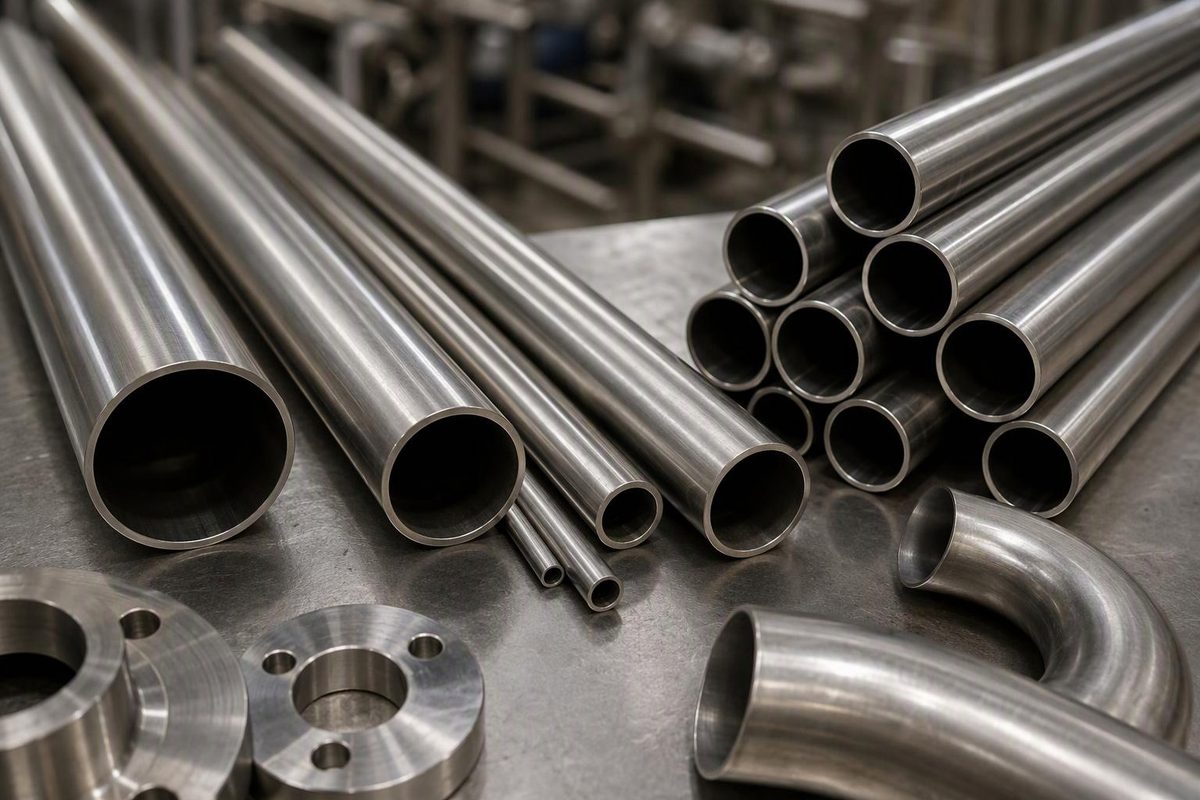
302 stainless steel is an austenitic chromium-nickel alloy identified as UNS S30200. It is closely related to 304 but permits more carbon. Annealed 302 is tough, ductile and essentially nonmagnetic; cold working increases its strength and hardness and can make it magnetic. Springs, wire forms, screens and stampings are established applications. Carpenter Technology’s 302 datasheet documents these characteristics.
For a tubing purchase, “302 stainless” identifies the alloy—not its dimensions, temper, finish, product standard or pressure capability. Those must be specified separately.
302 vs 304 and 304L
The following chemistry limits are percentages by weight for plate, sheet and strip, as reported in Allegheny Ludlum’s archived technical data under ASTM A240/ASME SA-240. They are not the measured chemistry of every heat; use the applicable standard edition for acceptance requirements.
| Grade | UNS designation | Carbon, maximum | Chromium | Nickel |
|---|---|---|---|---|
| 302 | S30200 | 0.15% | 17.00–19.00% | 8.00–10.00% |
| 304 | S30400 | 0.08% | 18.00–20.00% | 8.00–10.50% |
| 304L | S30403 | 0.030% | 18.00–20.00% | 8.00–12.00% |
Source: Allegheny Ludlum’s 302/304/304L/305 technical data.
The practical differences are:
- Cold-worked parts: 302 can be useful in temper-rolled products because its higher carbon can help meet strength requirements while retaining ductility. Compare the specified strength and elongation, not just the grade name.
- General corrosion resistance: 302 and 304 perform similarly in many environments. 302 is not a corrosion-resistance upgrade over 304.
- As-welded corrosive service: 304L is generally preferred because its lower carbon reduces susceptibility to weld-related intergranular corrosion.
These distinctions are explained in the same mill technical data. A substitution still needs approval against the drawing, service conditions and applicable product specification.
Properties depend on the supplied condition
302 is not hardenable by heat treatment. Its strength and hardness increase through cold working; solution annealing removes the effects of cold forming. Drawing or bending can also increase its magnetic response. A magnet therefore cannot reliably distinguish 302 from 304. See Allegheny Ludlum’s cold-work and heat-treatment guidance and the broader explanation of stainless-steel magnetism.
Useful reference values include:
| Property | Reference value | Qualification |
|---|---|---|
| Density | 7.90 g/cm³; 0.285 lb/in³ | Datasheet value for weight estimates |
| Tensile strength | 75,000 psi (515 MPa), minimum | Reported for annealed plate, sheet and strip |
| 0.2% offset yield strength | 30,000 psi (205 MPa), minimum | Reported for annealed plate, sheet and strip |
| Elongation | 40%, minimum | In 2 in. (51 mm), annealed plate, sheet and strip |
These values are reported in Brown Metals’ technical datasheet. Do not transfer the flat-product minimums to spring wire or tubing. Obtain the requirements and certified results for the actual product form and condition.
Welding and corrosion checks
302 can be welded by shielded fusion and resistance processes. Carpenter identifies AWS E/ER308 consumables as candidates where filler is needed—not as a substitute for a qualified welding procedure. Its higher carbon makes sensitization a concern: heating can precipitate chromium carbides at grain boundaries, leaving the material susceptible to intergranular attack in aggressive service. Carpenter’s welding guidance and Allegheny Ludlum’s welding discussion both address this risk.
Do not select 302 for seawater or hot chloride service merely because it is stainless. The mill data warn of pitting, crevice corrosion and chloride stress-corrosion cracking in the 18-8 family and recommend considering higher-molybdenum alloys for more severe conditions. Temperature, chloride concentration, crevices and stress all matter; a chloride concentration alone does not establish suitability for an assembly. Corrosion guidance.
What to specify when ordering 302 tubing
Before accepting a quotation, define:
- Material: 302 / UNS S30200, with heat or lot traceability and a material test report.
- Product specification: the standard and edition, with confirmation that the proposed grade is covered.
- Construction and condition: welded or seamless; annealed or a defined cold-worked condition; required hardness or mechanical properties.
- Dimensions: outside diameter (OD), wall thickness and length, each with tolerances. State whether wall is nominal or minimum.
- Bore requirements: for round tube, nominal inside diameter (ID) equals OD minus twice the wall; specify an ID tolerance separately if clearance is critical.
- Surface and ends: internal and external finish, roughness where relevant, weld-seam treatment, cleaning and end preparation.
- Service requirements: fluid, temperature, pressure, fabrication method and required inspection or testing.
For example, ASTM A269/A269M-25 covers designated grades of nominal-wall stainless tubing for general service and includes heat-treatment and testing requirements. Its scope does not make every austenitic alloy automatically eligible. Confirm grade coverage rather than attaching “A269” to a 302 description by assumption; the specified condition must also agree with the standard’s requirements.
Keep tube dimensions separate from nominal pipe size and schedule. Most importantly, resolve the product standard and supplied condition before using a 302 datasheet value in a design calculation.