
Flap Wheel vs Sanding Disc: Contact Shape and Access
That wheel-shaped construction makes it a useful starting point for pipe interiors, concave profiles, narrow edges, and irregular contours.
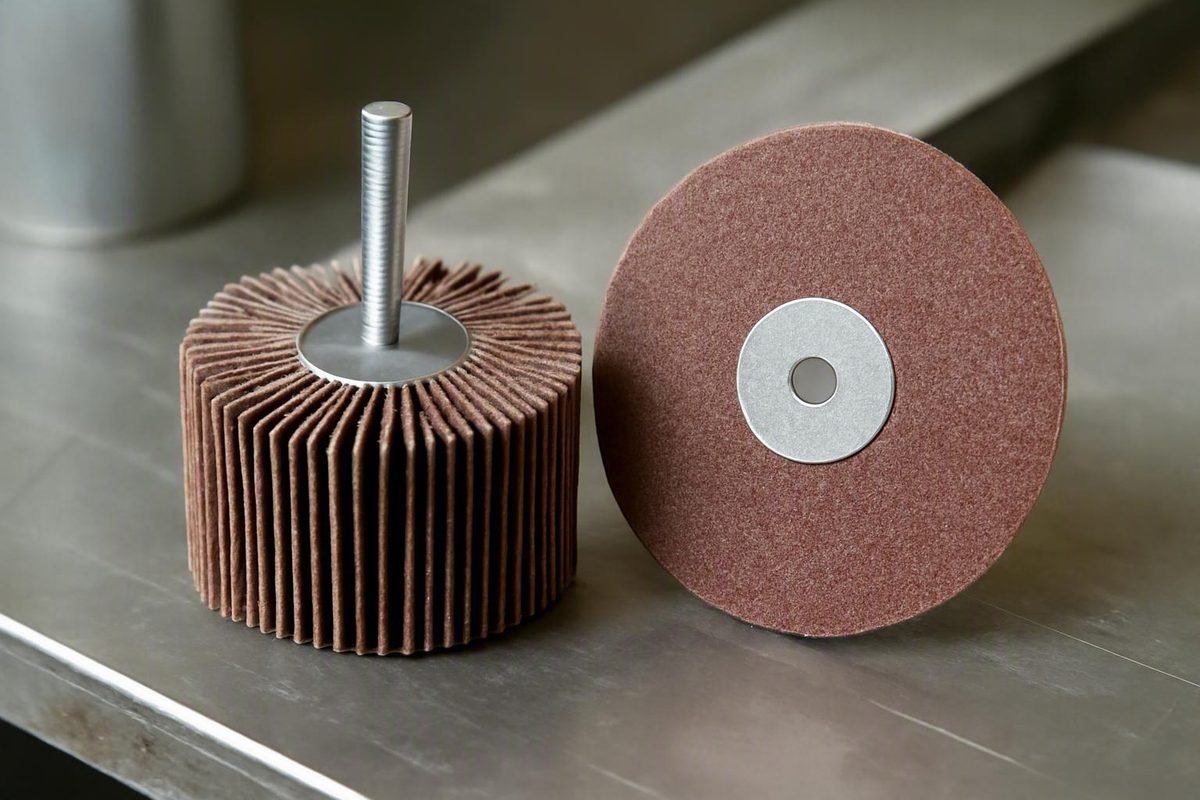
The practical answer to flap wheel vs sanding disc begins with surface geometry, not with a claim that one abrasive is universally better.
A true flap wheel presents flexible abrasive-cloth flaps around a central hub or spindle. That wheel-shaped construction makes it a useful starting point for pipe interiors, concave profiles, narrow edges, and irregular contours. A conventional sanding disc presents a flat abrasive face through a backing pad or attachment system, making it a natural starting point for broad, accessible, flat surfaces.
That distinction does not settle every job. Grit, abrasive grain, backing stiffness, flap density, tool speed, pressure, mounting system, workpiece material, and required scratch pattern can all change the result. Most available comparisons also come from abrasive manufacturers or sellers rather than controlled independent tests, so format-level claims about speed, heat, life, or cost should remain conditional.
First, Define the Products: Flap Wheel, Flap Disc, and Sanding Disc
Terminology matters
A flap wheel, flap disc, and sanding disc are different abrasive constructions. Advice for one should not automatically be applied to another, even when operators or suppliers use “wheel” and “disc” loosely.
A true flap wheel consists of multiple pieces of abrasive cloth arranged radially around a central hub, core, or spindle. It has a cylindrical or wheel-shaped working surface rather than a broad, flat face. Depending on its dimensions and mounting arrangement, it can work along profiles, inside cylindrical openings, or against curved and irregular surfaces. Kimball Midwest’s product overview likewise distinguishes cylindrical-core flap wheels from disc-shaped abrasives and identifies internal, curved, and hard-to-reach areas as typical flap-wheel applications (see its wheel-and-disc guide).
A conventional sanding disc is a flat abrasive layer used with a compatible backing pad or attachment system. It can include:
- Hook-and-loop discs
- Pressure-sensitive adhesive discs
- Paper-backed discs
- Cloth-backed discs
- Resin-fiber discs
- Other product-specific coated-abrasive formats
A useful subtype breakdown is:
| Sanding-disc subtype | Typical support or attachment | Selection implications |
|---|---|---|
| Hook-and-loop | Compatible backing pad | Convenient changes; behavior depends heavily on pad firmness and tool motion |
| Pressure-sensitive adhesive | Smooth compatible pad | Requires the specified adhesive-compatible support |
| Paper-backed | Product-specific pad or sander | Common for smoothing and surface preparation; backing flexibility varies |
| Cloth-backed | Product-specific pad or attachment | Can provide different flexibility and durability from paper-backed products |
| Resin-fiber | Firm backing pad and compatible grinder system | Flat, single-layer construction commonly associated with assertive metal removal and preparation |
A flap disc is separate again. It has overlapping abrasive flaps attached across a backing plate and is generally intended for an appropriate angle grinder. Its flaps lie across a disc-shaped backing rather than radiating from a cylindrical hub. Commercial comparisons identify flap discs as distinct from both conventional flat sanding discs and wheel-shaped flap products (see Red Label Abrasives’ construction comparison).
Their mounting systems, working surfaces, and approved machines can differ.
The short selection rule is:
- Begin with a flap wheel for pipe and tube interiors, internal curves, concave areas, narrow profiles, and irregular contours.
- Begin with a sanding disc for broad, accessible, flat surfaces.
This is a geometry-based starting point, not a universal ranking for removal rate, finish quality, service life, cost, or safety.
How Construction Changes Contact with the Workpiece
A flap wheel contacts the work through multiple individual flaps. As the wheel rotates, each flap reaches the surface, flexes under contact, and moves away. This repeated flexing allows the abrasive to accommodate gradual changes in curvature and reach portions of a profile that a broad, flat disc may contact only at its edge.
Not every flap wheel is equally conformable. Flap length, density, cloth backing, wheel diameter, wheel width, wear condition, and the amount of unsupported flap can all affect how the product follows a shape. A densely packed or stiffly backed wheel may feel comparatively firm, while a more flexible construction can follow a contour more readily.
Flap wear can also expose additional abrasive as the product is used. That progressive exposure may help maintain cutting action, but it does not prove that every flap wheel will outlast every sanding disc. Product design, grit, pressure, workpiece material, loading, and the operator’s acceptance point all affect usable life.
A sanding disc works through a flat abrasive layer supported by a pad or attachment surface. On an open panel, that arrangement provides broad contact and makes it practical to cover the work with systematic, overlapping passes. The support beneath the disc influences the result:
- A firmer pad generally resists deformation and concentrates the disc’s action.
- A more flexible pad can follow gentle surface variation more readily.
- Product-specific backing and attachment requirements determine which combinations are suitable.
- Tilting a flat disc changes its contact patch and can concentrate the cut into a smaller area.
Contact area and pressure are closely related. That is one reason format alone cannot predict cutting speed or finish.
Flexibility also does not prevent workpiece damage.
Both formats are available in multiple sizes, constructions, and grits. The words “wheel” and “disc” identify basic geometry, not a complete performance specification. First determine which abrasive surface can contact the work correctly; then narrow the choice by product construction and operating requirements.
Flap Wheel vs Sanding Disc at a Glance
| Selection factor | Flap wheel | Conventional sanding disc |
|---|---|---|
| Construction | Abrasive-cloth flaps radiating around a hub, core, or spindle | Flat abrasive layer used with a compatible pad or attachment system |
| Primary contact shape | Narrow radial face that can flex along a profile | Broad, flat face |
| Starting geometry | Pipe interiors, internal curves, concave profiles, narrow areas, irregular edges | Open panels, broad flat faces, accessible sheet and plate |
| Access | Can reach some cylindrical, recessed, or confined surfaces | Requires clearance for the disc face, pad, and machine |
| Typical attachment | Product-specific shank, spindle, hub, bore, or arbor | Hook-and-loop, adhesive, center hole, locking attachment, or product-specific pad and arbor |
| Common tasks | Deburring, cleaning, profile smoothing, internal finishing, edge work, matching some linear finishes | Leveling, routine smoothing, coating removal, broad preparation, pre-finish sanding |
| Likely scratch direction | Often directional or linear along the wheel’s travel | Commonly circular, arced, or overlapping, depending on the machine |
| Initial price tendency | May have a higher unit price than a simple sanding disc | Seller comparisons commonly report a lower initial price, but constructions vary widely |
| Major limitations | Limited coverage on large flat areas; poor control can alter an edge or profile | May not contact internal or sharply curved geometry evenly; requires the specified support system |
The price tendency in the table is seller-reported, not a controlled cost-per-job finding. One commercial comparison says conventional sanding discs generally cost less upfront while also noting substantial variation among products (Red Label Abrasives).
Both formats can remove material, blend defects, or create a finer finish when their grit and construction suit the work. Neither belongs exclusively to “grinding” or “finishing.”
Useful flap-wheel starting applications include:
- Pipe and tube interiors
- Concave fabricated profiles
- Irregular or radiused edges
- Narrow areas with adequate machine clearance
- Deburring and cleaning
- Internal finishing
- Reproducing some directional or brushed appearances
Useful sanding-disc starting applications include:
- Flat sheet, plate, and panels
- Broad surface preparation
- Paint or varnish removal with a suitable product
- Joint or surface leveling
- Routine smoothing
- Preparation for paint, coating, polishing, or another finishing stage
Do not assume either product is inherently faster, more aggressive, cooler, safer, or longer-lasting. Those outcomes depend on the actual abrasive, backing, machine, material, and technique.
A reliable geometry-first selection sequence is:
- Identify the accessible surface shape. Is it broad and flat, cylindrical and internal, gently curved, sharply contoured, or confined?
- Identify the machine and mounting system. Determine which products the machine and abrasive documentation allow.
- Define the task. Decide whether the operation is coating removal, deburring, leveling, blending, scratch refinement, or finish matching.
- Choose grit and grain. Select a product approved for the workpiece and appropriate to the required cut.
- Test the process. Check access, scratch direction, loading, edge retention, and appearance on scrap or an inconspicuous area.
If neither format provides the required access or finish, a belt, cartridge roll, nonwoven abrasive, hand abrasive, or another purpose-designed product may be a better candidate.
Choose by Job: Pipes, Flat Panels, Edges, Welds, and Coatings
Pipe or tube interiors
For the inside of a pipe or tube, evaluate a correctly sized flap wheel first. Its radial flaps can contact a cylindrical interior where the face of a broad sanding disc cannot sit properly. Abrasive suppliers commonly distinguish wheel-shaped products from flap discs on this basis and identify pipes, tubes, and other internal areas as typical flap-wheel applications (Benchmark Abrasives’ comparison).
The wheel still has to match the operation. Confirm from the product markings and machine instructions:
- Wheel diameter and width
- Shank, spindle, hub, or bore dimensions
- Approved machine type
- Marked maximum speed
- Available clearance and insertion depth
- Required surface finish and scratch direction
A wheel should not be selected merely because it can be pushed into the opening. The correct size must provide usable contact while remaining compatible with the intended mounting system and machine.
Broad flat panels
For a large, accessible panel, evaluate a compatible sanding disc. Its flat face provides wider coverage and supports controlled, overlapping passes across sheet, plate, wood, or another approved substrate.
The exact disc subtype matters. A paper-backed hook-and-loop disc may suit routine smoothing, while a cloth or resin-fiber construction may be intended for a different machine and removal level. Pad firmness, machine motion, grit, and pressure can all change whether the disc levels high spots, follows gentle variation, or leaves an uneven pattern.
Outside curves and irregular fabricated edges
A flap wheel may follow an outside curve or changing fabricated edge more readily than a broadly supported sanding disc. It is especially useful where a flat disc would contact the work only through a narrow portion of its face.
Begin with controlled contact and test the selected grit on scrap or an inconspicuous area. A flexible product can still alter a crisp corner or existing radius, and its directional scratch pattern may remain visible after subsequent finishing.
Rust or coating removal
For removable rust, paint, or varnish on an open flat surface, a compatible sanding disc is a practical starting point. Choose the disc construction and grit according to both the coating and the substrate rather than assuming that the same product suits every finish.
If the coating or substrate requires special handling, exposure controls, or disposal procedures, follow the applicable product information and workplace process before disturbing it. The abrasive format alone does not establish those requirements.
Narrow-profile deburring and cleaning
A suitably sized flap wheel is often the more practical starting point for deburring a narrow profile, cleaning a shaped edge, or smoothing a location that a full sanding-disc face cannot reach.
Match wheel width and diameter to the accessible profile. This is preferable to choosing an oversized product and trying to perform the entire operation through a small, unintended contact area.
Weld blending
For weld blending, divide the decision by access and required finish:
- On an accessible broad weld, a suitable sanding disc may provide useful coverage when the surrounding surface is flat.
- On a weld inside a tube, along a concave transition, or within confined geometry, a flap wheel may contact the shape more effectively.
- For substantial stock removal, evaluate whether a different purpose-designed abrasive should perform the initial reduction before either format is used for refinement.
The objective should be defined before work begins. Removing a visible weld profile, blending surrounding scratches, and matching a decorative finish are different operations and may require different products or grit stages.
Finish matching
Scratch direction can matter as much as nominal smoothness. Many flap-wheel operations produce a directional, linear, or brushed appearance, while rotating disc formats commonly produce circular or overlapping patterns. United Abrasives makes the same distinction when comparing the linear appearance associated with flap wheels and the more circular pattern associated with disc-shaped flap products (its finishing guide explains the pattern difference).
Neither format guarantees an exact appearance. Existing finishes vary in direction, line spacing, depth, and reflectivity. Use a planned grit sequence, maintain consistent travel where direction matters, and make a test panel before working on a prominent finished surface.
Removal Rate, Finish, Grit, and Abrasive Grain
Lower grit numbers generally indicate coarser abrasive particles and more assertive material removal. Higher grit numbers generally indicate finer particles and a more refined scratch pattern.
Treat grit selection as a process rather than a one-number answer:
- Select a grit capable of removing the defect, coating, or previous scratch.
- Avoid starting so coarse that unnecessary deep scratches are introduced.
- Progress through finer grits in manageable steps.
- Remove the previous stage’s scratch pattern before advancing.
- Stop when the functional or visual finish requirement is met.
Supplier guidance for flap discs, grinding wheels, and resin-fiber discs uses 40–60 grit as an example for removal or blending and 80–120 grit for a smoother finish. These are examples from adjacent product categories, not universal prescriptions for every true flap wheel or sanding disc (Benchmark Abrasives’ grit progression).
Nominal grit is only one variable. Performance also depends on:
- Abrasive grain
- Grain distribution and coating
- Backing material and stiffness
- Flap density and geometry
- Backing-pad characteristics
- Machine speed
- Applied pressure
- Contact area
- Workpiece condition
- Abrasive loading and wear
- Operator movement and dwell time
Available abrasive-grain families include aluminum oxide, zirconia, ceramic, and silicon carbide. These are broad families rather than interchangeable specifications. Product design, bond, backing, and approved applications matter, so no one grain should be treated as universally best for every material.
Pressure changes the cutting action. If an abrasive cuts only under heavy force, check the product’s condition, grit, speed requirements, and material compatibility rather than assuming more pressure is the correct remedy.
Commercial comparisons also disagree about which construction is more aggressive. One flap-wheel supplier characterizes flap wheels as more aggressive than sanding discs, while comparisons involving resin-fiber discs sometimes favor the flat disc for rapid removal. These are not controlled grit-for-grit tests of equivalent products. Differences in grain, backing, speed, pressure, and contact geometry can account for different conclusions.
The available evidence therefore does not establish a universal winner for:
- Removal rate
- Finish quality
- Heat generation
- Gouging or surface-damage risk
- Abrasive life
- Cost per completed job
Compare actual candidate products under similar operating conditions rather than choosing from a format-level promise.
Material Considerations: Steel, Stainless, Aluminum, Wood, and Coatings
Abrasive format alone does not establish material compatibility. A flap wheel is not automatically suitable for every metal, and a sanding disc is not automatically appropriate for every surface a sander can reach. Use the product label and technical information for the specific accessory.
Steel and stainless steel
For steel or stainless fabrication, begin with surface geometry and the required finish, then choose an abrasive explicitly approved for the workpiece and operation.
Relevant selection questions include:
- Is the surface internal, contoured, or flat?
- How much material may be removed?
- Is scratch direction important?
- Is the surface decorative or dimensionally controlled?
- Which grain, backing, and grit does the product specify?
- Does the fabrication procedure impose contamination controls?
- What downstream finishing steps will follow?
Do not infer suitability for a particular alloy or finish merely because a product has worked on another steel component.
Aluminum
Aluminum can load an abrasive when frictional heat contributes to removed metal adhering to the cutting surface. Excessive pressure can worsen that behavior. National Abrasives advises selecting aluminum-compatible products, applying light pressure, monitoring loading, and keeping abrasives used for aluminum separate where cross-contamination matters (its aluminum abrasive guide).
For aluminum work:
- Use a product explicitly approved for aluminum.
- Apply controlled pressure rather than forcing the cut.
- Monitor the abrasive for metal buildup.
- Stop and reassess if loading or surface damage develops.
- Keep aluminum abrasives identified and separate when the work procedure requires contamination control.
- Follow the product manufacturer’s instructions for any grinding aid or lubricant rather than improvising.
These points do not establish that one abrasive format is always best for aluminum. Disc or wheel size, grit, backing, task, and approved machine remain part of the selection.
Wood, plastic, and composites
Sanding discs are offered for wood, plastic, and other nonmetallic materials, but suitability remains product-specific. The selected disc, machine, backing system, speed, substrate, and extraction arrangement must be considered together.
Do not transfer metalworking settings automatically to nonmetallic materials. Likewise, the existence of a flexible flap wheel does not establish that it is approved for a particular wood, plastic, or composite operation.
Paint and other coatings
A sanding disc can be useful for coating removal on a flat surface, but the approach depends on the coating, substrate, and product instructions. A disc that works effectively on bare material may behave differently when exposed to paint, varnish, resin, or adhesive.
Determine the coating and required workplace controls before beginning the operation. Then choose the least aggressive practical grit and a disc construction approved for both the substrate and the intended machine.
Product-label checklist
Before choosing either format, check the label, packaging, and technical information for:
- Approved workpiece materials
- Abrasive grain
- Grit
- Backing or flap construction
- Diameter and width
- Arbor, shank, hub, bore, or attachment method
- Required backing pad
- Maximum RPM
- Approved machine types
- Rotational direction, if marked
- Prohibited uses
- Product-specific inspection, storage, and operating instructions
If the product and machine documentation do not establish compatibility, physical fit alone is not enough to make the selection.
Tool Fit and Setup: Check Before Either Abrasive Touches the Work
The suitable abrasive is one approved for the intended machine and mounting system—not simply one that can be made to attach.
For a flap wheel, verify from the exact product information:
- Wheel diameter and width
- Hub, bore, spindle, or shank dimensions
- Approved machine type
- Mounting arrangement
- Rotational direction, if marked
- Maximum rated speed
- Clearance required for the operation
Flap wheels are made in different mounting configurations. A product intended for one machine or spindle arrangement should not be assumed suitable for another.
For a sanding disc, verify:
- Disc diameter
- Required backing pad or support
- Arbor, center hole, locking feature, adhesive, or hook-and-loop system
- Approved machine
- Maximum rated speed
- Intended contact method
- Any product-specific guard or mounting instructions
Do not omit a backing pad or attachment component that the disc manufacturer specifies. Product approval depends on the complete system, not on the abrasive layer alone.
Marked maximum RPM is a limit. Benchmark’s flap-wheel guidance instructs users to inspect the accessory, remain within the manufacturer’s recommended RPM, and use eye or face, hand, and hearing protection; those instructions apply within the scope of the products covered by that manufacturer’s guidance, not automatically to every sanding-disc configuration (Benchmark Abrasives).
Pre-start checklist
Because machines and abrasive systems vary, the exact pre-start procedure must come from the relevant tool and accessory instructions. At minimum, use those documents to confirm:
- The machine is in the required safe state before an accessory is changed.
- The abrasive and mounting components show no disqualifying damage or wear.
- The accessory is installed using the specified hardware and method.
- The workpiece and work area are prepared as the machine instructions require.
- Required guards and protective equipment are in place.
- The marked speed and machine configuration are compatible.
- The operator follows any product-specific start-up or test-run procedure.
This checklist is a prompt to consult the applicable instructions, not a universal replacement for them.
Flap-disc sidebar: Type 27 and Type 29 only
Type 27 and Type 29 designations and working-angle guidance refer to flap discs used on suitable angle grinders—not automatically to spindle-mounted flap wheels or conventional sanding discs.
Norton specifies 0°–15° for Type 27 flap discs and 15°–25° for Type 29 flap discs. Its flap-disc guidance also calls for pre-use inspection, speed compatibility, disconnection of power before disc changes, and retention and correct positioning of the grinder guard. Follow the markings for the exact product because these instructions do not transfer automatically to other abrasive formats (Norton’s flap-disc safety guidance).
Cost, Service Life, and Safety: Make a Conditional Choice
Commercial comparisons commonly report that simple sanding discs have a lower initial purchase price, while flap constructions can expose additional abrasive as their flaps wear and may provide longer usable life in some applications. The same seller guidance does not provide controlled cost-per-job, lifespan, removal-rate, or downtime measurements, so it cannot establish the more economical format overall.
Unit price is therefore a weak purchasing metric. Compare cost per completed surface by recording:
- Purchase price per abrasive
- Number of abrasives consumed
- Changeover time
- Area or number of parts completed
- Total operating time
- Rework or rejected parts
- Additional grit stages required
- Whether the final surface met the specification
- Operator observations about loading and control
For a useful shop trial, hold as many variables constant as practical:
- Workpiece material and dimensions
- Starting surface condition
- Abrasive-grain family
- Nominal grit
- Machine and operating speed
- Applied pressure
- Contact time
- Travel pattern
- Finish target
- Operator or documented technique
Different constructions will still not become identical, but a controlled shop comparison is more informative than unrelated vendor claims.
Baseline safety controls
Safety requirements must be taken from the exact abrasive instructions, machine manual, workplace procedure, and applicable rules. Product-specific manufacturer guidance supports inspecting abrasives before use, staying within marked speed limits, and using the protective equipment specified for the operation. Norton’s flap-disc guidance, for example, says not to use dropped or damaged flap discs and identifies impact-resistant eye and face protection, gloves, hearing protection, protective clothing, footwear, and respiratory protection where harmful material may be produced. Those requirements are directly applicable to the flap discs covered by that guidance and illustrate why instructions must remain format- and product-specific.
The workpiece and any coating also affect the required controls. Determine what material is being removed and follow the relevant technical and workplace requirements.
The final decision rule is straightforward: choose the format that fits the geometry and an approved tool, then optimize grit, grain, pressure, speed, and technique. A properly specified flap wheel is generally the better starting point for pipe interiors, tight profiles, curves, and irregular surfaces. A compatible sanding disc is generally the better starting point for broad, flat work.
There is no overall winner. Claims about universal aggression, cooler cutting, longer life, better finish, or lower cost should remain conditional until comparable products are evaluated under the same conditions.
Frequently Asked Questions
Is a flap wheel the same as a flap disc?
No. A flap wheel has abrasive-cloth flaps arranged radially around a central hub, core, or spindle, creating a wheel-shaped or cylindrical working surface. A flap disc has overlapping flaps attached across a backing plate and is generally designed for an appropriate angle grinder.
Do not apply Type 27 or Type 29 flap-disc angle guidance to a spindle-mounted flap wheel. Use the mounting, speed, machine, and operating instructions for the exact product.
Which is better for sanding inside stainless-steel pipe or tubing?
A correctly sized flap wheel is usually the better starting point because its radial flaps can contact the cylindrical interior more readily than a flat sanding disc. It may also suit a directional finish when the selected product and technique produce the required scratch pattern.
Confirm wheel diameter and width, mounting dimensions, approved machine, marked maximum speed, material compatibility, and finish requirements before use. Test the process before working on a visible or dimensionally controlled tube.
Does a flap wheel last longer than a sanding disc?
It may in some applications because flap wear can expose additional abrasive. Available seller guidance does not establish that every flap wheel lasts longer than every sanding disc.
Usable life depends on grain, grit, backing, flap density, speed, pressure, material, loading, contact method, and the point at which the abrasive no longer produces an acceptable result. Compare cost per completed part or surface rather than abrasive life alone.
What grit should I use for material removal, blending, and finishing?
Supplier guidance for adjacent abrasive categories uses 40–60 grit as an example for removal or blending and 80–120 grit for finer finishing. These ranges come from guidance covering flap discs, grinding wheels, and resin-fiber discs—not controlled guidance for every true flap wheel and sanding-disc subtype (Benchmark Abrasives).
Begin only as coarse as necessary, then progress through finer grits until the previous scratch pattern is removed and the finish requirement is met. Equal grit labels can behave differently across grains, backings, tools, speeds, pressures, and materials.
Can I put a flap wheel or sanding disc on any grinder or drill?
No. Physical fit does not establish compatibility.
For a flap wheel, verify the approved machine, wheel dimensions, shank or hub arrangement, rotational direction if marked, and maximum RPM. For a sanding disc, verify the required backing pad, attachment method, diameter, machine, and speed rating. Follow the exact abrasive and machine instructions rather than improvising a mounting arrangement.