
Stainless Tube Cutter: Match OD, Wall and End Preparation
Compare stainless tube cutter capacities, choose wheel cutting or sawing, and prepare square, deburred ends for fittings or welding.
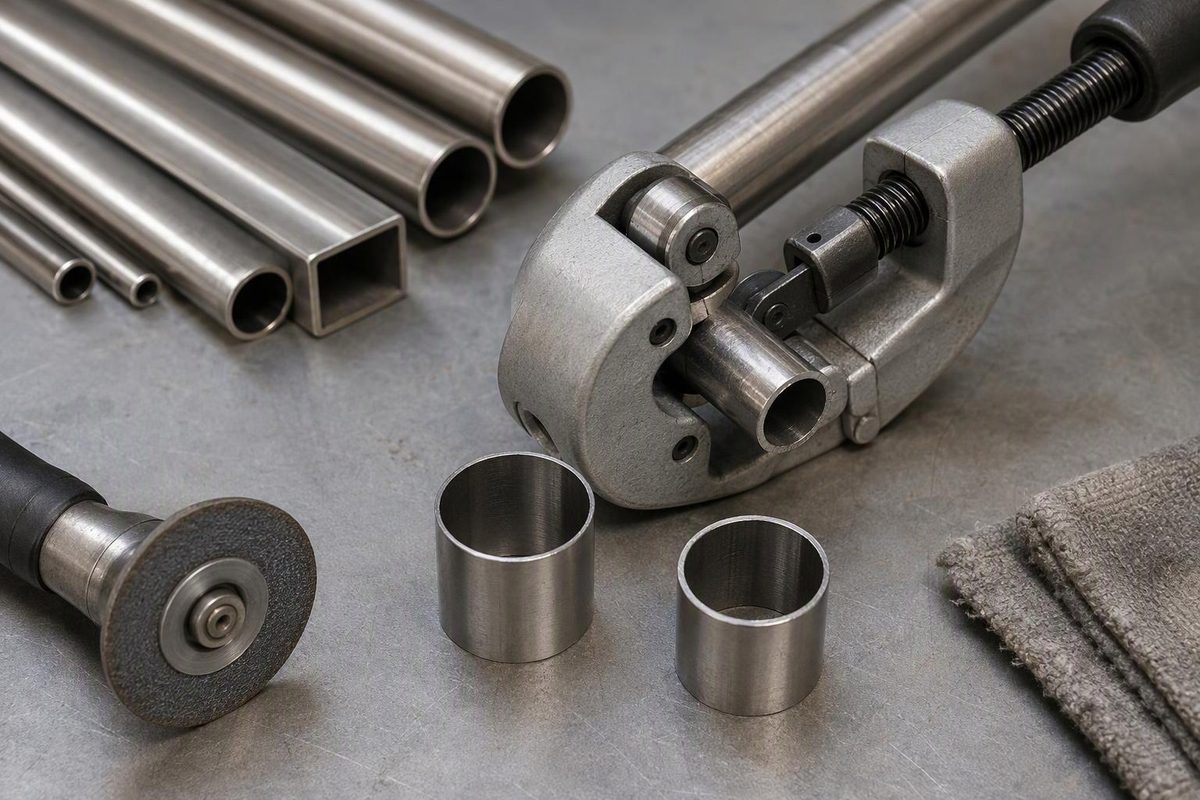
For round stainless tubing, choose a tube cutter explicitly rated for stainless steel and for the tube’s actual outside diameter (OD). Then verify suitability for the wall thickness and material condition. A diameter capacity alone does not establish that a cutter will handle every wall or stainless alloy within that range.
A hand wheel cutter is a practical starting point when it fits the tube and can rotate around it. For very small diameters, thick walls or tubing beyond the cutter’s capacity, Swagelok Northern California recommends a hacksaw instead. Use a guide to keep the cut square. Neither method eliminates the need to inspect, deburr and clean the end. Tube preparation guidance
Check the tube before choosing the tool
Keep these purchase details separate:
- OD: the dimension that must fall within the cutter’s diameter range. Do not select from a nominal pipe size or schedule alone.
- Wall thickness: a separate compatibility check; a large opening is not a heavy-wall rating.
- Grade and condition: identify the actual stainless grade and whether the tubing is annealed or hardened, rather than specifying only “stainless.”
- Finish: identify any surface that must remain unscratched, especially where a fitting will seal or grip.
- Required end preparation: a cut for a compression fitting is not automatically ready for a precision butt weld.
Swagelok emphasizes OD, wall and material when selecting tubing, and calls for inspection for scratches, dents and loss of roundness before preparation. Its sawing guide is designed to hold tubing without distorting or scratching it. Preparation checks; tool catalog
Published hand-cutter capacities
These are manufacturer-listed examples, not a performance ranking. Capacities and replacement-wheel references were checked on October 19, 2026.
| Cutter | Published inch capacity | Published metric capacity | Replacement cutting wheel |
|---|---|---|---|
| RIDGID 35S | 1/4–1 3/8 in. | 6–35 mm | E-635; catalog no. 29973 |
| RIDGID 65S | 1/4–2 5/8 in. | 6–67 mm | E-635; catalog no. 29973 |
| Swagelok MS-TC-308 | 3/16–1 in. OD | 6–25 mm OD | MS-TCW-308 |
The inch and metric entries reproduce the manufacturers’ published ranges; they are not exact conversions. Sources: RIDGID stainless tubing cutters and Swagelok tubing tools catalog.
These capacity entries do not supply a maximum stainless cutting-wall thickness. Confirm that limit for your tube rather than borrowing a wall rating from a bender or facing tool in the same catalog. Also check clearance for the cutter body and handle throughout a full rotation.
For example, an inquiry for 1/2 in. OD × 0.049 in. wall, annealed 316L round tubing should include all those details—not just “a cutter for half-inch stainless.” Ask for confirmation of compatibility and the correct replacement wheel.
Cut with controlled wheel feed
Use appropriate protective equipment, including gloves and safety glasses, as recommended in Swagelok Northern California’s preparation guidance.
A wheel cutter displaces material rather than removing it as chips. Swagelok’s manual explains that a dull wheel can expand and work-harden the tube end; replace it when cutting becomes difficult or the end begins to expand. Tube Fitter’s Manual, tube preparation section
For the Swagelok cutter, the published procedure is:
- Measure and mark the cut; position the tube between the rollers and wheel.
- Bring the wheel into contact, then advance the handle 1/16 turn.
- Rotate around the tube, advancing another 1/16 turn after every second rotation for stainless.
- Continue until the tube separates.
Those increments are tool-specific, not a universal instruction for every cutter. Follow the selected manufacturer’s feed procedure. Swagelok cutting instructions
If using a hacksaw, Swagelok specifies a square cut, a tube sawing guide and a blade with at least 24 teeth per inch. Check that the guide also accommodates your tube’s OD. Hacksaw guidance
Inspect the end—not just the cut length
Check the end for squareness, burrs, flare-out, ovality and surface damage. Remove ID burrs and any OD burrs, then clean away debris. Swagelok warns that OD burrs can prevent full fitting insertion, while loose ID burrs can damage downstream valves or seals. Deburring requirements
For compression connections, follow the fitting manufacturer’s preparation and insertion requirements; see stainless compression fitting compatibility. For precision butt-weld preparation, assess whether a facing operation is required: Swagelok’s facing tools are specifically designed to produce flat, smooth, square, burr-free and chamfer-free ends. Accept the end against the applicable weld-preparation requirements, not appearance alone. End-facing guidance