
Stainless Compression Fittings: Size, Tube Compatibility and Assembly
Select stainless compression fittings by tube OD, wall, hardness and connection type. Check inch–metric fit, pressure limits and assembly instructions.
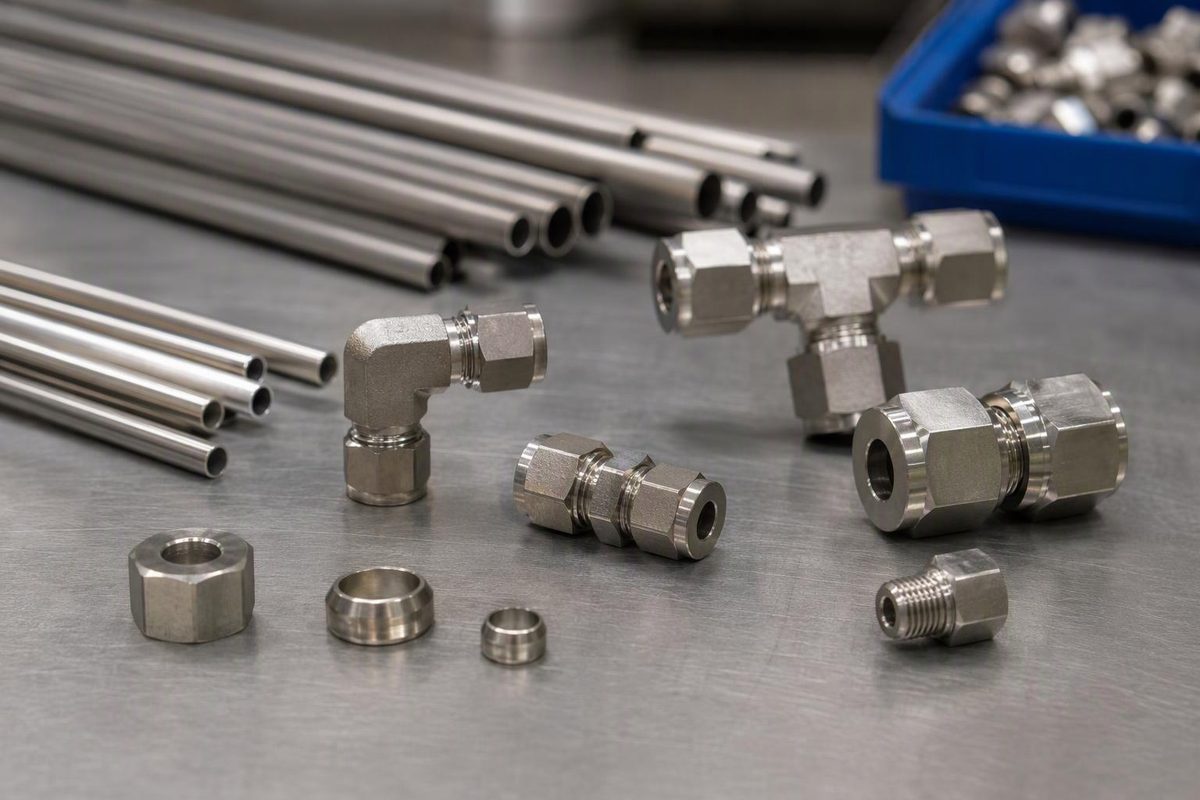
Select the tube end by actual tube outside diameter (OD), then verify wall thickness, material, hardness and surface condition against the fitting manufacturer’s requirements. Identify the other end independently: a tube-to-NPT connector has two different sizing systems, even when both ends say “1/4 inch.”
This guide covers ferrule-type stainless compression fittings for instrumentation and process tubing. Their compatibility depends on the complete tube-and-fitting combination—not simply whether the tube slides into the nut.
Read both connection sizes
A 1/4-inch tube OD × 1/4-inch male NPT connector accepts nominal 0.250-inch OD tubing at one end and connects to a matching female NPT port at the other. Swagelok’s SS-400-1-4 is one documented example, with a 316 stainless body. The NPT designation is a nominal thread size, not the tube OD. Product specifications
Keep inch and metric tube sizes separate:
| Tube specified | Nominal OD in millimeters | Tube-end size to order |
|---|---|---|
| 1/4 in. OD | 6.35 mm | 1/4 in. |
| 6 mm OD | 6.00 mm | 6 mm |
| 3/8 in. OD | 9.525 mm | 3/8 in. |
| 10 mm OD | 10.00 mm | 10 mm |
| 1/2 in. OD | 12.70 mm | 1/2 in. |
| 12 mm OD | 12.00 mm | 12 mm |
These are nominal dimensions and exact unit conversions, not acceptance tolerances. Near sizes are not substitutes. Parker lists separate imperial and metric tube ends in its tube-end dimensional data.
Wall thickness is a separate specification. For round tube, nominal ID = OD − 2 × wall: 1/4-inch OD × 0.035-inch wall gives a nominal 0.180-inch ID. The fitting still sizes to the 1/4-inch OD; ID describes the tube bore.
For an unidentified threaded port, use the NPT size identification guide rather than transferring the tube measurement to the thread designation. Pipe schedules do not identify a compression tube-end size.
What the ferrules do
Tightening the nut drives the ferrule or ferrules into the fitting seat, producing a seal and a mechanical grip on the tube. In Parker’s two-ferrule A-LOK design, the front ferrule seals against the tube and body while the back ferrule provides the mechanical hold. Its single-ferrule CPI design combines those functions in one ferrule. Both are offered for instrumentation service; ferrule count alone is not a pressure rating. Parker design descriptions
Do not build a connection from look-alike nuts, bodies and ferrules from different brands. Matching threads do not establish compatible sealing geometry. Swagelok expressly prohibits mixing or interchanging its tube-fitting end connections with other manufacturers’ components. Manufacturer warning
Check the tube before buying the fitting
The tube is part of the sealing system. Verify these fields:
- Grade and condition: Specify the alloy and annealed condition separately. Parker’s catalog identifies seamless and welded-redrawn, fully annealed 304, 316 and 316L tubing as compatible with its stainless CPI/A-LOK fittings. That does not establish chemical suitability for every fluid.
- Hardness: Swagelok specifies a maximum of 90 HRB or 200 HV for its recommended stainless tubing. Parker also lists 90 HRB maximum and recommends softer tubing, around 80 HRB, for improved gas-service results.
- Wall thickness: Use the selected manufacturer’s approved OD–wall combinations. A thicker wall is not automatically acceptable if it falls outside the fitting’s listed range.
- Surface and tolerances: Keep the sealing region free of scratches and verify OD and ovality. Swagelok notes that some tubing’s permitted ovality can prevent it from fitting its precision tube fittings.
These requirements are documented in Swagelok’s tubing data sheet and Parker’s tubing selection and ordering guidance. A grade label or decorative finish alone is insufficient.
Pressure and temperature belong to the complete assembly
Do not assign one working pressure to all “316 stainless compression fittings.” Check the tube’s OD, wall and manufacturing route, the fitting configuration, both end connections and operating temperature. Parker specifically notes that a pipe-thread end may limit the connection rating and rates tube-to-pipe fittings to the lower applicable pressure. Its tables also provide elevated-temperature derating factors. Pressure-rating guidance
For gas service, consult the manufacturer’s gas-service wall selections rather than relying only on a liquid pressure value. Swagelok calls for additional attention to tube wall and surface condition because the ferrules must seal potential leak paths. Gas-service guidance
Assembly: use the exact series instructions
Cut the tube square, deburr and clean it, and fully seat it against the body shoulder. Hold the body steady while tightening the nut. Preparation and assembly guidance Provide the required straight tube length near bends and support the tubing against movement. Tubing installation guidance
Do not substitute a generic torque or “tight enough” judgment for the prescribed procedure. For example, standard initial assembly of a new 1/4-inch Swagelok tube fitting requires 1¼ nut turns from finger-tight, whereas its 1/16-, 1/8- and 3/16-inch sizes require ¾ turn. For high-pressure applications and high safety-factor systems, the guide specifies further tightening until the tube cannot turn by hand or move axially before marking the nut and counting those turns. Sizes over 1 inch/25 mm require hydraulic preswaging and a different final tightening procedure. These instructions are product-specific, not a rule for every compression fitting. Installer’s pocket guide
Ferrule-type tube connections seal without thread sealant; do not add it to compensate for a leaking joint. Parker tube-connection guidance Tapered pipe threads require their specified sealant. Initial assembly and reassembly are different procedures: do not repeat the initial full-turn instruction on an already swaged connection. Swagelok’s gap gauge checks initial tightening, not reassembled fittings. Always depressurize before adjusting or disconnecting a fitting—never vent by loosening its nut. Assembly and safety instructions
Write an order that can be checked
A useful purchase description separates the fitting from the tube:
316 stainless male connector, specified manufacturer and ferrule series, complete with matching nut and ferrules; 1/4-inch tube OD × 1/4-inch male NPT. For use with fully annealed seamless 316 stainless tubing, 0.250-inch OD × 0.035-inch wall, ASTM A269, hardness and dimensional tolerances meeting the selected fitting manufacturer’s requirements, free of scratches in the sealing region.
This example specifies seamless tubing; if selecting welded-and-drawn tubing instead, state that route and verify its applicable pressure rating. Add the fluid, design pressure, temperature range, quantity, cleanliness and traceability requirements. Obtain confirmation of the exact tube-and-fitting combination’s suitability before treating that description as an approved pressure-system specification.