
Stainless Pipe Clamps: OD, Grade and Load Selection
Compare pipe and tube diameters, check a clamp’s fit range, and specify stainless grade, liner limits and load direction before ordering pipe supports.
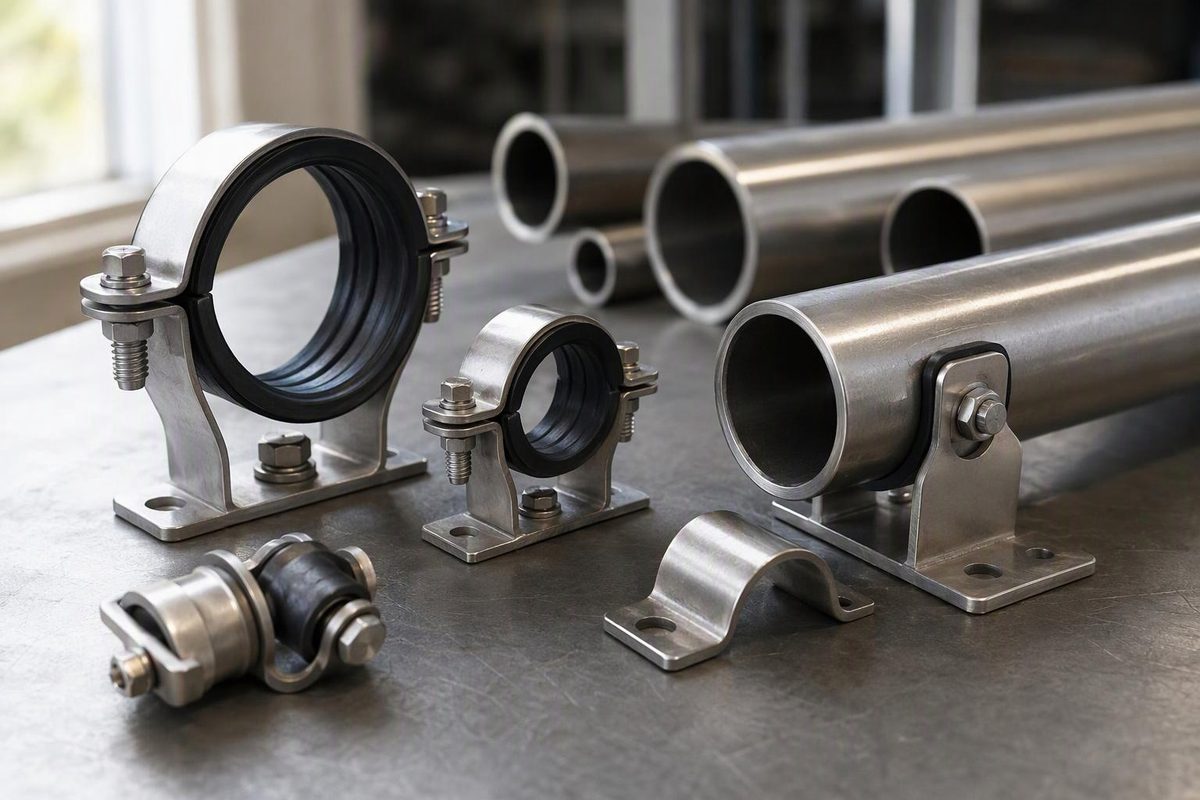
Choose stainless pipe clamps by actual outside diameter (OD), support function and rated load—not by the inch label alone. NPS 1 pipe has a nominal OD of 1.315 in. (33.40 mm); tubing specified as 1 in. OD is 1.000 in. (25.40 mm). A clamp labeled “1 inch” therefore needs its dimensional sheet checked. National Pipe Hanger’s catalog also distinguishes pipe dimensions from nominal copper-tube dimensions. Source: manufacturer dimensional tables.
Enter your pipe OD in millimetres to check the dimensional fit of Walraven model 31179035.
Walraven 31179035 OD Fit Check
Dimensional range: 32–36 mm. This checks fit only, not support capacity.
Use the measured OD, not the nominal inch label. Example: NPS 1 is 33.40 mm; 1 in. OD tube is 25.40 mm.
33.40 mm is within 32–36 mm, including the endpoints.
Fit does not establish suitability. Verify load direction, temperature, liner compatibility and installation instructions.
Model Specifications and Limits
- Model
- 31179035
- Metal grade
- AISI 316
- Pipe OD range
- 32–36 mm
- Mounting thread
- M8/10
M8/10 is the mounting connection, not the pipe size. This lined model’s range must not be applied to other clamps.
Allowable load for your installation: —. No load value is used in this fit check.
Source: Walraven BIS Stainless Steel Pipe Clamp with Lining (M8/10) dimensional sheet, model 31179035; example ODs from the National Pipe Hanger catalog.
This guide covers clamps that support or restrain pipe and tubing. A sanitary Tri-Clamp is a different component: it closes a ferrule-and-gasket connection rather than mounting a tube to a structure. See Tri-Clamp gasket sizing if that is the connection you need. Source: Alfa Laval connection types.
Match the Clamp to the Measured OD
These common sizes show how far a pipe-size label can differ from the diameter the clamp must fit.
| Size Label | Pipe OD, in. | Pipe OD, mm* | OD Tube, in. |
|---|---|---|---|
| 1/2 | 0.840 | 21.34 | 0.500 |
| 3/4 | 1.050 | 26.67 | 0.750 |
| 1 | 1.315 | 33.40 | 1.000 |
| 1-1/2 | 1.900 | 48.26 | 1.500 |
| 2 | 2.375 | 60.33 | 2.000 |
*Pipe dimensions are NPS nominal ODs from the National Pipe Hanger catalog cited above. Millimetres are converted from the catalog’s inch dimensions and rounded; these are not manufacturing tolerances. The last column applies to tubing explicitly specified by OD, not nominal copper tubing or every product sold as “tube.”
Measure at the intended clamp location and compare the result with the manufacturer’s pipe-OD range. Do not measure the outside of the clamp or infer its capacity from the mounting-thread size.
For example, Walraven’s AISI 316 lined clamp 31179035 lists a 32–36 mm pipe-diameter range and an M8/10 mounting connection. NPS 1 pipe at 33.40 mm falls within that range; 1 in. OD tubing at 25.40 mm does not. M8/10 identifies the mounting thread, not the pipe size. Source: Walraven dimensional sheet.
Keep wall thickness and ID separate from clamp fit. They still belong in the support design because they affect pipe weight and local loading. Use the empty and filled pipe-weight calculation when establishing supported weight.
Choose the Support Function Before the Clamp Style
A clamp that fits is not necessarily the correct support.
| Support Style | Intended Duty | Selection Limit |
|---|---|---|
| Split-ring or two-bolt hanger | Suspended piping | Use a model intended for suspension. |
| Riser clamp | Vertical runs | Verify the load-transfer arrangement. |
| Block clamp | Machinery pipe or tube | Specify body and mounting hardware. |
| Guide or sliding support | Controlled movement | Verify whether it carries weight. |
National Pipe Hanger offers stationary split-ring hangers and suspension clamps in 304 and 316 stainless. For riser supports, some heavy-duty designs require welded shear lugs; tightening a general-purpose clamp does not establish equivalent capacity. Its Fig. 500 alignment guide is explicitly not a gravity support. Source: National Pipe Hanger service descriptions.
STAUFF’s DIN 3015 standard series uses separate clamp bodies and mounting hardware, with vibration- and noise-reducing options. It offers thermoplastic or aluminium bodies separately from stainless hardware options. “Stainless clamp” therefore does not necessarily mean an all-metal assembly. Source: STAUFF standard-series construction.
Confirm fixed or sliding behavior in the selected assembly’s documentation; a liner alone does not establish it. STAUFF describes its profiled, tension-clearance bodies as fixed-point clamps intended to prevent sliding. Source: STAUFF catalog, clamp-body designs.
Specify Stainless Components and Liner Limits Separately
316 offers greater resistance than 304 to chloride-related pitting and crevice corrosion. That makes it worth evaluating for coastal or aggressive exposure, but it is not a blanket seawater approval. BSSA warns that 316 can suffer localized corrosion in seawater and identifies mechanical fastening systems as potential crevice locations. Sources: ASSDA grade comparison and BSSA seawater guidance.
Ask for the material of the band or body, bolts, nuts, cover plate and base plate, rather than accepting a stainless description for the assembly as a whole.
Check the liner or body against pipe-surface temperature and external chemicals, including cleaning agents. STAUFF lists these product-specific material limits:
| STAUFF Material | °C Range | °F Range |
|---|---|---|
| Standard polypropylene body | −30 to +90 | −22 to +194 |
| Standard EPDM insert | −50 to +120 | −58 to +248 |
These are material limits, not universal stainless-clamp assembly ratings. Source: STAUFF material tables.
Verify Load Direction and the Complete Assembly
Request the allowable load in the required direction, at the operating temperature and for the supplied hardware. A suspension rating does not establish axial grip or anchor capacity.
STAUFF’s maximum-load-in-pipe-direction data, for example, marks the onset of sliding. It reports averages from three tests at 23°C (73.4°F) using rolled-surface St37 steel pipe and specified clamp hardware. Those results are not automatically an allowable anchor load for stainless tubing with a different surface finish. The load-test notes are in the STAUFF catalog linked above; no allowable load for a particular stainless-tube installation is established here.
Check the complete load path—clamp, fasteners, rod or rail, bracket and structural attachment—and use the selected product’s installation torque. Do not substitute a generic bolt torque for the clamp manufacturer’s instructions.
Put the Fit and Duty in the Purchase Description
A useful purchase description includes:
Stainless pipe support clamp; actual pipe OD in mm or inches; pipe wall and grade; horizontal or vertical installation; fixed, sliding or suspension function; required loads and directions; operating temperature; external exposure; stainless grade for each metal component; liner material; mounting connection; and manufacturer part number, rating sheet and assembly instructions.
If insulation is present, also state its thickness and whether the support contacts the pipe or an engineered insulation-support assembly. That detail can change the required support configuration.