
UDIMET 720 Nickel Alloy Powder Requirements
A defensible purchase requires the exact variant, lot chemistry and particle data, production history, cleanliness controls and qualification of the process chain.
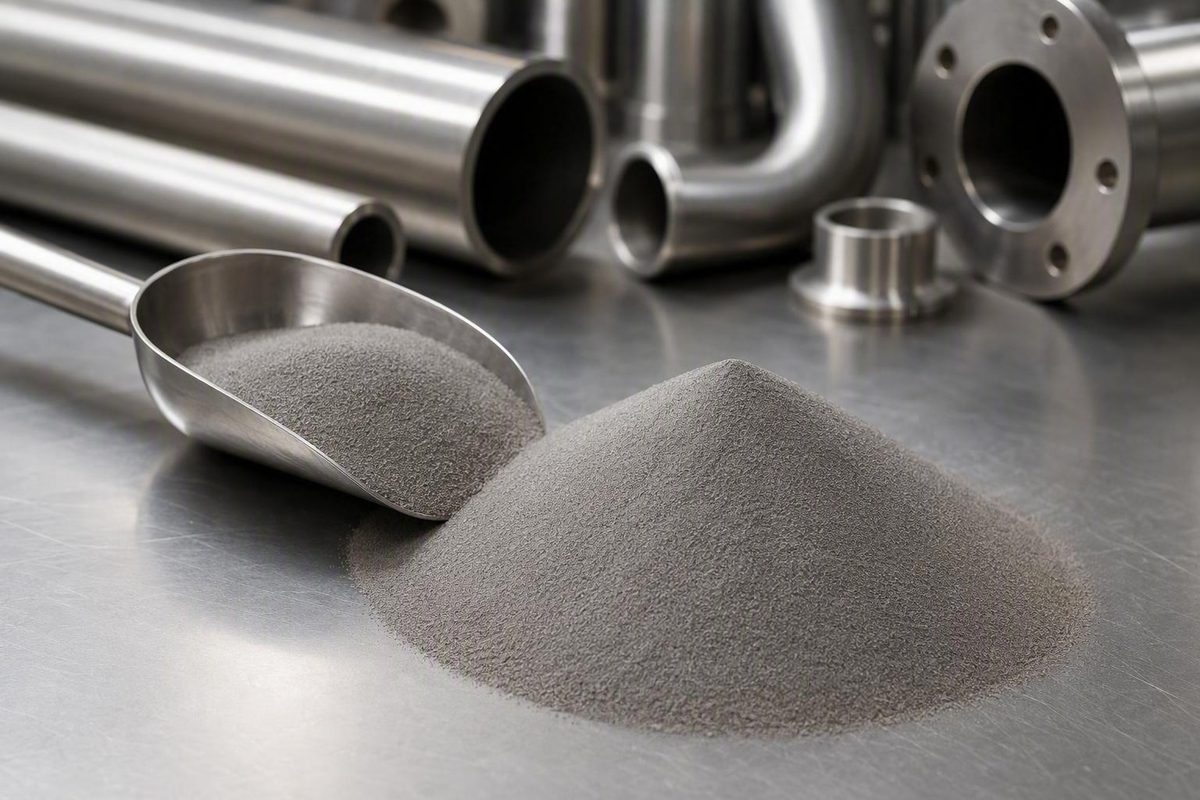
UDIMET 720 nickel alloy powder is not adequately specified by writing “Alloy 720 powder” on a request for quotation. The name identifies an alloy family, but it does not establish the exact variant, powder-production method, particle-size distribution, cleanliness, thermal history, qualification route, or properties of the eventual component.
A defensible purchase treats the powder as one element in a controlled process chain. The buyer must connect alloy identity and lot chemistry to atomization, classification, storage, consolidation or deposition, hot isostatic pressing (HIP), heat treatment, machining, inspection, and mechanical testing.
Published billet properties and individual research studies can guide specification development. They cannot substitute for powder-specific requirements, machine- and route-specific process qualification, or component design allowables.
Evidence scope: This guide distinguishes primary process research, manufacturer data for bulk product forms, third-party datasheets, and attributed supplier claims. Current powder availability and universal additive-manufacturing parameters are not independently established by the available evidence.
What UDIMET 720 is—and what the alloy name does not prove
UDIMET 720 is a high-strength, precipitation-hardening nickel-base superalloy commonly associated with UNS N07720 and turbine applications. Aluminum and titanium principally support formation of the γ′ strengthening phase, while cobalt, chromium, molybdenum, and tungsten provide additional strengthening contributions.
Carpenter identifies its Alloy 720 as a precipitation-hardening nickel-base alloy under UNS N07720, but the product form shown on its page is billet—not powder. Its page also lists aerospace as an application and identifies MSRR7252 and C50TF105 as applicable specifications, without establishing that either specification governs loose powder.Carpenter’s Alloy 720 product page identifies UNS N07720, type analysis, applications, listed specifications, and billet form
Several names encountered during sourcing overlap without necessarily being contractually equivalent.
| Term | What the available evidence establishes | What remains unproven |
|---|---|---|
| UDIMET 720 | A precipitation-hardened nickel-base superalloy strengthened principally through γ′ precipitation and associated with turbine applications. | The name alone does not define powder form, atomization route, particle-size distribution, interstitial limits, heat treatment, or qualification status. |
| Alloy 720 | A generic or producer-specific designation commonly associated with UNS N07720. Research also uses “Alloy 720” for powder-metallurgy material. | Generic use does not prove equivalence to every branded UDIMET 720 product or low-interstitial variant. |
| ATI 720 | ATI identifies ATI 720 as UNS N07720 and publishes data for bar and billet. | ATI’s page does not establish equivalence to every UDIMET-branded product or identify powder as an offered form. |
| UNS N07720 | A useful identifier shared by multiple commercial references. | A UNS number does not specify powder manufacture, particle distribution, gas content, condition, processing route, or finished-part properties. |
| UDIMET 720LI / U720LI | Research describes “LI” as “low interstitial” and applies the designation to powder-metallurgy and laser-deposited material. | The evidence does not provide one universal chemistry table or prove interchangeability with standard 720. |
“Low interstitial” should be treated as a meaningful variant designation, not as optional wording. Research on UDIMET 720LI associates the designation with reduced interstitial content and particular attention to carbon and boron. That does not prove that all products called 720LI share one contractual chemistry or can replace standard 720 without review.
UNS N07720 remains useful because it gives engineering, purchasing, and quality teams a common identifier and helps prevent substitution with unrelated nickel alloys. It simply does not carry enough information to serve as the complete procurement specification.
At minimum, the purchase order should state:
- Exact alloy and variant designation, including whether 720LI is required
- UNS number where applicable
- Governing material or customer specification and revision
- Product form: loose pre-alloyed powder, elemental blend, HIP billet, bar, or another form
- Approved powder-production and classification route
- Intended consolidation or deposition process
- Required delivered and final heat-treated conditions
- Customer, component, or regulatory qualification restrictions
- Formal approval requirements for substitutions and process changes
Any proposed substitution among UDIMET 720, generic Alloy 720, ATI 720, and UDIMET 720LI should receive materials-engineering and quality approval rather than being accepted solely because the products share the “720” label.
Nominal chemistry, density, and the limits of datasheet properties
The table below separates alloy-family ranges from producer type-analysis values and powder-specific controls. It is an identification aid, not a contractual powder chemistry.
| Element | Reported basis | Value or required treatment | Product-form limitation |
|---|---|---|---|
| Nickel | Reported alloy-family range | 55.16–59.705% | Secondary datasheet value; do not treat the unusually precise interval as a universal powder limit |
| Chromium | Reported alloy-family range | 15.5–16.5% | General alloy data |
| Cobalt | Reported alloy-family range | 14.0–15.5% | General alloy data |
| Titanium | Reported alloy-family range | 4.75–5.25% | General alloy data |
| Molybdenum | Reported alloy-family range | 2.75–3.25% | General alloy data |
| Aluminum | Reported alloy-family range | 2.25–2.75% | General alloy data |
| Tungsten | Reported alloy-family range | 1.00–1.50% | General alloy data |
| Carbon | Reported range or producer maximum | 0.010–0.020%, with some producer analyses stating a maximum | Governing specification and variant must control |
| Boron | Reported range or nominal value | 0.010–0.020% | Do not assume one range applies to every 720LI product |
| Zirconium | Reported range or nominal value | 0.025–0.050% | Confirm against the governing specification |
| Oxygen | Producer maximum in one bulk-alloy type analysis; powder reporting requirement | One type analysis lists 0.002% maximum | A bulk value does not establish the acceptable limit or sampling method for loose powder |
| Nitrogen and hydrogen | Requested powder controls | Report measured results and methods | No universal limits are established by the available evidence |
| Iron, phosphorus, silicon, manganese, sulfur | Producer- or specification-dependent residual limits | Report applicable limits and measured values | Limits vary with source and contractual basis |
The Special Metals data reproduced by MatWeb report the central alloy-family ranges, density of 8.08 g/cm³, precipitation hardening through titanium and aluminum, and solid-solution strengthening through tungsten and molybdenum.MatWeb’s UDIMET 720 entry reports composition, density, strengthening mechanisms, thermal data, and condition-specific rupture values attributed to Special Metals
Carpenter’s separate type analysis is nominally 57% Ni, 16% Cr, 15% Co, 5% Ti, 3% Mo, 2.5% Al, and 1.25% W. These values broadly align with the general ranges above, but Carpenter lists billet as the product form. They should therefore be treated as a cross-check on alloy identity, not as a loose-powder specification.
Four categories of chemistry information must remain distinct:
- Nominal alloy composition identifies the intended alloy family.
- Measured billet chemistry describes consolidated bulk material and may reflect blending, sampling, and processing history.
- Contractual powder limits define what loose feedstock must meet, including gases, residuals, and trace elements relevant to the selected route.
- A lot-specific certificate of analysis states what was measured for the particular powder lot offered or delivered.
The certificate must be checked against contractual limits rather than merely repeating a nominal datasheet. For powder, the buyer should require measured oxygen, nitrogen, hydrogen, carbon, sulfur, phosphorus, and process-relevant trace elements because nominal nickel-alloy chemistry does not establish cleanliness or powder condition.
Why bulk mechanical values are not powder guarantees
ATI publishes 1517 MPa minimum tensile strength, 1104 MPa minimum yield strength, 15% minimum elongation, and 43 HRC maximum hardness for ATI 720 bar and billet. ATI’s page does not list powder, and the displayed figures are not accompanied by complete heat-treatment and test-condition details.ATI reports these mechanical values and a density of 8.08 g/cm³ specifically under its bar-and-billet product forms
Those values cannot automatically be transferred to:
- Loose or as-atomized powder
- HIP-consolidated stock
- Laser-deposited material
- LPBF or EBM builds
- Heat-treated near-net shapes
- Machined and inspected components
Mechanical performance belongs to a defined material condition. Loose powder has no component-scale tensile property.
Published melting information demonstrates why secondary summaries should not control process design. MatWeb reports a melting range of 1194–1338°C for its Special Metals entry.MatWeb reports a 1194–1338°C melting range
A separate AZoM overview reports a single melting point of 1371°C.AZoM reports 1371°C in its secondary overview of Udimet 720
The discrepancy should not be resolved by selecting whichever figure best suits a model. An original producer specification, approved material standard, or validated thermal analysis for the actual lot and condition should control.
Powder routes and particle-size evidence
“Alloy 720 powder” can refer to materially different feedstocks and intermediates. A product-form matrix helps prevent data from one route being assigned to another.
| Product form | Starting material and route | What it can establish | What it cannot establish |
|---|---|---|---|
| Pre-alloyed atomized powder | Molten alloy is atomized so each suitable particle nominally contains the alloying system. | Relevant feedstock for qualified HIP or deposition routes after classification and acceptance. | Suitability for a specific machine, nozzle, recoater, or parameter set. |
| Elemental-powder blend | Separate elemental powders are mixed or mechanically alloyed. | Feasibility of experimental PM and consolidation routes. | Equivalence to commercially qualified spherical pre-alloyed AM powder. |
| HIP-consolidated billet or near-net shape | Powder is canned, outgassed, sealed, and consolidated under temperature and pressure. | Bulk microstructural and mechanical performance for the tested route. | Loose-powder flow, particle distribution, or deposition behavior. |
| Laser-deposited material | Powder is delivered into a focused-energy melt pool. | Feasibility for the studied LMD equipment and conditions. | A universal LPBF, EBM, or DED recipe. |
| Wrought bar | Bulk material is thermomechanically processed into bar. | Bar-specific procurement and property data. | Powder quality or powder-derived performance. |
| Billet | Bulk or consolidated stock supplied for further processing. | Billet-specific chemistry and condition requirements. | Commercial availability or suitability of loose powder. |
Documented pre-alloyed powder routes
A historical as-HIP Alloy 720 study used vacuum-induction-melted metal atomized with high-pressure argon. Atomization produced spherical droplets, and the powder was screened below 53 µm before canning and HIP consolidation. The study used multiple powder heats combined into a master blend, making lot definition and genealogy especially important. The 53 µm cutoff was a study choice, not a universal HIP feedstock requirement.The as-HIP Alloy 720 paper documents atomization, screening below 53 µm, blending, canning, HIP consolidation, heat treatment, and mechanical evaluation
A separate creep study used argon-atomized powder with particle diameters from 10 to 90 µm and an average near 30 µm. The powder was HIP-consolidated before microstructural and creep testing. That distribution describes the investigated material; it is not an automatic limit for another HIP vessel, deposition nozzle, recoater, or qualification program.The PM UDIMET 720 creep study reports the 10–90 µm range, approximately 30 µm average, HIP route, grain structures, and 650°C testing
A 2024 laser melting deposition study used spherical UDIMET 720LI alloy powder. The available preview does not disclose the supplier, complete powder chemistry, particle-size distribution, or full LMD and post-processing settings. It establishes that spherical 720LI powder was used in the investigated LMD route, but it does not provide a reproducible feedstock procurement specification.The 2024 LMD study identifies spherical UDIMET 720LI feedstock while leaving key powder and process details undisclosed in the available preview
Elemental blending is a different proposition
Another experimental route targeted U720LI by mixing elemental powders with particle sizes spanning 3–150 µm. The constituent powders differed in morphology and production method, and the investigated Attritor process produced more effective mixing and mechanical alloying than the double-cone blender.The U720LI elemental-powder study describes its target chemistry, 3–150 µm constituent powders, mixing methods, and consolidation approach
This route creates a different qualification problem from pre-alloyed atomized powder. The purchaser or process owner must demonstrate local chemical homogeneity, control of contamination from milling media, oxidation, mixing uniformity, morphology, and consolidation response. An elemental blend must not be represented as equivalent to gas-atomized, pre-alloyed additive feedstock.
No study-specific particle range should become a purchase specification by default. PSD limits must be derived from the actual equipment, powder-delivery strategy, flow and packing requirements, process validation, and acceptance data.
Process suitability: HIP has stronger evidence than a universal AM recipe
The evidence is not equally strong across powder-based routes. Conventional powder metallurgy and HIP have direct published support. Laser melting deposition has narrower experimental support. The available evidence does not establish independently validated universal windows for LPBF, EBM, or DED.
| Process | Available evidence | Indicative feedstock information | Principal risks to qualify | Missing qualification data |
|---|---|---|---|---|
| HIP | Published work documents atomized Alloy 720 powder, classification, canning, consolidation, heat treatment, and mechanical evaluation. | Study-specific screened or atomized powder, as described in the documented routes above. | Entrapped gas, inclusions, residual pores, can contamination, grain growth, prior-particle effects, and unsuitable γ′ evolution. | Production lot limits, can design, validated cycle, cooling rate, geometry effects, inspection sensitivity, and statistical properties. |
| Laser melting deposition | A 2024 study used spherical UDIMET 720LI and evaluated HIP plus heat treatment. | Supplier, complete chemistry, PSD, and full process settings were absent from the available preview. | Microcracking, porosity, segregation, columnar grains, carbide evolution, and spatially varying thermal history. | Full parameter matrix, powder certificate, platform conditions, orientation effects, crack statistics, and elevated-temperature properties. |
| LPBF | Supplier discussion exists, but the available primary research does not establish a qualified window. | Fine, classified, flowable powder would require machine-specific validation. | Hot cracking, recoating problems, lack of fusion, keyholing, residual stress, anisotropy, and oxygen pickup. | Machine parameters, preheat, scan strategy, build envelope, crack-density data, reuse limits, HIP schedule, and design properties. |
| EBM | Commercial discussion exists; no independently validated window is established here. | Conductive, flowable, classified powder would be required. | Preheat and sintering behavior, chemistry loss, surface condition, porosity, cracking, and powder-recovery effects. | Beam parameters, bed temperature, reuse data, chemistry control, defect maps, and property allowables. |
| DED | The LMD study is relevant to one laser-directed deposition route, not all DED systems. | Delivery behavior must match nozzle, carrier gas, melt-pool geometry, and capture efficiency. | Cracking, dilution, oxidation, unmelted particles, bead geometry, and thermal variation. | Deposition efficiency, parameter envelope, shielding, dilution limits, orientation, repair-interface behavior, and qualified post-processing. |
The defensible conclusion is not that UDIMET 720 is “AM ready.” It is that powder-metallurgy and selected deposition routes have been investigated, with stronger evidence for HIP than for any universal additive-manufacturing recipe.
A commercial supplier identifies hot-cracking susceptibility as a laser-processing concern and names energy input, scan strategy, preheating, and post-processing as variables requiring control. Those are attributed development considerations, not validated numerical settings for a buyer’s machine.
Before approving an AM route, require:
- Machine model, software version, and relevant hardware configuration
- Powder producer, lot, condition, and reuse status
- Build-platform or chamber temperature
- Complete parameter matrix and permitted boundaries
- Scan or deposition strategy
- Shielding environment and oxygen controls
- Crack-density and porosity results by location and orientation
- Build orientation and specimen-extraction map
- Nondestructive-inspection method and demonstrated sensitivity
- HIP heating, pressure, dwell, cooling, and canning details where applicable
- Solution and aging treatments
- Room- and elevated-temperature tensile results
- Creep, stress-rupture, fatigue, dwell-fatigue, and crack-growth evidence appropriate to service
- Metallography covering grains, γ′, carbides, segregation, inclusions, and defects
Qualification must cover the complete chain: powder production, packaging, storage, opening, sampling, sieving, reuse if permitted, deposition or canning, HIP, heat treatment, machining, surface finishing, inspection, and mechanical testing.
How HIP and heat treatment change defects, grains, and γ′
HIP combines elevated temperature and isostatic gas pressure to consolidate powder or reduce certain internal defects. It is a consolidation and defect-control operation with substantial metallurgical side effects—not an automatic strength upgrade.
In the historical as-HIP study, powder was loaded into mild-steel containers, outgassed, sealed, and consolidated at 1129°C and 103 MPa for four hours. The study then evaluated subsolvus and supersolvus solution treatments followed by aging. These conditions belonged to that powder blend, container, billet geometry, and research program; they are not universal production instructions.The as-HIP study reports the 1129°C, 103 MPa, four-hour cycle and the tested solution-and-aging routes
Subsolvus and supersolvus treatments serve different objectives
Solution treatment relative to the γ′ solvus changes both grain structure and precipitate behavior:
- A subsolvus treatment retains more grain-boundary pinning influence and can preserve a finer structure.
- A supersolvus treatment can allow substantial grain growth as relevant phases dissolve.
- Subsequent aging develops secondary γ′ populations that contribute strongly to strength.
Under the historical study conditions, the subsolvus-treated material retained finer grains and produced higher tensile strength and ductility. The supersolvus-treated material developed coarser grains and improved stress-rupture strength. This was a route- and condition-specific property tradeoff, not proof that one treatment is universally superior.
The required balance depends on temperature, stress, dwell time, section size, defect population, component life, and inspection strategy.
Densification does not guarantee increased strength
The 2024 LMD study provides a direct warning. HIP increased measured relative density from 97.06% to 99.97% and eliminated observed internal microcracks, although a few small pores remained. At the same time, microhardness fell from 480 HV to 404 HV, and room-temperature tensile strength declined from 1258 MPa to 1234 MPa after HIP alone.The LMD study reports density, residual pores, microcrack elimination, hardness, tensile strength, and microstructural changes after HIP
The authors associated the HIP-only reduction with changes that included fewer strengthening precipitates and larger carbides. After HIP plus heat treatment, the same study reported:
| Room-temperature property | Study-specific result after HIP plus heat treatment |
|---|---|
| Ultimate tensile strength | 1394 MPa |
| Yield strength | 702 MPa |
| Elongation at fracture | 18.33% |
The post-heat-treatment improvement was associated with a larger population of smaller secondary γ′ precipitates. The reported average secondary γ′ size decreased from 283.4 nm to 266.3 nm while the quantity increased.
These results help explain the sequence of densification and precipitation strengthening. They are not design allowables and cannot be assigned to another powder, geometry, machine, orientation, HIP cycle, or heat treatment.
A useful process map is:
- Deposition or consolidation establishes the initial pores, cracks, segregation, grains, carbides, and precipitate state.
- HIP may close cracks and pores while also recrystallizing grains, altering carbides and precipitates, and changing residual stress.
- Solution treatment adjusts solute distribution and the balance between retained grain control and grain growth.
- Aging develops the secondary γ′ population required for the intended property balance.
- Service exposure can further change the phase structure and move the material away from its qualified condition.
Every cycle must therefore be qualified for the actual powder-lot family, component geometry, consolidation or deposition route, and required balance among tensile strength, ductility, fatigue, creep, and rupture life.
Creep, fatigue, and temperature limits in context
A temperature attached to an alloy name can describe oxidation resistance, a creep test, a rupture test, an application range, a thermal exposure, or an approved design limit. These categories are not interchangeable.
| Temperature context | Evidence or claim | Correct interpretation |
|---|---|---|
| Oxidation or sulfide-corrosion resistance | Carpenter reports resistance up to 982°C for its Alloy 720. | A manufacturer materials-resistance statement, not proof of continuous load-bearing capability. |
| Creep research | PM UDIMET 720 microstructures were tested at 650°C. | Evidence for specific HIP-consolidated, heat-treated materials under the study conditions. |
| Turbine-disk application context | PM research discusses disk service below approximately 700°C; the LMD paper introduces compressor and turbine-disk use around 650–750°C. | Application context, not a blanket allowable for every product form or component. |
| Long-term thermal exposure | HIP UDIMET 720 was exposed at 800°C for 1000 hours. | A microstructural-stability investigation, not a recommended duty cycle. |
| Rupture data | Secondary sources list isolated rupture values at several temperatures. | Condition-specific test data requiring original material, treatment, and test details. |
| Allowable design temperature | Not established by the available evidence. | Must come from governing design data and component qualification. |
Carpenter’s resistance claim near 982°C should not be read as approval for a rotating disk, pressure-containing component, repair deposit, or other loaded part to operate continuously at that temperature. Oxidation resistance does not by itself establish acceptable creep strain, fatigue life, crack growth, phase stability, or environmental interaction.
The 650°C creep research also shows why microstructure matters. Coarse-grained material displayed the conventional three creep stages, while the fine-grained material transitioned from primary to apparent tertiary creep without an obvious steady-state stage under the investigated conditions. The study also reported different deformation mechanisms with changing stress and microstructure.The PM UDIMET 720 creep paper reports 650°C testing and distinct behavior for fine- and coarse-grained microstructures
Fatigue performance is similarly tied to defects. In the historical as-HIP investigation, pores and ceramic inclusions initiated some low-cycle-fatigue failures in subsolvus-treated specimens.
Long-term phase stability creates another limit. A 2022 study of HIP UDIMET 720 associated exposure at 800°C for 1000 hours with sigma-phase formation, reduction of the γ′ strengthening fraction, and deterioration in tensile and creep-rupture properties. The available repository evidence contains the abstract rather than the full paper; the underlying publication is Journal of Materials Engineering and Performance, volume 31, pages 8327–8333, DOI 10.1007/s11665-022-06858-6.The journal record identifies the study and its reported 800°C, 1000-hour exposure findings
Before assigning service capability, an engineering program should obtain application-specific data for:
- Elevated-temperature tensile strength and ductility
- Creep and stress rupture
- Low- and high-cycle fatigue
- Dwell fatigue
- Fatigue-crack initiation and growth
- Thermomechanical fatigue where applicable
- Oxidation and relevant corrosion environments
- Notch and section-size effects
- Build orientation and location
- Defect acceptance thresholds
- Long-term phase stability
- Inspection capability and recurring inspection intervals
Room-temperature tensile results, oxidation limits, and isolated rupture measurements are not aerospace design allowables. They can support material screening and test planning, but not final life substantiation.
A procurement specification for UDIMET 720 powder
A purchase specification should make every essential assumption visible. The following checklist can be adapted to a request for quotation, purchase order, source-control drawing, or supplier quality plan.
Alloy identity
- State the exact designation: UDIMET 720, Alloy 720, or UDIMET 720LI.
- Include UNS N07720 where applicable, while making clear that it is not the complete requirement.
- Cite the governing material or customer specification and revision.
- Define whether alternative producer designations are prohibited or subject to approval.
- State the intended route: HIP, LMD, LPBF development, DED, or another process.
- Define the delivered condition and approved final condition.
- Identify source-approval and country-of-origin restrictions where applicable.
Chemistry
Require a lot-specific certificate reporting:
- Nickel, chromium, cobalt, titanium, molybdenum, aluminum, and tungsten
- Carbon, boron, and zirconium
- Oxygen, nitrogen, and hydrogen
- Sulfur and phosphorus
- Iron, silicon, manganese, and other controlled residuals
- Trace elements restricted by the governing specification
- Test methods, laboratory identity, sample location, units, and reporting limits
Do not accept “meets nominal composition” without measured results. If multiple heats are blended, require the blend definition, heat genealogy, and evidence that the sampling plan represents the delivered lot.
Powder characteristics
Specify or request:
- D10, D50, and D90
- Fines and oversize fractions
- Full reported distribution rather than a nominal sieve label alone
- Test method and dispersion conditions
- Sieve, air-classification, or other classification history
- Particle-morphology images at agreed magnifications
- Quantitative sphericity or aspect ratio where required
- Satellite-particle assessment
- Agglomerate and fused-particle controls
- Internal particle porosity
- Apparent density and tap density
- Flowability by an agreed method
- Moisture condition and test method
- Foreign-particle and inclusion controls
A nominal size label does not disclose distribution tails, sampling uncertainty, test method, or the amount of out-of-range powder.
Production history
Require disclosure of:
- Melt practice, including vacuum practice where applicable
- Atomization method and atomizing gas
- Number of heats represented by the lot
- Blending history
- Materials used in powder-contact equipment
- Classification and sieving equipment
- Cleaning and cross-contamination controls
- Reconditioning or reprocessing
- Thermal and drying history
- Powder reuse history
- Additions of reclaimed powder
- Changes in production site, atomizer, raw-material source, or key process
Virgin powder, reused powder, and blends of the two should be treated as different conditions unless the qualified procedure explicitly permits them.
Documentation and traceability
The supplier package should define:
- Powder-lot number and lot boundaries
- Parent melt and atomization genealogy
- Sampling plan
- Certificate of analysis
- Particle-size report
- Gas-analysis report
- Morphology, density, and flowability results
- Raw data or controlled summaries where required
- Laboratory accreditation where contractually applicable
- Calibration and method references
- Nonconformance and deviation history
- Change-notification obligations
- Retention period for records and samples
References associated with Alloy 720 include MSRR7252, C50TF105, EMS 55477, EMS 73105, and MTS 5013. Their current revisions, ownership, availability, and exact scopes must be verified. The evidence does not prove that every identifier governs loose powder rather than bulk alloy, intermediate stock, or another product condition.
Packaging and logistics
Specify:
- Container material and size
- Maximum powder mass per container
- Tamper evidence and seal requirements
- Packaging atmosphere
- Moisture and oxygen controls
- Required label content
- Safety-data-sheet inclusion
- Applicable transport classification
- Opening and resealing instructions
- Shelf-life or retest policy
- Quarantine triggers after package damage or environmental exposure
Qualification evidence
For the proposed route, request:
- Prior qualified applications, if disclosure is permitted
- Equipment and parameter identification
- Density and defect distributions
- Crack inspection and metallography
- HIP and heat-treatment records
- Grain and γ′ characterization
- Room- and elevated-temperature properties
- Fatigue and fracture evidence
- Statistical basis for acceptance limits
- Witness-coupon strategy
- Demonstrated inspection sensitivity
- Control of production changes
Commercial availability is not independently established. One supplier asserts that it offers UDIMET 720 powder, while the cited Carpenter page lists billet and ATI lists bar and billet. The supplier’s claims concerning stock, origin, pricing, documentation, and qualification require direct verification against the actual offered lot.MWAlloys asserts commercial powder availability and describes its claimed testing and traceability package
Buyers should determine whether a seller is the atomizer, an authorized distributor, or a reseller. They should request a sample certificate, identify the manufacturing site, verify genealogy and lead time, and confirm that the offered variant, PSD, chemistry, packaging, and production route match the qualification basis.
A practical acceptance rule is:
Reject or quarantine substitutions between 720 and 720LI, altered particle distributions, reused powder, blended lots, or changed production routes unless the change has been formally reviewed and accepted through the applicable qualification and change-control process.
Qualification, storage, and safe powder handling
Qualification does not end when a certificate is received. Incoming inspection must verify that the containers, documentation, and tested material correspond to the approved order.
Incoming-inspection workflow
- Inspect the shipment before opening. Check for damaged containers, compromised seals, corrosion, moisture exposure, and mismatched labels.
- Reconcile identities. Match the purchase order, packing list, container numbers, lot numbers, heat genealogy, and certificate numbers.
- Review documentation. Confirm specification revision, chemistry, interstitial gases, PSD, methods, deviations, and release signatures.
- Sample under controlled conditions. Follow a documented method intended to limit contamination, segregation, moisture pickup, and personnel exposure.
- Confirm critical characteristics. Perform independent chemistry, gas analysis, PSD, or other verification at a frequency justified by risk and supplier performance.
- Inspect morphology. Compare satellites, irregular particles, agglomerates, fused particles, and foreign material with the approved baseline.
- Release or quarantine. Keep the lot segregated until acceptance requirements have been satisfied.
Representative feedstock samples should be retained. Witness specimens should preserve traceability through deposition or consolidation, HIP, heat treatment, machining, inspection, and mechanical testing. This allows later defects to be investigated without relying solely on the supplier’s original certificate.
Qualification testing should target known failure mechanisms
A suitable qualification plan may include:
- Archimedes, image-based, or computed-tomography density and porosity assessment
- Surface and internal crack inspection
- Inclusion and foreign-particle review
- Metallography by build or billet location
- Grain-size and texture evaluation
- γ′ size, distribution, and fraction where relevant
- Carbide and undesirable-phase characterization
- Chemical-segregation assessment
- Elevated-temperature testing
- Low-cycle, high-cycle, and dwell-fatigue testing
- Fatigue fractography to identify crack origins
- Inspection probability-of-detection work for critical defects
Fractography is particularly important because an acceptable average density can coexist with an individual ceramic inclusion or pore capable of initiating fatigue failure.
Storage and handling controls
Supplier guidance for this product includes dust management, suitable respiratory protection, grounded equipment, sealed dry storage, and compliance with applicable workplace, shipping, waste, and transport requirements.MWAlloys lists these general powder-handling precautions
That supplier guidance is subordinate to:
- The current product safety data sheet
- The facility’s documented risk assessment
- Equipment-manufacturer instructions
- Applicable occupational-health and environmental requirements
- Fire and emergency-response requirements
- Transport and waste classifications in the relevant jurisdiction
Written procedures should cover storage, opening, dispensing, sampling, sieving, recycling, spill response, and quarantine after environmental exposure. Specific requirements for ventilation, grounding and bonding, personal protective equipment, housekeeping, and cleaning equipment must come from the facility’s powder-hazard assessment rather than generic alloy guidance.
Most importantly, qualification belongs to a specific combination of:
- Powder producer and lot family
- Melt and atomization route
- PSD and powder condition
- Storage and reuse controls
- Manufacturing equipment
- Process parameters
- Component geometry and orientation
- HIP cycle
- Solution and aging treatments
- Machining and surface condition
- Inspection plan
- Mechanical-test basis
- Acceptance criteria
The evidence hierarchy should remain explicit: governing specifications and approved qualification data come first; primary process research comes second; manufacturer bulk-alloy data provide context; and supplier marketing is useful only as attributed information requiring verification.
Frequently asked questions
Is UDIMET 720 nickel alloy powder commercially available?
One commercial supplier asserts that it offers UDIMET 720 powder, but the available evidence does not independently verify inventory, manufacturing origin, lead time, minimum order, genealogy, or aerospace qualification. Carpenter lists Alloy 720 as billet, while ATI lists ATI 720 as bar and billet.
As described in the procurement specification, a buyer should determine whether the seller is the atomizer, distributor, or reseller; obtain sample lot documentation; and verify the offered variant, chemistry, PSD, packaging, production route, and qualification status.
What is the difference between UDIMET 720 and UDIMET 720LI?
UDIMET 720LI is described in the research literature as a low-interstitial variant. The designation is associated with tighter attention to interstitial-related chemistry, but the available evidence does not provide one universal chemistry that makes all 720LI products interchangeable.
The purchase order should name the required variant and governing limits. Standard 720 and 720LI should not be substituted for one another without formal technical review.
What particle size should be specified for UDIMET 720 powder?
There is no universal particle size. Published examples include the study-specific distributions described under documented pre-alloyed powder routes, but those values are not general purchase standards.
Specify PSD from the qualified process and equipment. Include D10, D50, D90, fines, oversize fraction, test method, classification history, morphology, apparent and tap density, flowability, and internal particle porosity.
Can UDIMET 720 powder be used in LPBF or directed-energy deposition?
Spherical UDIMET 720LI powder has been used experimentally in laser melting deposition, a laser-directed deposition process. That demonstrates compatibility for the studied material and conditions, not a universal DED recipe.
The evidence does not establish independently validated parameter windows for LPBF, EBM, or DED generally. Approval requires machine-specific evidence for cracking, porosity, orientation, microstructure, powder reuse, HIP, heat treatment, inspection, and elevated-temperature properties.
Can a UDIMET 720 component operate continuously at 982°C?
Not on the basis of an oxidation or sulfide-corrosion resistance statement. Such a statement does not establish continuous allowable operation for a loaded component.
Service capability must be based on the actual material condition, stress state, environment, life requirement, creep and fatigue data, long-term phase stability, defect population, inspection plan, and governing design allowables. The distinctions are summarized in creep, fatigue, and temperature limits.
Final takeaway
The alloy name and nominal chemistry are only the starting point. A defensible UDIMET 720 powder decision requires an exact variant, lot-level chemistry and particle data, verified production history, cleanliness controls, and qualification of the complete manufacturing and thermal-processing chain.
Where current supply details, powder-specific specifications, validated AM windows, or design allowables are unavailable, the correct response is to identify and close those gaps—not to replace them with billet properties, isolated research results, or supplier marketing claims.