
316L Surgical Stainless Steel: Properties, Uses and Tube Specs
Understand 316L’s corrosion resistance, welding behavior and hardness limits, then distinguish surgical instruments, implant stock and tubing specs.
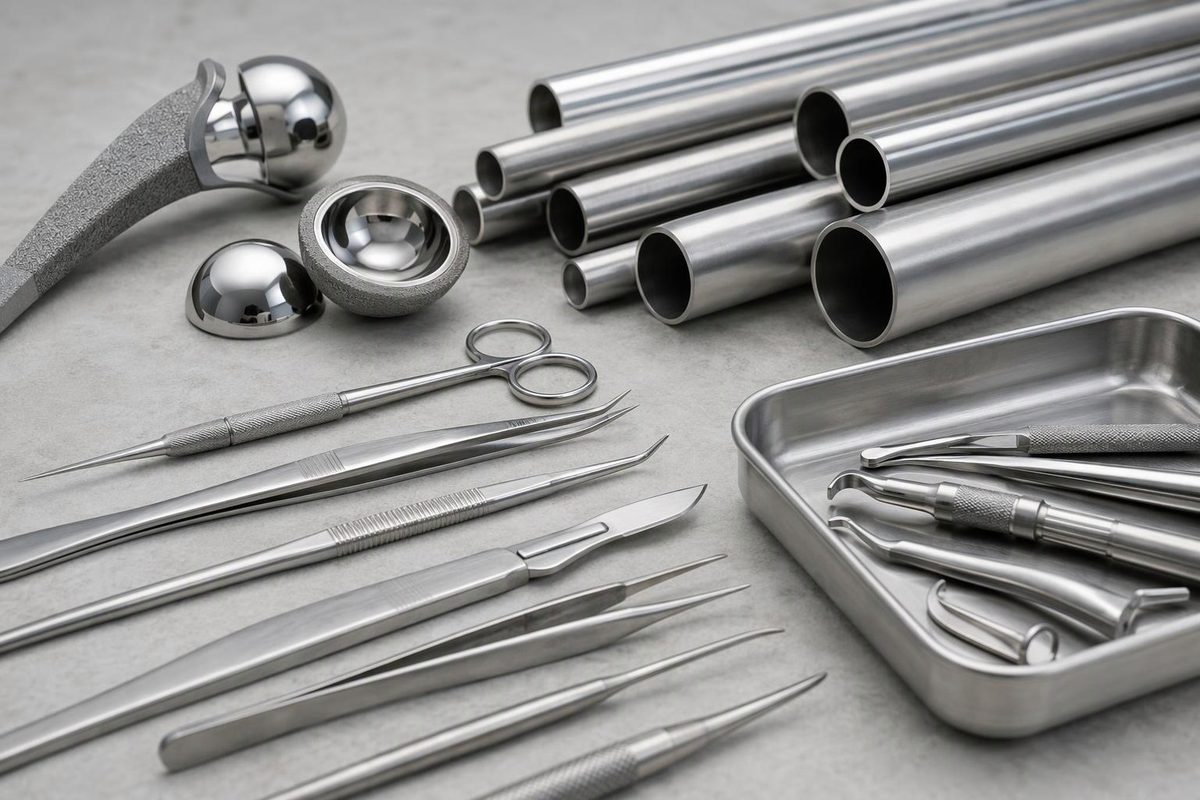
316L is a low-carbon, molybdenum-bearing austenitic stainless steel, identified as UNS S31603. It offers good corrosion resistance, formability and weldability. Calling it “surgical stainless steel” does not establish a complete material specification: general-service tubing, surgical instruments and implant stock have different requirements.
For a buyer or fabricator, the useful question is not simply whether the steel is 316L. It is whether its grade, product standard, condition and finished surface fit the intended service.
What 316L brings to the application
Brown Metals’ ASTM A240 plate, sheet and strip data lists 316L with 16–18% chromium, 10–14% nickel, 2–3% molybdenum and 0.030% maximum carbon, by mass. These identify the alloy chemistry; they are not a tubing dimension or pressure specification. 316/316L technical data
Three properties explain its usefulness:
- Corrosion resistance: Molybdenum helps 316L resist pitting and crevice corrosion better than conventional chromium-nickel grades such as 304. It is more resistant, not corrosion-proof.
- Welding behavior: The “L” means low carbon. Lower carbon reduces carbide precipitation from welding heat and improves resistance to intergranular corrosion; it does not give 316L a universal corrosion advantage over 316 in every environment.
- Formability rather than heat-hardened hardness: 316L can be formed and strengthened by cold working, but cannot be hardened by heat treatment. Its condition therefore matters when specifying strength, hardness or further forming.
Sources: Brown Metals’ grade comparison and Outokumpu’s Supra datasheet, including fabrication guidance.
That hardness distinction matters for instruments: a component needing a hard, wear-resistant cutting edge should not default to 316L merely because it is described as surgical steel.
Instruments, implants and tubing are different specifications
“Surgical” does not identify one stainless family or one product form. Use the application to decide which requirements to check.
| Intended product | Relevant specification scope | Selection consequence |
|---|---|---|
| General-service stainless tubing | ASTM A269/A269M covers seamless and welded austenitic tubing for corrosion-resisting and low- or high-temperature service | Specify the tube grade, dimensions, condition and testing; this is not an implant-material specification |
| Surgical instruments | ASTM F899 covers chemistry requirements for wrought stainless steels, including austenitic, martensitic, precipitation-hardening and ferritic classes | Instrument function determines the material choice; mechanical properties, heat treatment and hardness need separate requirements |
| Surgical-implant bar and wire | ASTM F138 covers chemical, mechanical and metallurgical requirements for UNS S31673 | Do not substitute ordinary S31603 stock solely because both materials are associated with the 316 family |
| Surgical-implant sheet and strip | ASTM F139 covers chemical, mechanical and metallurgical requirements for UNS S31673 | Match the specification to sheet or strip rather than treating F138 as covering every form |
Sources: ASTM A269/A269M, ASTM F899, ASTM F138 and ASTM F139.
316LVM is not just a finish applied to ordinary 316L. Fort Wayne Metals identifies its 316LVM as UNS S31673 under ASTM F138 and describes vacuum arc remelting to improve homogeneity and microcleanliness. Its documented alloy and processing distinguish it from a generic 316L listing. 316LVM material data
For the separate question of nickel content and skin-contact concerns, see Does Surgical Steel Have Nickel?.
Low carbon does not replace surface control
316L’s low carbon does not prevent weld oxidation or eliminate the need for appropriate post-weld cleaning. Outokumpu recommends removing weld oxides by pickling to restore corrosion resistance. It also notes that surface finish affects corrosion initiation and that molybdenum-bearing austenitic steels remain susceptible to chloride-induced stress corrosion cracking. Corrosion and welding guidance
Define the cleaning chemicals, concentrations, temperatures and exposure times before selecting the material. A polished appearance alone is not an acceptance criterion for corrosion performance. For welded tubing, specify both internal and external surface requirements; see also how to assess stainless weld heat tint.
What to put on a tubing order
Replace “316L surgical tube” with a purchase description that states:
- Service: General equipment, instrument component or implant-related application, with the applicable design requirements.
- Material: Exact grade and UNS designation, plus the product standard and edition.
- Geometry: Outside diameter (OD), wall thickness, length and tolerances; specify inside diameter (ID) where fit or flow requires it.
- Manufacturing and condition: Welded or seamless, heat-treated condition, and required mechanical properties consistent with the chosen product standard.
- Finish and acceptance: Internal/external finish, measurable roughness where needed, weld-oxide removal, cleanliness, end preparation and inspection requirements.
- Documentation: Material test reports and heat/lot traceability to the supplied stock.
For very small tubing, check the standard’s mechanical-property limits: A269/A269M-25 states that its mechanical-property requirements do not apply below 1/8 in. [3.2 mm] ID or 0.015 in. [0.38 mm] thickness. This is not a blanket exemption from testing. Additional application-specific requirements may therefore be needed. ASTM A269/A269M scope