
SS Flange Specifications: What to Check Before Buying
Class 150 is not a universal 150 psi limit; the checklist and request template cover grade, NPS, facing, bore, standards, gasket and bolting.
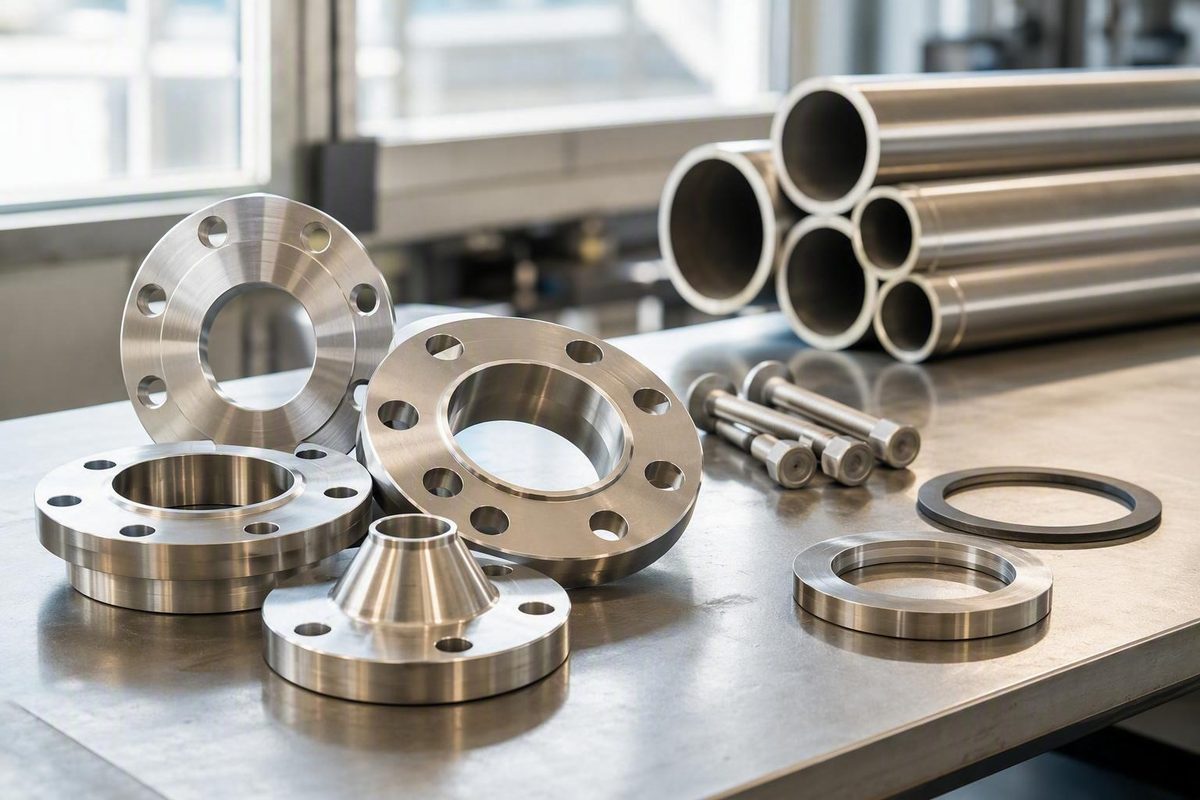
An SS flange is a stainless-steel component used with a mating flange, gasket, and bolting to connect pipe, valves, fittings, or equipment in a bolted piping system. Do not select one from “304/316, size, Class 150” alone.
SS flange specification checklist: start here
Define these fields before requesting a quote or approving a product:
- Stainless-steel grade and material specification
- Nominal pipe size (NPS)
- Pressure class
- Flange type
- Facing
- Bore or matching pipe schedule
- Design pressure
- Design temperature
- Applicable flange standard and edition
- Process fluid and external environment
- Mating component and facing
- Gasket specification
- Bolting specification
- Quantity
- Required markings and documentation, such as material certification, heat-number traceability, dimensional reports, or project-specific inspection records
Pipe schedule and flange pressure class are separate fields. Pressure class belongs to a pressure-temperature rating system. “Schedule 40S, Class 150” therefore communicates two different characteristics, not two versions of the same rating.
Evaluate the flange as part of the complete joint.
Do not fill unresolved fields with generic assumptions. If the process fluid, temperature, external exposure, pipe schedule, facing, or governing code is unknown, mark it to be confirmed and refer the decision to the responsible authority. A familiar stainless grade or catalog description does not establish application-specific corrosion resistance or an allowable pressure-temperature rating.
Common stainless-steel flange types found in Class 150 catalogs
Commercial catalogs can identify products for comparison, but they do not establish universal availability. One seller advertises Class 150 flanges in 304L and 316L stainless steel from 1/2 inch through 24 inches, with the following categories:
| Catalog category | Basic configuration |
|---|---|
| Weld neck | Neck intended for a welded pipe connection |
| Slip-on | Flange positioned over the pipe for welding |
| Socket weld | Pipe received into a socket before welding |
| Threaded | Internally threaded connection |
| Lap joint | Flange used in a lap-joint arrangement |
| Blind | Closes a flanged opening |
| Blind plate | Seller-listed plate-style closure |
| Slip-on plate | Seller-listed plate-style slip-on product |
The same seller lists Schedule 10S, 40S, and 80S only on selected products. It should not be assumed that every type, grade, facing, size, or schedule combination is available. These range and assortment details are seller-reported and must be checked against the current PipingNow Class 150 stainless-steel flange catalog.
For each candidate product, verify its construction, type, facing, bore, dimensions, tolerances, and markings against the exact drawing or certified documentation. This is particularly important for products described as plate flanges: a shared Class 150 label does not by itself establish identical construction or standards coverage.
What Class 150 means—and what it does not mean
Class 150 is a pressure-temperature class designation, not a universal maximum pressure of 150 psi. An allowable rating cannot be determined from the class number alone; the relevant material and design temperature must be checked under the applicable standard, governing piping code, and project requirements. The official ASME B16.5-2025 summary identifies pressure-temperature ratings as part of the standard’s scope but does not reproduce the rating tables.
According to that summary, ASME B16.5-2025 covers Classes 150, 300, 400, 600, 900, and 1500 for flanges from NPS 1/2 through NPS 24. It covers Class 2500 flanges from NPS 1/2 through NPS 12.
Because the public summary does not provide the pressure-temperature tables, no numerical rating should be inferred from it. Use the full standard edition required by the project rather than treating a seller filter or shorthand such as “150#,” “150 lb,” or “ANSI 150” as the final design basis.
How to interpret standards and material claims
References shown on a product page may address different parts of the specification. ASME’s description says B16.5-2025 covers pressure-temperature ratings, materials, dimensions, tolerances, marking, testing, methods of designating openings, bolting, gaskets, and flange joints within its scope. ASME also describes the standard as generally covering cast or forged products, with stated exceptions allowing plate material for blind and certain reducing flanges. These scope statements should be checked in the full ASME B16.5-2025 edition applicable to the project.
A commercial page may combine several standards claims. The example seller cites ASTM A182 or ASME SA182 for its advertised products and says its general flange dimensions conform to MSS SP-51 while bolt-hole and bolt-circle dimensions correspond to ASME B16.5. Visible listings also use dual-grade descriptions such as 304/304L and 316/316L. These are seller statements, not independent certification that a particular item satisfies every referenced requirement, as shown on the seller’s catalog page.
Reconcile mixed standards claims against:
- The exact product description and drawing
- The required material specification and grade
- The flange standard and edition named by the project
- The applicable dimensional and tolerance requirements
- Product markings and heat-number traceability
- The certification and inspection documents required by the purchase order
A catalog title does not prove that a flange was manufactured, tested, inspected, or certified to every standard mentioned on the page. Likewise, a dual-grade label does not automatically establish acceptability when the purchase specification calls for one particular grade. Confirm the required chemistry, mechanical properties, heat treatment, product form, certification, and governing-code acceptance through the applicable documents.
A fill-in SS flange request template
Use this template to convert project inputs into a clear inquiry:
SS FLANGE REQUEST

Material grade/specification:
Nominal pipe size (NPS):
Pressure class:
Flange type:
Facing:
Bore or matching pipe schedule:
Applicable flange standard and edition:
Design pressure:
Design temperature:
Process fluid:
External environment:
Mating component and facing:
Gasket:
Bolting:
Quantity:
Required markings:
Required documentation/certification:
Additional owner or code requirements:
A hypothetical catalog-style line item could read:
NPS 4, Class 150, raised-face slip-on SS flange, material and bore to be confirmed, applicable standard edition to be confirmed.
This is only a formatting model. It is not an approved specification or evidence that the item suits a particular service. It deliberately leaves unresolved the exact alloy, bore, standard edition, pressure-temperature rating, gasket, bolting, and governing-code requirements.
Several fields cannot safely be completed from a generic product search:
- Exact alloy suitability: requires the actual fluid, concentration, temperature, contaminants, cleaning conditions, and external environment.
-
Pressure-temperature rating: requires the exact material, design temperature, applicable standard, and governing code.
-
Gasket and bolting: must be specified as parts of the complete joint.
- Code requirements: depend on the system, owner, location, and jurisdiction.
Keep price out of the core technical description. Price, stock status, and lead time are point-in-time commercial details that should be requested separately after the technical requirements have been established.
Final checks before approving a flange
Compare the physical markings and supplier documents with the purchase request. Confirm the grade, material specification, NPS, class, flange type, facing, bore, and claimed standard. Make sure the documentation supplies the level of traceability and conformity evidence required by the project; a product-page statement is not a material certificate or dimensional report.
Review the complete joint rather than the flange alone. The gasket, bolting, mating face, connected component, and assembly requirements must be compatible under the applicable code and actual pressure, temperature, fluid, loading, and environmental conditions. Do not assume components can be combined solely because their nominal size and class labels match.
Confirm current stock, price, lead time, and schedule availability directly with the supplier. A category page may identify a possible configuration, but product-level availability and conformity must be verified when the order is placed.
Escalate service-specific material selection and pressure-temperature decisions to the responsible piping engineer or another qualified authority using the complete governing documents. If a required field remains unknown, leave it unresolved rather than turning a catalog convention into a design decision.
The purchasing rule is simple: do not approve an SS flange from “304/316, size, Class 150” alone. Complete and verify this line before purchase:
[Material/specification] — [NPS] — [class] — [type] — [facing] —
[bore/schedule] — [standard and edition] — [design pressure/temperature] —
[gasket] — [bolting] — [required certification]