
Stainless Grade for Data Center Liquid Cooling
Choose between 304L, 316L and duplex for PG25, treated-water or dielectric cooling loops, including copper cold plates and manifold limits.
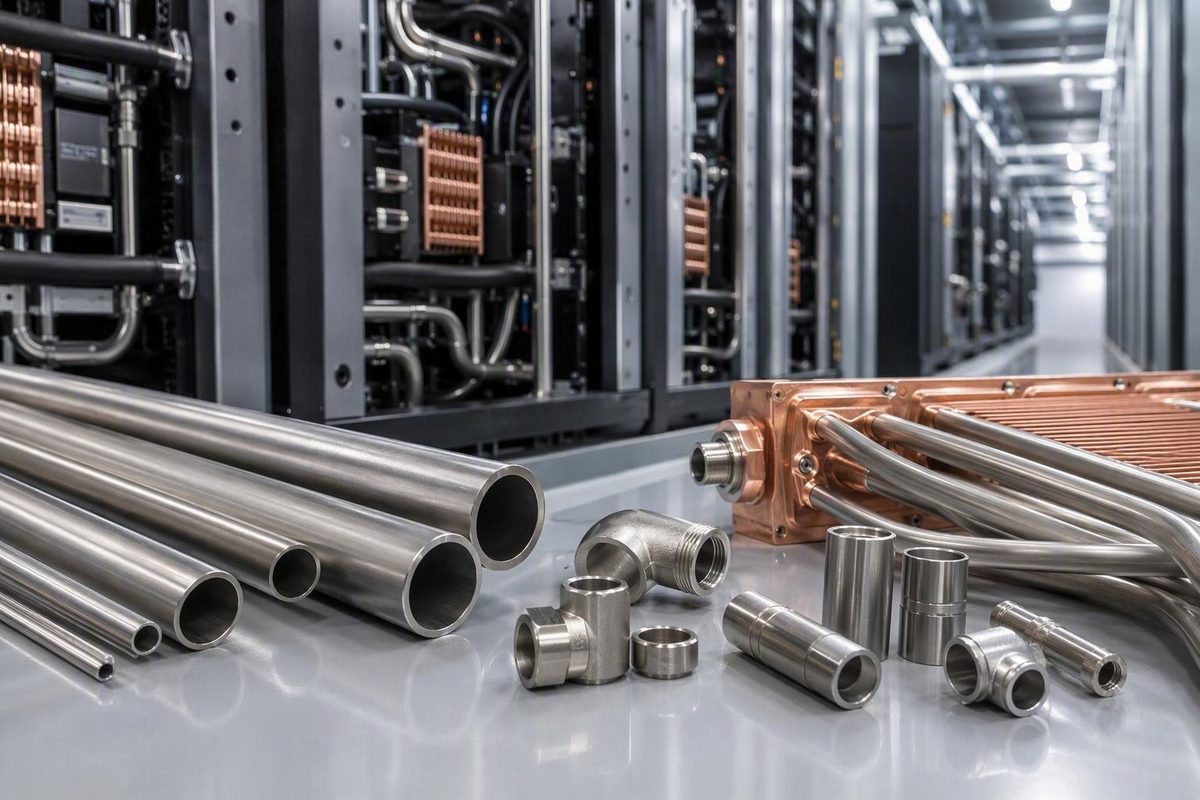
For a technology-cooling manifold or carrier tube, evaluate 304L only in a tightly controlled, explicitly approved loop; start with 316L when chloride exposure, makeup-water variability or coolant uncertainty is greater. Neither grade is automatically sufficient. Use lean duplex only when strength or stress-corrosion concerns justify the added qualification work, and do not specify 303 as the default for continuously wetted tubing or welded manifolds.
No published source cited here establishes a universal chloride, pH, conductivity, temperature or service-life boundary between 304L and 316L. The final grade must satisfy the CDU, server, cold-plate, connector, seal and coolant suppliers for the named fluid and completed assembly.
Select the coolant, temperature case, water control, joint and mixed metals to generate a screening verdict.
This produces a screening position, not a corrosion limit or OEM approval. Unknown chemistry returns an evidence request rather than a fabricated grade rule.
For controlled PG25 near the cited 50–60°C operating example, 304L can remain on the shortlist only with named-coolant and OEM approval. Start with 316L if the inhibitor package, chloride exposure or aging behavior is uncertain.
Orbital welding favors evaluating low-carbon grades, but weld procedure, purge, heat-tint treatment, cleaning and inspection still control assembly quality.
Coolant and Wetted-Material Evidence Matrix
| Coolant | Wetted Material | Screening Status | Evidence Needed |
|---|---|---|---|
| PG25 | Copper cold plates | Conditional | Named fluid, inhibitor package, aeration and mixed-metal review |
| PG25 | EPDM seals | Conditional | Exact formulation, concentration, temperature and aged-fluid approval |
| PG25 | Polypropylene manifold | Not established here | OEM permission plus coolant, joint, pressure and temperature evidence |
| Treated water | Copper cold plates | Conditional | Chloride, pH, conductivity, oxygen and galvanic-system review |
| Treated water | EPDM seals | Conditional | Treatment chemicals, biocide, temperature and seal-supplier approval |
| Treated water | Polypropylene manifold | Not established here | OEM permission and documented fluid, joint and fault-case envelope |
| Dielectric | Copper cold plates | Unknown | Exact formulation and written cold-plate supplier approval |
| Dielectric | EPDM seals | Unknown | Exact formulation, aging and elastomer-supplier evidence |
| Dielectric | Polypropylene manifold | Unknown | Exact formulation and complete assembly qualification |
Showing PG25. Published testing cited in the article included AISI 303 and 304 in named PG25 fluids but did not disclose the stainless results.
Joining Method Consequences
| Method | Grade Implication | Assembly Controls | Unresolved Item |
|---|---|---|---|
| Orbital weld | Evaluate 304L or 316L | Procedure, purge, penetration, heat tint, cleaning and inspection | Coolant and OEM approval |
| Press connection | Tube grade alone is insufficient | Fitting alloy, seal, tube tolerance, tooling and listed envelope | Exact assembly compatibility |
| Quick disconnect | Body grade alone is insufficient | Springs, plating, valve internals, lubricant, seals and trapped volumes | Complete connector approval |
Source basis: the article’s cited supplier, trade-publication and ASHRAE resource material. No universal chloride threshold or 304L-to-316L changeover value was available.
The Practical Grade Shortlist
| Candidate | Best Screening Role | Main Qualification Gap |
|---|---|---|
| 304L | Welded tube and manifolds in controlled, approved chemistry | No universal chemistry envelope |
| 316L | Starting point where chloride or chemistry uncertainty is greater | Still needs coolant and OEM approval |
| Lean duplex | Specialized design where strength or stress-corrosion resistance matters | Exact alloy and fabrication system required |
| 303 | Selected machined adapters or fittings | Continuous-wet suitability not established |
Commercial suppliers offer both 304 and 316 for data-center cooling components. CSI describes 304 as typical for certain adapters while offering both families in cooling products (CSI’s data-center cooling component page). That confirms availability, not suitability for a welded manifold or long carrier-tube run.
A materials distributor recommends 316 rather than 303 when chemical exposure is higher or the cooling fluid is more aggressive, while presenting 303 mainly as a machining choice (Copper and Brass Sales’ stainless liquid-cooling overview). A valve supplier likewise recommends evaluating 316 or 316L where chloride and broader chemical exposure are concerns (Merit Brass’s data-center valve guidance). Neither source supplies a coolant-specific changeover concentration or independent corrosion-rate comparison.
The low-carbon grades belong on the welded-assembly shortlist, but the suffix does not resolve weld quality, heat tint, cleanliness or compatibility. A properly controlled 304L assembly can be more defensible in an approved loop than a contaminated or poorly welded 316L assembly. Conversely, good fabrication cannot make 304L acceptable when the coolant or equipment supplier rejects it.
Lean duplex is a family rather than a complete procurement specification. Supplier guidance promotes it for strength and resistance to stress-corrosion cracking while identifying weld integrity, cold work, dimensional precision, surface finish, connection design and thermal cycling as relevant factors (Stalatube’s stainless selection guidance). A project must still name the exact UNS or EN designation, product form, filler system, welding procedure, inspection plan, repair method and approved coolant envelope.
PG25, Treated Water and Dielectric Coolants Need Different Evidence
A coolant category is not a compatibility specification. “PG25,” “treated water” and “dielectric” do not identify every inhibitor, biocide, contaminant, degradation product or maintenance chemical that will contact the assembly.
For PG25, record the coolant manufacturer and product, glycol concentration and permitted variation, inhibitor package, water source, replenishment method, biocide exposure and aging assumptions. A sponsored testing account describes AISI 303 and AISI 304 being tested in two named PG25 fluids under hot, continuously aerated and cold, deaerated conditions. It reports results for proprietary brass alloys but not the measured stainless results, so it cannot rank 303, 304, 304L or 316L (Data Center Dynamics’ PG25 testing report). Its useful lesson is that alloy, named fluid, temperature, salts and aeration state belong in the test basis.
For treated water, define permitted chloride, pH, conductivity, dissolved oxygen, hardness, suspended solids, biological contamination and residual cleaning chemicals. The available evidence supplies no universal numerical limit for choosing 304L over 316L. Use the controlling OEM documents, coolant instructions, applicable standards or an approved compatibility program.
For a dielectric coolant, the available sources provide no grade-specific compatibility dataset. Do not assume that electrical nonconductivity establishes chemical compatibility with stainless, copper, EPDM, polypropylene, coatings or connector internals. Obtain written approval for the exact formulation, temperature envelope and assembly materials. Without that evidence, the correct result is undetermined, not an automatic upgrade to 316L.
Normal and abnormal temperatures must both appear in the design basis. A sponsored industry article reports operating-fluid temperatures around 50–60°C in some hyperscale loops and testing as high as 90°C under fault conditions (Data Center Knowledge’s materials discussion). These are examples, not universal grade limits. Testing or approval should cover credible temperature, aeration, flow, stagnation, crevices, coolant aging and makeup-water variation.
Copper Cold Plates Make This a System Decision
Copper cold plates do not automatically disqualify stainless carrier tube, nor do they automatically require 316L. They create a mixed-metal circuit that must be reviewed as a complete conductive and chemical system.
Map every wetted material, including copper heat exchangers and cold plates, brass or bronze valves, aluminum parts, stainless grades, weld and braze fillers, plated surfaces, probe sheaths, quick connectors, hoses, coatings, seals and filter media. Also record direct electrical contacts and grounding or structural paths that may connect dissimilar materials through the coolant.
Dissimilar metals interacting through an electrolyte can create galvanic-corrosion risk, but alloy names alone do not quantify that risk. Chemistry, area relationships, electrical continuity, coatings, oxygen conditions and component geometry all matter. An all-stainless distribution assembly may reduce the number of dissimilar couples, yet the loop can still contain copper cold plates, different stainless grades, weld zones, crevices and embedded contamination.
EPDM also requires formulation-specific approval. “EPDM compatible” is not enough without the exact coolant, concentration, temperature, aging products and compression or seal duty. Quick disconnects introduce further materials such as springs, platings, valve internals and lubricants that may control compatibility even when the connector body is stainless.
Joining Method Can Change the Grade Verdict
An orbital-welded manifold makes the low-carbon grades natural candidates, but the material schedule must extend beyond “304L” or “316L.” Define the tube product standard, wall and dimensional standard, filler system where applicable, weld procedure, internal purge, penetration and acceptance criteria. Specify how heat tint, oxide, scale and internal debris will be controlled.
Press connections shift part of the decision from base metal to the listed assembly. The fitting alloy, seal formulation, tube tolerance, surface condition, installation tooling and pressure-temperature approval all require confirmation. A 316L tube does not validate an incompatible seal or an unapproved press fitting.
Quick disconnects require the same assembly-level review. Body material alone does not describe the wetted spring, valve, plating, lubricant or elastomer. Verify flow restriction, trapped volumes, crevices, replacement controls and the exact coolant approval.
The fabrication specification should also include filler-metal or connection-material requirements, protection from carbon-steel tooling, cleaning, flushing, filtered commissioning, pressure and leak testing, drying, capping, traceability and repair controls. Internal cleanliness is especially consequential where downstream cold plates contain fine channels vulnerable to weld debris, scale, machining residue, seal fragments and corrosion products.
Specify the exact designation required by the governing material or product standard, not merely a family name. State whether the item is tube, pipe, plate, bar, casting or forging and whether tubular material is welded or seamless. Grade, product form and acceptance standard must agree.
Plastic Manifolds Fall Short When Approval or Evidence Stops
Polypropylene should not be rejected solely because it is plastic, but it should not be accepted from a generic compatibility claim either. A sponsored article reports that ASHRAE liquid-cooling guidance does not list polypropylene as a recommended Technology Cooling System piping material. That is secondary reporting rather than the primary guideline text, and omission would not by itself choose a stainless grade.
For a project decision, a polypropylene manifold falls short when the CDU or IT-equipment supplier does not permit it, when the supplier cannot document the exact coolant and temperature case, or when the complete joint and connector assembly lacks the required pressure, fault-condition and lifecycle evidence. The cited sources provide no universal polypropylene pressure, temperature or service-life limits, so none should be invented.
A plastic body also does not remove mixed-material questions. The manifold may still contain metal inserts, valves, sensors, quick disconnects and conductive attachments. Its seals and joining system remain part of the wetted-material review.
Stainless becomes the more defensible candidate when the approved material list, fabrication route and assembly evidence support it and the plastic alternative cannot meet those same requirements. That is a documented-compliance verdict, not proof that stainless is universally superior to polypropylene.
The Procurement Specification Must Name the Service
Start by identifying the exact boundary: facility-water circuit, CDU primary side, technology-cooling secondary side, rack distribution or cold-plate circuit. A material accepted on one side of a heat exchanger is not automatically accepted on the other.
Trade-publication engineering guidance recommends selecting piping materials and connection accessories from the CDU manufacturer’s project requirements while accounting for coolant, water quality, corrosion prevention, filtration, pressure, flow and whole-circuit compatibility (Consulting-Specifying Engineer’s piping guidance). The material-selection order should therefore be:
- CDU, server, cold-plate, connector, seal and coolant-manufacturer requirements.
- Exact fluid formulation, fill water, makeup water and chemistry controls.
- Every material and electrically conductive path in the wetted circuit.
- Component function, product form and joining route.
- Compatibility evidence, fabrication acceptance and written approvals.
The operating envelope must include normal and fault temperatures, pressure, flow, thermal cycles, aeration, pump shutdowns, stagnant branches, startup, draining, refilling and intended service life. Record who owns coolant sampling, inhibitor management, filtration, makeup-water control and response to chemistry excursions.
Tubular fabrication is now part of chip-cooling infrastructure. Morton Industries has described carrier tubes for AI and data-center customers as transporting cooling fluids used in chip cooling, although the report does not identify those tubes as stainless or state a grade (25News Now’s tubular-fabrication report). It is industry context, not selection evidence.
ASHRAE Technical Committee 9.9 covers data centers, technology spaces and electronic equipment. Its Data Center Resource Page points to material on cooling technologies and water-cooled servers, but the page itself contains no recommendation for 304, 304L, 316, 316L, 303 or lean duplex. Review the substantive document, edition, section and scope before placing “per ASHRAE” on a material schedule.
The procurement record should state the exact alloy and product standard, dimensional standard, condition, finish, permitted substitutions, joining process, inspection, internal-surface requirements, heat-tint treatment, cleaning, filtration, leak testing, packaging and traceability. It should also identify the controlling source for each chemistry limit and carry written approvals from the responsible equipment, coolant and component suppliers.
The defensible default is conditional rather than absolute: 304L for a controlled and expressly approved welded loop; 316L as the initial candidate where chloride, water variability or chemistry uncertainty is greater; lean duplex only for a defined engineering need; and no stainless verdict for a dielectric formulation without specific compatibility evidence.